
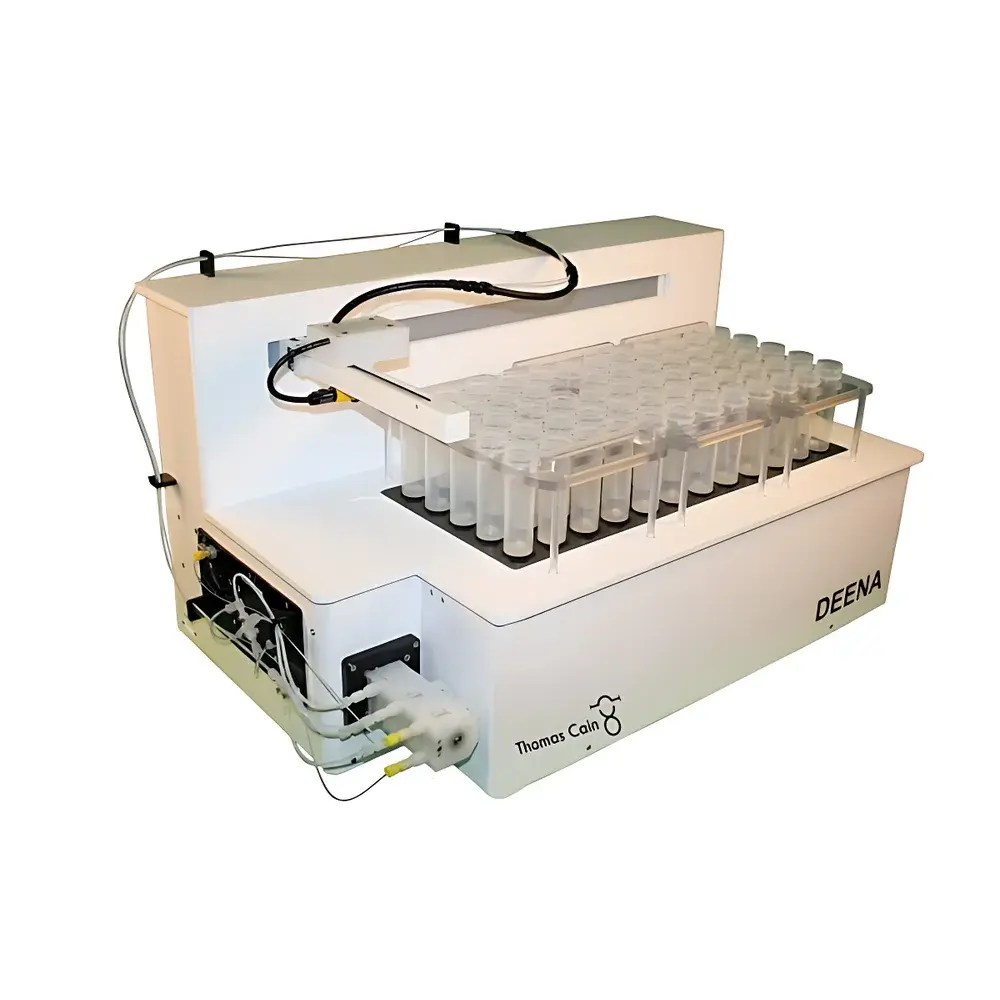
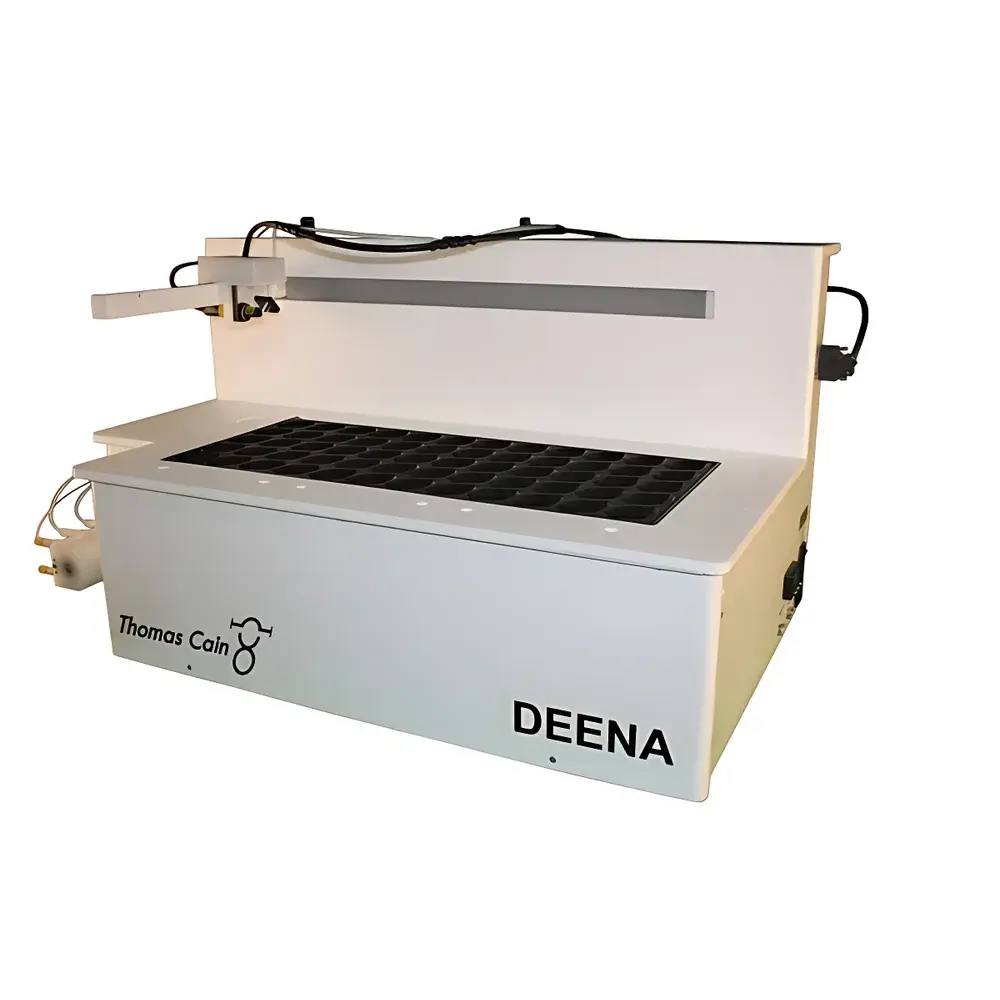
Thomas Cain DEENA Fully Automated Graphite Digestion System
| Brand | Thomas Cain |
|---|---|
| Origin | USA |
| Manufacturer Type | Authorized Distributor |
| Product Category | Imported |
| Model | DEENA |
| Instrument Type | Graphite Digestion System |
| Automation Level | Fully Automatic |
| Sample Capacity | 60 positions (50 mL per tube) |
| Temperature Range | Ambient to 230 °C |
| Temperature Control Accuracy | ±0.1 °C |
| Heating Mechanism | PTFE-coated graphite block heating module |
| Reagent Channels | 9 (including dedicated channel for oxidizing reagents, e.g., KMnO₄) |
| Standard Solution Channels | 6 |
| Dimensions (H×W×D) | 44.5 × 80 × 49.5 cm |
| Power Supply | 120–240 V AC, 15 A |
| Interface | RS-232 or USB |
| Reagent Dispensing Precision | <0.025 mL or ±1% |
| Reagent Delivery Speed | <4 mL/s |
| Final Volume Accuracy (50 mL) | <±1% |
| Sample Rack Quantity | 3 × 20-position racks |
Overview
The Thomas Cain DEENA Fully Automated Graphite Digestion System is an engineered solution for high-throughput, reproducible sample preparation in trace metal analysis by ICP-OES, ICP-MS, and AAS. It implements a closed, programmable digestion workflow based on controlled conductive heating via a PTFE-coated graphite block—ensuring uniform thermal distribution across all 60 sample positions. Unlike open-vessel hot plates or microwave systems, the DEENA operates at atmospheric pressure with precise ramp-and-hold temperature profiles (ambient to 230 °C, ±0.1 °C stability), minimizing analyte volatility losses and enabling safe, unattended processing of environmental, food, and wastewater matrices. Its design directly addresses the primary bottlenecks in regulatory-compliant metal analysis: manual reagent addition variability, inconsistent heating gradients, volumetric inaccuracies during final dilution, and lack of audit-ready process documentation.
Key Features
- Fully automated digestion sequence: reagent addition, heating ramp/hold, oscillation-assisted mixing, colorimetric endpoint detection (e.g., for KMnO₄-based oxidation), and final volume adjustment (to 50 mL) using ultrasonic micro-positioning sensors.
- Modular reagent architecture: nine independently controlled peristaltic pump-driven reagent channels—including one isolated channel for aggressive oxidants—to eliminate cross-contamination risks.
- Six calibrated standard solution dispensing channels for automated calibration curve preparation and spike recovery testing within the same run.
- Three interchangeable 20-position PTFE-lined sample racks, compatible with standard 50 mL digestion tubes; designed for seamless transfer between DEENA, autosamplers, and ICP/AAS instruments (e.g., Thermo iCAP, PerkinElmer AA3).
- Corrosion-resistant stainless steel chassis with multi-layer PTFE coating; optimized for long-term exposure to concentrated HNO₃, HCl, HF, and H₂O₂ vapors.
- Integrated X-Y robotic arm with vertical lift and oscillation capability for precise tube handling, reagent delivery, and homogenization without external agitation.
Sample Compatibility & Compliance
The DEENA supports digestion protocols compliant with EPA Methods 3050B, 3051A, 3052, and ASTM D5762 for soils, sediments, sludges, and biological tissues. It is routinely validated for food (AOAC 999.10), wastewater (ISO 11885), and plant tissue applications where low-temperature (<230 °C), extended-duration digestions are required. All process parameters—including temperature setpoints, reagent volumes, timing, endpoint confirmation, and final dilution—are logged with timestamped metadata, supporting GLP/GMP documentation requirements and FDA 21 CFR Part 11-compliant electronic records when paired with validated LIMS integration.
Software & Data Management
The DEENA Control Software provides a graphical, icon-driven interface for method development, instrument calibration, and run monitoring. Users define digestion sequences using intuitive drag-and-drop logic blocks (e.g., “Add HNO₃ → Heat to 120 °C → Hold 30 min → Add H₂O₂ → Detect color change → Dilute to 50 mL”). Each method stores full configuration metadata, and system-generated calibration reports include traceable verification of reagent delivery accuracy, temperature uniformity mapping, and volumetric precision validation. Audit trails record operator ID, method version, start/stop times, deviations, and sensor-triggered events—enabling full traceability from raw sample to final digestate.
Applications
The DEENA is deployed in environmental testing laboratories performing routine compliance monitoring under NPDES and RCRA mandates; food safety labs conducting heavy metal screening per EU Commission Regulation (EC) No 1881/2006; and municipal water authorities implementing ISO 17294-2 for multi-element wastewater profiling. Its 60-sample capacity and 9-channel reagent flexibility make it especially suitable for batched analyses requiring matrix-matched standards, internal standardization, and procedural blanks—all executed autonomously within a single platform.
FAQ
Does the DEENA support HF-based digestions for silicate-rich samples?
Yes—the PTFE-coated graphite block, PTFE-lined digestion tubes, and chemically inert fluid path materials (e.g., Viton-free tubing, ceramic pump heads) are fully compatible with hydrofluoric acid up to 5% concentration.
Can digestion methods be exported and shared across multiple DEENA units?
Yes—method files (.dsm) are portable and version-controlled; they include embedded calibration constants and can be imported into other DEENA systems running the same firmware revision.
Is ventilation integration mandatory?
No—the system includes optional fume hood mounting hardware, but its low-volatility, closed-tube operation allows benchtop use with standard laboratory exhaust ducting connected via the rear vent port.
How is temperature uniformity verified across the 60-position block?
During factory acceptance testing, a 12-point thermocouple array maps spatial variance; certified uniformity is ≤±0.3 °C across all positions at 200 °C, documented in the system qualification report.
What maintenance intervals are recommended for the peristaltic pumps and color sensor?
Reagent pump tubing requires replacement every 6 months under continuous use; the colorimetric sensor is self-calibrating and validated daily via built-in reference LED checks—no consumables required.



