
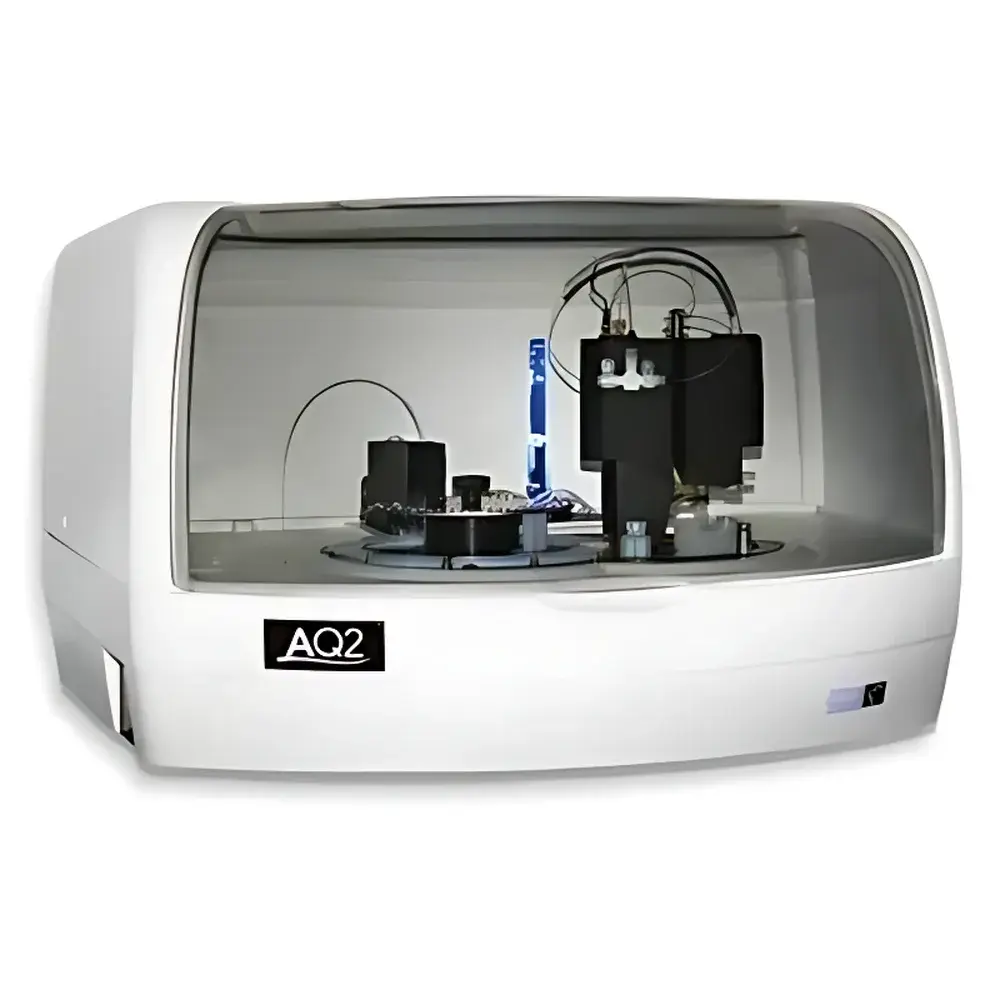
SEAL AQ2 Automated Discrete Analyzer
| Brand | SEAL |
|---|---|
| Origin | USA |
| Model | AQ2 |
| Instrument Type | Laboratory Water Quality Analyzer |
| Detection Parameters | Ammonia-N, Nitrate, Nitrite, Phosphate, Total Nitrogen, Total Phosphorus, Hexavalent Chromium, Alkalinity, Color, Hardness, Chloride, Sulfate, etc. |
| Throughput | Up to 150 samples/hour |
| Reagents | 15 × 43 mL (on-board refrigerated) |
| Sample Capacity | 57 × 2 mL or 100 × 1.2 mL removable trays |
| Reaction Temperature | Precisely controlled at 37 °C |
| Optical System | 7-position interference filter wheel (standard: 405, 480, 505, 520, 578, 660, 880 nm) |
| Calibration | Linear and up to 6th-order polynomial (20 calibration points supported) |
| Data Output | CSV, HTML reports |
| Compliance | CE-marked |
| Power | 110/115 V 60 Hz or 220/240 V 50 Hz |
| Dimensions | 68 × 41 × 55 cm (W × H × D) |
| Weight | 40 kg |
Overview
The SEAL AQ2 Automated Discrete Analyzer is a computer-controlled, benchtop wet-chemistry platform engineered for high-precision, standardized environmental water quality analysis. It implements the discrete analytical principle—where individual sample-reagent reactions occur in physically isolated, temperature-regulated reaction wells—eliminating cross-contamination and enabling method flexibility unattainable in continuous-flow systems. Unlike segmented-flow or flow-injection analyzers, the AQ2 performs true discrete chemistry: each sample is aspirated, diluted (if required), mixed with up to four reagents in sequence, incubated under tightly controlled thermal conditions (37 °C ± 0.3 °C), and measured photometrically in a dedicated optical cell. This architecture ensures high reproducibility, traceable calibration integrity, and full compliance with regulatory method requirements—including USEPA Methods 350.1, 353.2, 365.3, ASTM D1253, D3869, ISO 6878, and ISO 15681. The system operates entirely under PC-based software control, permitting uninterrupted scheduling, real-time QC monitoring, automated report generation, and audit-ready data archiving without instrument downtime.
Key Features
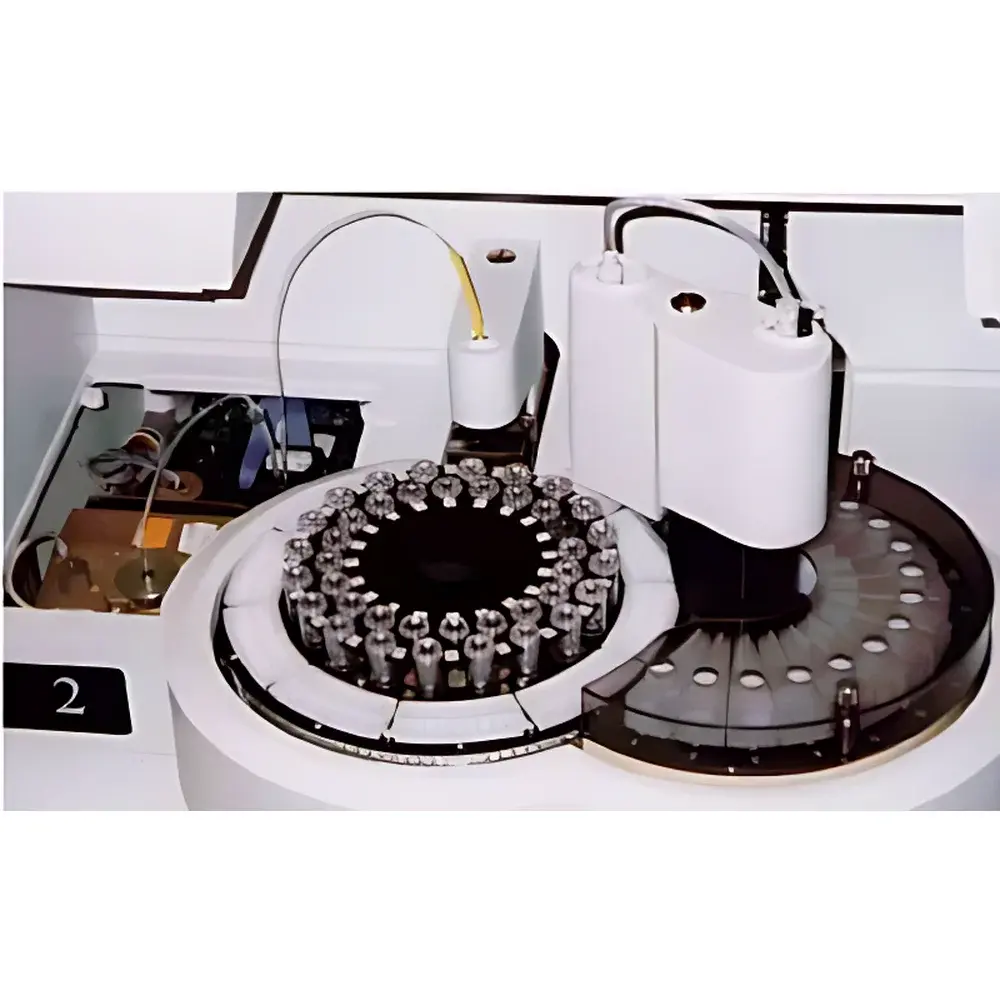
- On-board refrigerated reagent carousel accommodating 15 × 43 mL bottles, with capacitive level sensing and automatic reagent usage tracking—including date-stamped consumption logs for GLP traceability.
- Dual configurable sample trays: standard 57-position tray (2 mL vials) or high-density 100-position tray (1.2 mL vials), both fully removable and barcode-compatible for LIMS integration.
- 180-well reaction ring (2 concentric rings of 90 wells each), segmented into ten disposable 18-position reaction modules (2 × 9 layout), ensuring zero carryover between analyses.
- Integrated cadmium reduction coil with automatic online regeneration—validated for nitrate-to-nitrite conversion per USEPA Method 353.2 and ISO 15681-2.
- Precision fluid handling: 1000 µL syringe pump with stainless-steel sampling probe, air-segmented aspiration (sample–reagent–water–air–sample), and on-probe washing station to suppress cross-contamination.
- Thermostatically stabilized optical path: 10 mm pathlength quartz flow cell (50 µL volume), maintained at constant temperature to minimize thermal drift during photometric measurement.
- Seven-position filter wheel with factory-calibrated interference filters (405, 480, 505, 520, 578, 660, 880 nm); optional custom filters available for specialized assays (e.g., 340 nm for enzymatic NADH detection).
Sample Compatibility & Compliance
The AQ2 is designed for aqueous matrices across environmental monitoring domains—including raw and treated drinking water, wastewater effluents, surface water, groundwater, and industrial discharges. It accommodates turbid, colored, or particulate-laden samples through integrated sample blanking, endpoint kinetics, and turbidity correction algorithms. All core methods are pre-validated against internationally recognized protocols: alkalinity (USEPA 310.1), ammonia (ISO 7150-1), phosphate (ISO 6878), total phosphorus (USEPA 365.3), nitrate/nitrite (USEPA 353.2 & 354.1), chloride (ISO 9297), sulfate (ISO 9298), hexavalent chromium (USEPA 7196A), and hardness (ISO 6059). The system supports 21 CFR Part 11–compliant user access controls, electronic signatures, and immutable audit trails when deployed with validated software configurations. CE marking confirms conformity with EU safety, electromagnetic compatibility (EMC), and RoHS directives.
Software & Data Management
Control and data processing are managed via SEAL’s AQ Analyst software—a Windows-based application supporting method development, sequence programming, calibration curve fitting (linear to 6th-order polynomial), QC rule enforcement (Westgard rules), and automated outlier flagging. Raw absorbance values, calibration coefficients, QC charts, and final concentration results are stored in a relational database with time-stamped metadata. Export options include ANSI-compliant CSV files for LIMS ingestion, HTML-formatted reports with embedded calibration curves and QC summaries, and encrypted archival to local HDD or network drives. All data modifications are logged with user ID, timestamp, and reason code—meeting GLP/GMP documentation requirements. Software updates are distributed via secure download with version-controlled release notes and validation support packages.
Applications
The AQ2 serves as a primary analytical platform in accredited environmental laboratories performing routine compliance testing under NPDES, SDWA, and WFD mandates. Its discrete architecture enables simultaneous deployment of multi-parameter panels—e.g., nutrient profiling (NH₃-N, NO₃⁻, NO₂⁻, PO₄³⁻, TP, TN) in a single run—or targeted analysis of regulated contaminants such as Cr(VI) in potable water supplies. It is routinely employed for method verification studies, interlaboratory comparison programs, and reference material certification. Additional applications include process control in water treatment plants (coagulant dosing optimization via alkalinity and phosphate monitoring), sediment pore-water characterization, and marine nutrient cycling research where low-level detection and matrix tolerance are critical. The system’s programmable dilution engine and post-analysis auto-dilution capability extend dynamic range without manual intervention—essential for variable-concentration field samples.
FAQ
What regulatory methods are validated for use on the AQ2?
The AQ2 supports over 30 standardized methods, including USEPA 310.1 (alkalinity), 350.1 (ammonia), 353.2 (nitrate), 365.3 (phosphate), ASTM D1253 (chlorine residual), and ISO 6878 (phosphorus), all verified using certified reference materials and spike recovery protocols.
Can the AQ2 perform kinetic assays or only endpoint measurements?
The AQ2 is optimized for endpoint colorimetric determinations; however, its precise timing control allows limited kinetic monitoring (e.g., initial rate assessment for enzymatic assays) when paired with custom method scripting.
Is remote monitoring or troubleshooting supported?
Yes—via secure RDP or TeamViewer sessions enabled through IT-approved network configurations; remote diagnostics require prior authorization and comply with institutional cybersecurity policies.
How is carryover prevented between samples?
Carryover mitigation employs three independent mechanisms: air segmentation during aspiration, on-probe washing with deionized water between every sample draw, and full-flow cleaning of the photometric flow cell between measurements.
What maintenance intervals are recommended for routine operation?
Daily: probe wash check, reagent level verification, waste container inspection. Weekly: tubing inspection, filter wheel alignment verification. Quarterly: photometer baseline validation, syringe calibration, and temperature sensor verification per manufacturer’s PM checklist.







