
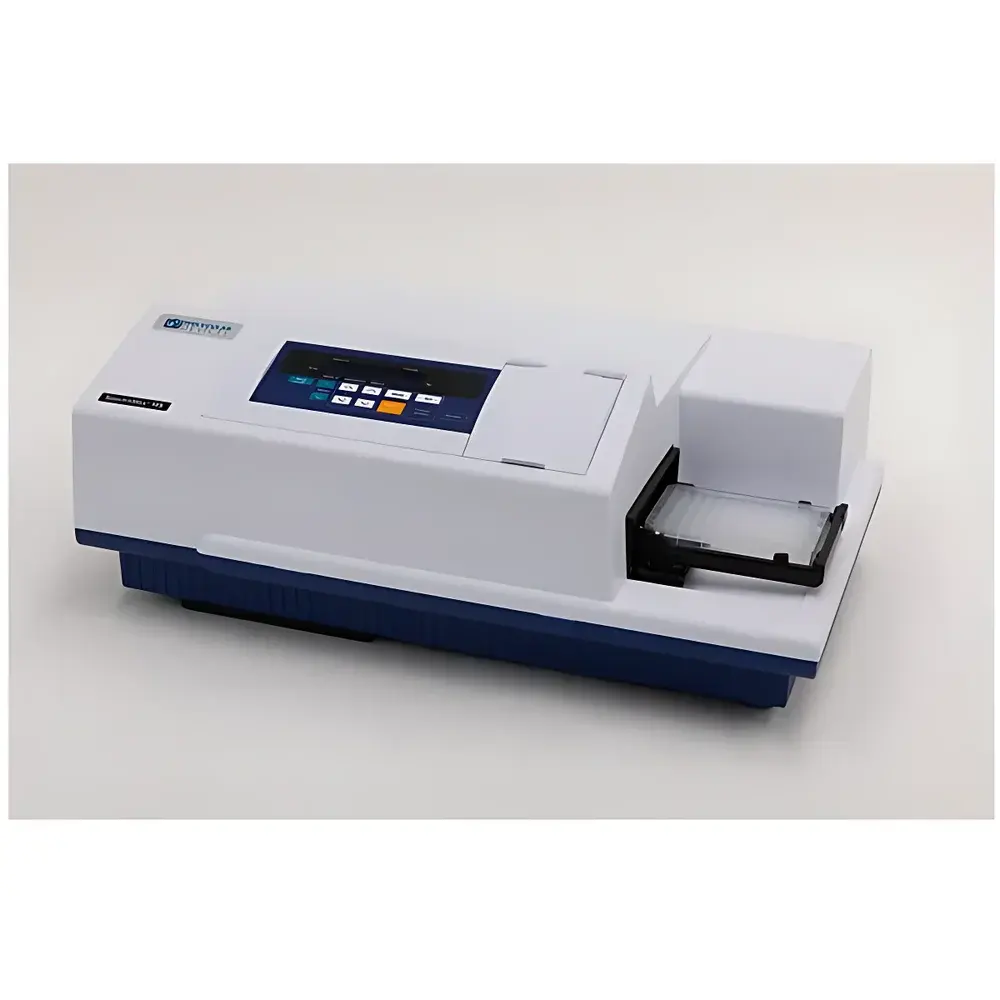
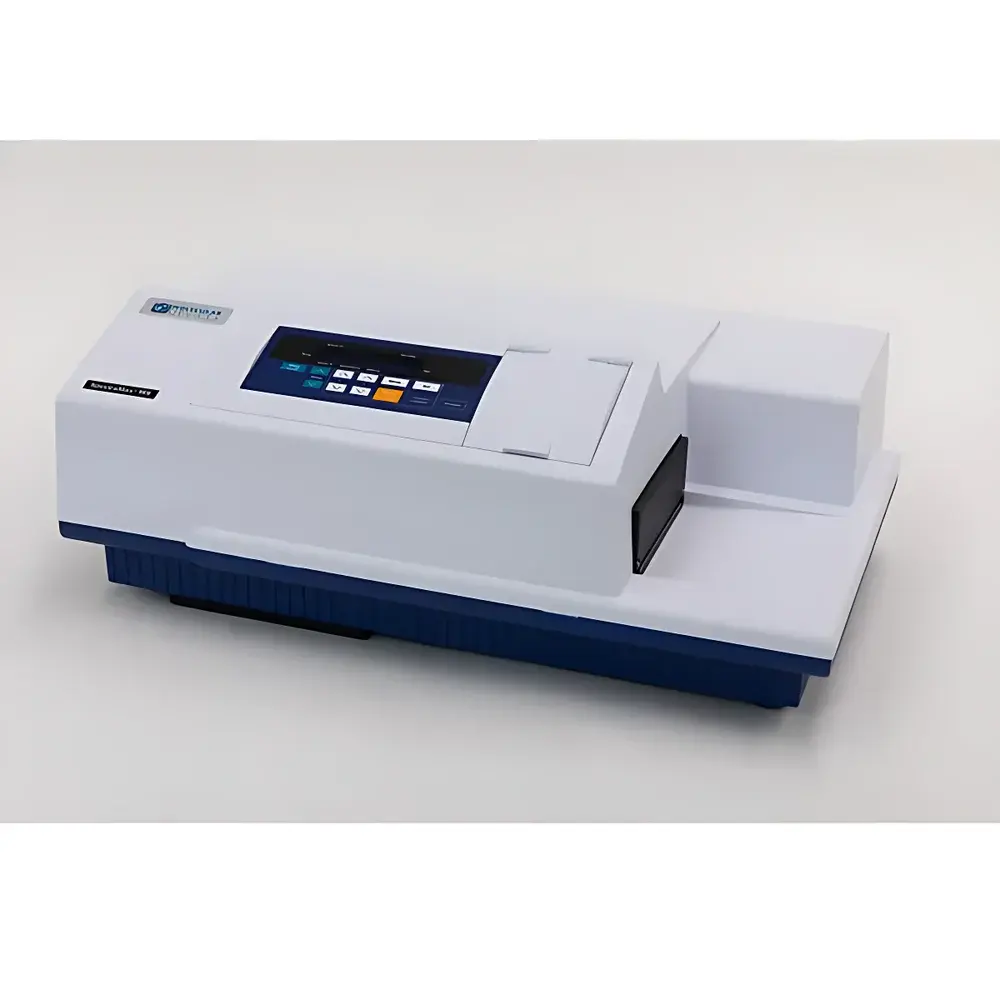
Molecular Devices SpectraMax M5/M5e Multimode Microplate Reader
| Brand | Molecular Devices |
|---|---|
| Origin | USA |
| Manufacturer | Yes |
| Import Status | Imported |
| Model | SpectraMax M5 |
| Detection Methods | Absorbance, Fluorescence Intensity (FI), Fluorescence Polarization (FP), Time-Resolved Fluorescence (TRF), Luminescence |
| Automation Level | Fully Automated |
| Assay Modes | Endpoint, Kinetic, Spectral Scan, Well Scan |
| Wavelength Range | 200–1000 nm |
| Absorbance Range | 0–4 OD |
| Linearity | 0–3 OD |
| 96-Well Plate Scan Speed | 18 sec |
| Absorbance Precision | <0.005 OD |
| Detectors | Dual PMT + 4 Photodiodes |
| Cuvette Slot | Integrated |
| HTRF® Certified | Yes |
| PathCheck™ Technology | Yes |
| Temperature Control | Precise incubation with virtual lid |
| Software | SoftMax Pro GxP (21 CFR Part 11 compliant) |
| Validation Kits | ABS1, FL1, LM1 |
| Automation Compatibility | StakMax stacker (up to 50 plates), LIMS & robotic integrations |
| Microvolume Capability | Compatible with SpectraDrop™ (2 µL, 24/64-well format) |
Overview
The Molecular Devices SpectraMax M5/M5e Multimode Microplate Reader is a high-performance, dual-monochromator-based platform engineered for precision and versatility in life science laboratories. Built upon a robust optical architecture grounded in monochromator-based wavelength selection—rather than fixed-filter optics—it delivers continuous spectral scanning across 200–1000 nm with exceptional resolution and reproducibility. Its multimodal detection capability encompasses absorbance (UV-Vis), fluorescence intensity (FI), fluorescence polarization (FP), time-resolved fluorescence (TRF), and luminescence (Lum), enabling quantitative analysis across diverse assay formats without hardware reconfiguration. The instrument features an integrated cuvette port for parallel solution-phase measurements, supporting direct comparison between microplate and cuvette data under identical optical conditions. Designed for both discovery research and regulated environments, the M5/M5e meets stringent performance expectations for mid-throughput screening, kinetic profiling, and GxP-compliant workflows—including FDA 21 CFR Part 11 requirements when operated with SoftMax Pro GxP software.
Key Features
- Dual-monochromator optical path eliminates dependence on costly filter sets, enabling precise, user-defined excitation and emission wavelengths across full UV-Vis-NIR range.
- PathCheck™ sensor technology automatically measures sample height in each well and converts absorbance readings to equivalent 1-cm pathlength values—enabling direct concentration calculation for analytes with known extinction coefficients, bypassing standard curve generation where appropriate.
- Optimized optical design includes reference photodiodes for real-time excitation source normalization, angled emission optics to minimize scatter-induced noise (especially critical in narrow-Stokes-shift assays), elliptical mirrors for high transmission and minimal chromatic aberration, and UV-transmitting fiber optics for enhanced short-wavelength sensitivity.
- Precise temperature control via virtual lid technology maintains stable thermal conditions within the sample chamber—critical for enzyme kinetics, cell-based assays, and thermally sensitive binding studies.
- Integrated cuvette slot supports absorbance, FI, and luminescence measurements in standard 1-cm quartz or plastic cuvettes—facilitating method transfer and validation between plate- and tube-based protocols.
- HTRF®-certified configuration (M5e variant) ensures validated performance for homogeneous time-resolved fluorescence assays, including those developed with Cisbio reagents and LanthaScreen™ TR-FRET platforms.
Sample Compatibility & Compliance
The SpectraMax M5/M5e accommodates all standard microplate formats: 6-, 12-, 24-, 48-, 96-, and 384-well plates—including flat-bottom, round-bottom, and V-bottom configurations—with consistent accuracy across geometries. It supports opaque, clear, and black-walled plates for absorbance, fluorescence, and luminescence applications respectively. The system complies with ISO/IEC 17025 principles for analytical instrument qualification and supports full IQ/OQ/PQ validation through Molecular Devices’ SpectraTest verification kits (ABS1, FL1, LM1) and documented protocols. When used with SoftMax Pro GxP software, it satisfies audit-trail, electronic signature, role-based access control, and data integrity requirements outlined in FDA 21 CFR Part 11, EU Annex 11, and ICH GCP guidelines—making it suitable for GLP and GMP environments.
Software & Data Management
SoftMax Pro software provides comprehensive instrument control, data acquisition, and analysis capabilities. It includes over 140 preconfigured assay protocols—from ELISA and IC50 dose-response modeling to kinetic enzyme analysis and TR-FRET ratio calculations—with customizable parameters and formula editors. The software supports cross-plate normalization, multi-plate statistical comparisons, and automated report generation with export to PDF, Excel, and XML. SoftMax Pro GxP adds controlled user licensing, immutable audit trails, electronic signatures, and locked-down method templates—all traceable to individual users and timestamps. Instrument calibration and performance verification data are embedded directly into experiment files, ensuring full data lineage from acquisition through final reporting. Integration with major LIMS systems and robotic platforms (e.g., Hamilton, Tecan, Agilent) enables seamless workflow automation and centralized data governance.
Applications
The SpectraMax M5/M5e serves as a core analytical platform across academic, pharmaceutical, and clinical research settings. Typical applications include: endpoint and kinetic ELISAs; cell viability and cytotoxicity assays (e.g., MTT, ATP-luciferase); microbial growth and MIC determination; protein quantification (Bradford, BCA); nucleic acid analysis (DNA/RNA purity and concentration); reporter gene assays (luciferase, GFP); FRET- and TR-FRET–based protein-protein interaction studies; membrane permeability and transporter assays; ADME/Tox profiling (CYP inhibition, P-gp efflux); DELFIA® and other lanthanide-based immunoassays; and FP-based receptor-ligand binding studies. Its compatibility with SpectraDrop™ microvolume plates extends utility to low-volume nucleic acid and protein quantitation (2 µL per sample, up to 64 samples per run), reducing reagent costs while maintaining inter-assay precision.
FAQ
What distinguishes the M5e from the M5 model?
The M5e variant is factory-validated and certified for HTRF® assays per Cisbio specifications, including optimized optics, firmware calibration, and documentation required for regulated use in drug discovery.
Can the SpectraMax M5/M5e perform spectral scans in fluorescence mode?
Yes—both excitation and emission spectra can be acquired across the full 200–1000 nm range with 1-nm resolution, enabling spectral deconvolution and optimal wavelength pair selection.
Is temperature control available during kinetic or scanning modes?
Yes—precise incubation (ambient to 45°C) remains active throughout all measurement modes, including real-time kinetic reads and spectral scans.
How does PathCheck™ improve quantitative accuracy in absorbance assays?
By measuring actual liquid height in each well, PathCheck™ corrects for volume variability and reports results normalized to a 1-cm pathlength—eliminating systematic error introduced by inconsistent fill volumes and enabling direct application of Beer-Lambert law.
What validation documentation is provided with the instrument?
Molecular Devices supplies IQ/OQ protocols, SpectraTest verification kits (ABS1, FL1, LM1), and a complete software validation package for SoftMax Pro GxP—including test scripts, evidence logs, and compliance summaries aligned with 21 CFR Part 11.



