
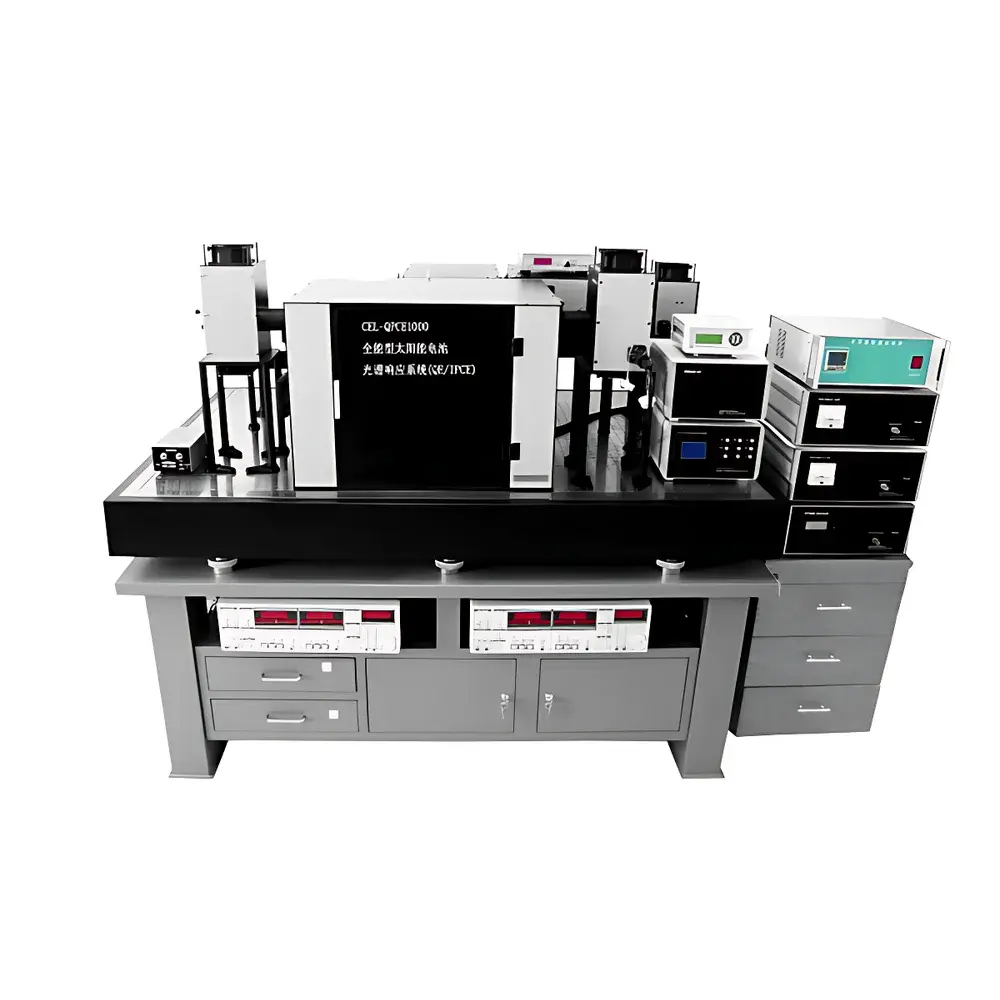
CEL-QPCE1000 All-in-One Solar Cell Spectral Response Measurement System
| Brand | CEL (China Education Goldsource) |
|---|---|
| Origin | Beijing, China |
| Manufacturer | Yes |
| Country of Origin | China |
| Model | CEL-QPCE1000 |
| Trigger Mode | Steady-State |
| Spectral Range | 200–2500 nm (optional extension) |
| Wavelength Resolution | ≥1 nm adjustable |
| Scan Repeatability | <0.3% (short-circuit current density) |
| Operating Modes | AC & DC |
| Chopping Frequency | 5–1000 Hz |
| Temperature Control Stage | 5–40 °C (±0.5 °C stability) |
| Bias Light Options | Dual-channel, configurable for multi-junction cells |
| Monochromator | Single or dual monochromator configuration available |
| Optical Monitoring | Real-time reference beam feedback loop |
| Software | Fully automated acquisition, calibration, and spectral data processing suite |
Overview
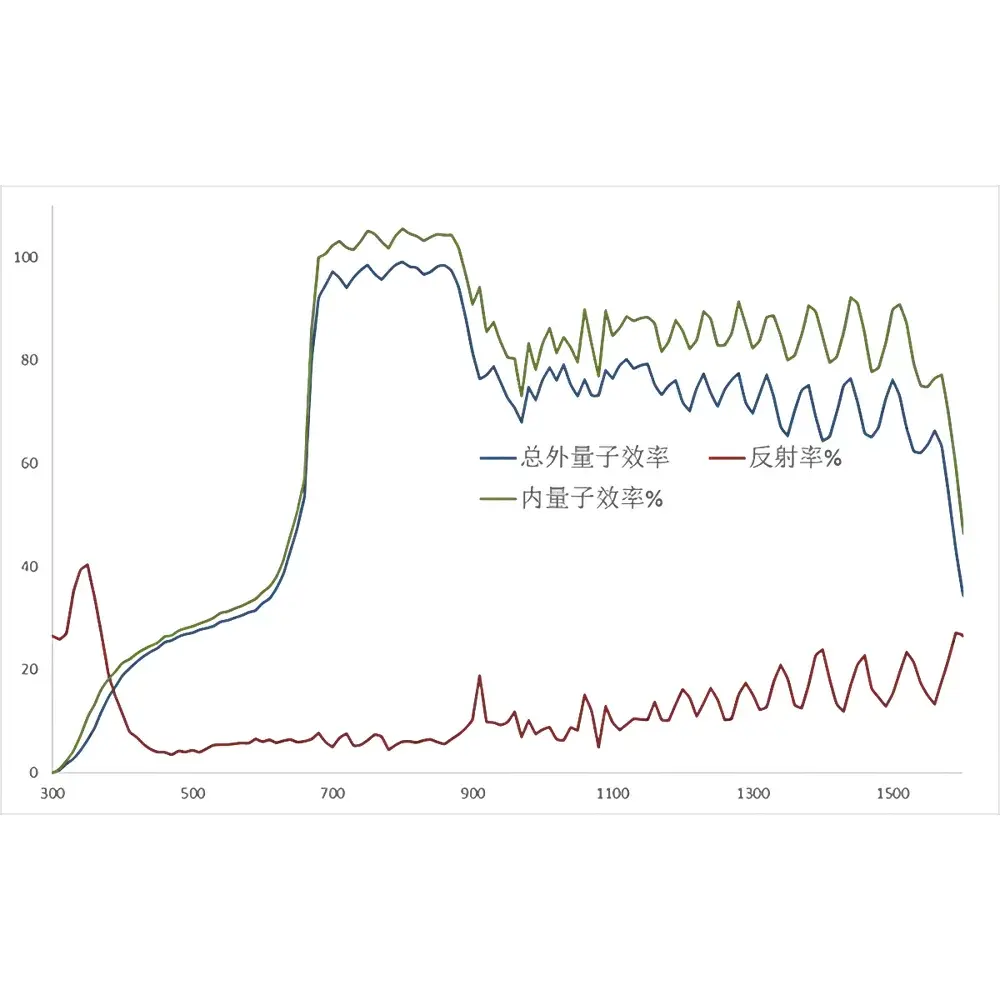
The CEL-QPCE1000 All-in-One Solar Cell Spectral Response Measurement System is a precision-engineered platform designed for quantitative characterization of photovoltaic devices across the full ultraviolet–visible–near-infrared (UV-VIS-NIR) spectrum (200–2500 nm). It implements monochromatic photon-based quantum efficiency analysis—specifically External Quantum Efficiency (EQE), Internal Quantum Efficiency (IQE), Incident Photon-to-Current Efficiency (IPCE), spectral reflectance, transmittance, and wavelength-resolved short-circuit current density (Jsc(λ))—using calibrated lock-in detection under controlled illumination conditions. The system operates on a dual-beam optical architecture with real-time reference monitoring to compensate for source intensity drift, ensuring measurement stability and traceability. Its modular design supports both steady-state (DC) and chopped (AC) measurement protocols, enabling high-fidelity signal recovery even from low-responsivity or high-impedance devices such as organic, perovskite, and multi-junction III–V solar cells.
Key Features
- Multi-source illumination architecture with selectable, stabilized broadband lamps (Xe, W, D2) for seamless spectral coverage from deep UV to NIR.
- Achromatic, coma-corrected monochromator system with automated filter wheel to suppress higher-order diffraction and minimize stray light (<10−5 relative intensity).
- Dual-mode detection: AC lock-in amplification (5–1000 Hz chopping) and DC integration, both with electromagnetic shielding and ultra-low-noise前置 amplification.
- Patented sample stage with vacuum-assisted fixation, low-contact-resistance electrode holders, and customizable thermal interface for reproducible electrical contact and minimal parasitic signal coupling.
- Integrated bias light subsystem with two independently controllable channels, supporting simultaneous illumination for multi-junction cell characterization (e.g., tandem Si/GaAs/InGaP devices).
- Real-time optical monitoring path with photodiode reference channel, enabling dynamic normalization and drift correction during spectral scans.
- Thermostatically regulated sample stage (5–40 °C, ±0.5 °C accuracy) with optional cryogenic or elevated-temperature extensions for temperature-dependent EQE analysis.
- Automated shutter control for primary monochromatic beam and bias light, synchronized with data acquisition for precise timing and background subtraction.
Sample Compatibility & Compliance
The CEL-QPCE1000 accommodates standard photovoltaic geometries including rigid wafers (up to 156 × 156 mm), flexible thin-film substrates, and lab-scale device stacks. It supports single-junction (c-Si, mc-Si, a-Si, CdTe, CIGS, DSSC, OPV), tandem (2T/3T), and multi-terminal architectures. All optical and electronic components comply with IEC 60904-8 (spectral mismatch correction), IEC 60904-9 (class A+B+C solar simulator requirements), and ISO/IEC 17025-aligned calibration traceability frameworks. System software maintains audit-ready metadata logs—including lamp hours, filter positions, monochromator calibration coefficients, and environmental sensor readings—to support GLP-compliant reporting and internal quality audits.
Software & Data Management
The proprietary QPCE Control Suite provides full instrument orchestration via Windows-based GUI. It manages monochromator positioning, filter selection, chopper synchronization, amplifier gain switching, A/D conversion parameters, and thermal stage setpoints in a single workflow. Automated scan routines execute wavelength sweeps with user-defined step size (≥1 nm), dwell time, and averaging cycles. Post-acquisition, the software performs integrated corrections: dark current subtraction, spectral responsivity calibration using NIST-traceable reference detectors, reflection/transmission deconvolution for IQE derivation, and systematic error compensation (linear, periodic, T-type, and system-level offsets). Export formats include CSV, TXT, XML, PNG, and PDF; comparative overlay of multiple datasets (e.g., before/after aging, different bias conditions) is supported with statistical deviation overlays and confidence interval shading.
Applications
This system is deployed in R&D laboratories, PV manufacturing QA/QC facilities, and national metrology institutes for fundamental optoelectronic characterization. Typical use cases include: validation of anti-reflection coating performance via spectral reflectance mapping; quantification of carrier collection losses through IQE/EQE ratio analysis; evaluation of spectral splitting efficiency in multi-junction concentrator cells; correlation of Jsc(λ) with electroluminescence (EL) or photoluminescence (PL) spectra; and temperature-dependent quantum yield profiling for thermal stability assessment. It serves as a primary tool for ASTM E1021, IEC 60904-8, and JEDEC JESD122-compliant testing protocols.
FAQ
What spectral range does the standard CEL-QPCE1000 cover?
The base configuration spans 200–1100 nm; optional NIR extension modules extend coverage to 2500 nm using InGaAs-detected optics.
Can the system measure both EQE and IQE without external accessories?
Yes—the integrated reflectance and transmittance measurement capability enables automatic IQE calculation when combined with front- and rear-side illumination modes.
Is the software compliant with 21 CFR Part 11 requirements?
The QPCE Control Suite supports user authentication, electronic signatures, and immutable audit trails—configurable to meet FDA 21 CFR Part 11 and EU Annex 11 expectations for regulated environments.
How is calibration traceability maintained?
All spectral and radiometric calibrations are performed using NIST-traceable reference detectors (e.g., Hamamatsu S1337 series for UV-VIS, extended InGaAs for NIR), with certificate-of-calibration files embedded in each dataset.
Does the system support custom sample fixtures for non-standard substrates?
Yes—mechanical drawings and mounting interfaces are provided to OEM partners for designing application-specific stages, including roll-to-roll compatible carriers and encapsulated mini-module test frames.
Related Products





