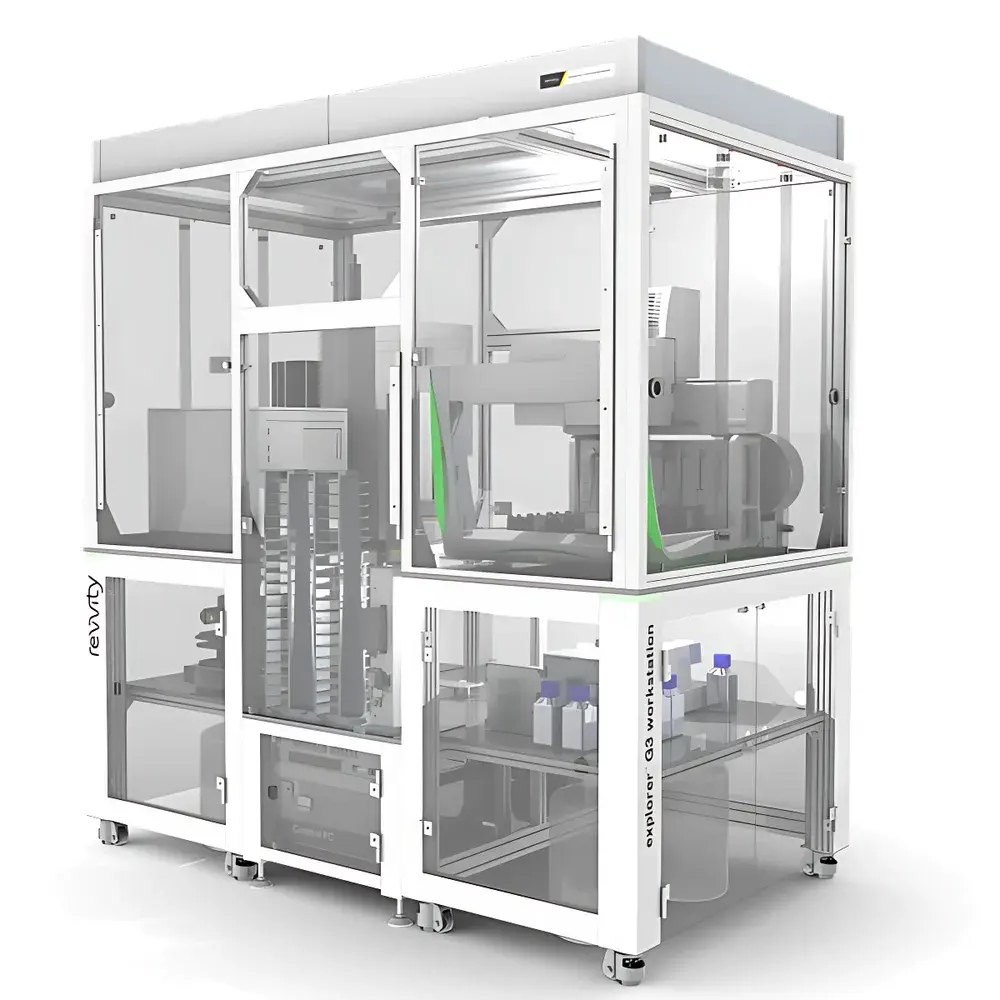
Revvity explorer G3 Integrated Robotic Automation System
| Brand | Revvity |
|---|---|
| Origin | USA |
| Manufacturer Type | Original Equipment Manufacturer (OEM) |
| Product Category | Imported Instrument |
| Model | explorer G3 Integrated Robotic Automation System |
| Instrument Type | Magnetic Bead-Based Nucleic Acid Purification |
| Automation Level | Dedicated Fully Automated Platform |
Overview
The Revvity explorer G3 Integrated Robotic Automation System is a purpose-built, fully automated laboratory platform engineered for high-throughput, reproducible nucleic acid purification and downstream genomic workflows. Built upon magnetic bead-based separation chemistry, the system leverages precise liquid handling, integrated thermal control, and programmable magnetic separation modules to deliver consistent yield, purity, and integrity across diverse sample types—including blood, saliva, tissue lysates, and cultured cells. Designed specifically for genomics, high-content screening (HCS), synthetic biology, and next-generation sequencing (NGS) library preparation, the explorer G3 operates as a modular, scalable infrastructure—supporting end-to-end automation from primary sample input to purified nucleic acid output ready for quantification or library construction. Its architecture adheres to core principles of laboratory automation engineering: deterministic motion control, traceable liquid handling calibration, and fail-safe interlock logic between subsystems.
Key Features
- Plate::handler Flex collaborative robotic arm: Four-axis SCARA-style manipulator with embedded real-time safety monitoring, ISO/TS 15066-compliant force-limited operation, and dynamic collision avoidance—enabling safe co-location with human operators without physical guarding.
- Three-tier vertical integration capability: Z-axis travel options of 400 mm, 750 mm, and 1060 mm accommodate compact benchtop setups or multi-instrument gantry configurations.
- Servo-driven gripper with in-motion orientation switching: Supports both vertical and horizontal plate engagement, enabling adaptive deck layout reconfiguration without manual hardware adjustment.
- One-touch teach-and-repeat programming: Intuitive jog mode and position memory allow rapid reconfiguration of deck layouts and protocol adaptation across assay formats.
- plate::works™ automation orchestration software: Unified graphical interface for cross-platform device synchronization, event-driven scheduling, and parallel task execution across liquid handlers, centrifuges, incubators, and detection instruments.
- Comprehensive error recovery protocols: Context-aware fault detection, automatic retry logic, and audit-trail–enabled pause/resume functionality ensure uninterrupted run continuity under variable lab conditions.
Sample Compatibility & Compliance
The explorer G3 supports standard microplate formats (24-, 96-, 384-, and 1536-well) and compatible tube racks for primary sample input. It is validated for use with Revvity’s proprietary magnetic bead chemistries—including MagneSil® and Maxwell®-compatible kits—as well as third-party magnetic bead reagents meeting ISO 15197:2013 and CLSI EP25-A2 compatibility criteria. The system meets IEC 61000-6-2 (immunity) and IEC 61000-6-3 (emissions) standards for laboratory electromagnetic environments. All software operations comply with FDA 21 CFR Part 11 requirements for electronic records and signatures, including role-based access control, full audit trail logging, and non-erasable timestamped event history. Platform design follows GLP and GMP-aligned operational practices for regulated bioanalytical laboratories.
Software & Data Management
plate::works™ serves as the central automation runtime engine and experiment lifecycle manager. Its drag-and-drop workflow builder enables visual protocol assembly using standardized device drivers compliant with SLAS ANSI/SLAS 2-2015 (Laboratory Automation Markup Language). The software implements deterministic timing resolution at ≤100 ms granularity and supports asynchronous command queuing for optimal instrument utilization. Integrated simulation mode allows offline validation of deck layouts and timing sequences prior to physical execution—reducing experimental risk and consumables waste. All raw log files, metadata annotations, and instrument telemetry are stored in vendor-agnostic HDF5 format, supporting direct import into LIMS (e.g., LabVantage, STARLIMS) and data analysis platforms (e.g., Python/Pandas, R/Bioconductor). Version-controlled protocol libraries support ISO 17025 traceability and method transfer across sites.
Applications
- Genomics Workflows: End-to-end automation of DNA/RNA extraction, normalization, qPCR setup, and NGS library prep—including fragmentation, end-repair, A-tailing, adapter ligation, and size selection—on a single platform.
- High-Content Screening (HCS): Seamless integration with Revvity Opera Phenix™ and Operetta CLS™ imaging systems for automated cell seeding, transfection, fixation, staining, and image acquisition workflows.
- Synthetic Biology Pipelines: High-throughput colony picking (>900 colonies/hour), bacterial culture expansion, plasmid miniprep, and enzyme activity profiling via integrated spectrophotometric or luminescence readouts.
- Drug Discovery Support: Automated assay plate formatting for HTS campaigns, including compound dilution series, cell-based viability assays, and reporter gene readouts compatible with EnVision® and EnSight® multimode readers.
FAQ
What sample volumes and input formats does the explorer G3 support?
The system accepts 0.1–1000 µL liquid samples in 24- to 1536-well plates, PCR tubes, and conical tubes; solid samples require pre-lysis using compatible homogenization modules.
Can the explorer G3 be integrated with third-party instruments?
Yes—via standardized SLIM (Standard Laboratory Instrumentation Messaging) API and RS-232/Ethernet interfaces; certified integrations include Agilent BioAnalyzer, Thermo Fisher Qubit, and Beckman Coulter Biomek workstations.
Is plate::works™ compliant with 21 CFR Part 11?
Yes—full electronic signature support, audit trail generation, and secure user authentication are enabled by default and configurable per site-specific SOPs.
What maintenance intervals are recommended for the Plate::handler Flex arm?
Scheduled calibration and belt tension verification every 6 months; gripper wear inspection and lubrication every 12 months—documented in the included Preventive Maintenance Logbook.
Does the system support custom magnetic bead protocols?
Yes—users may define custom wash/elution steps, magnet engagement durations, and aspiration/dispense parameters through plate::works™ Advanced Scripting Mode.