
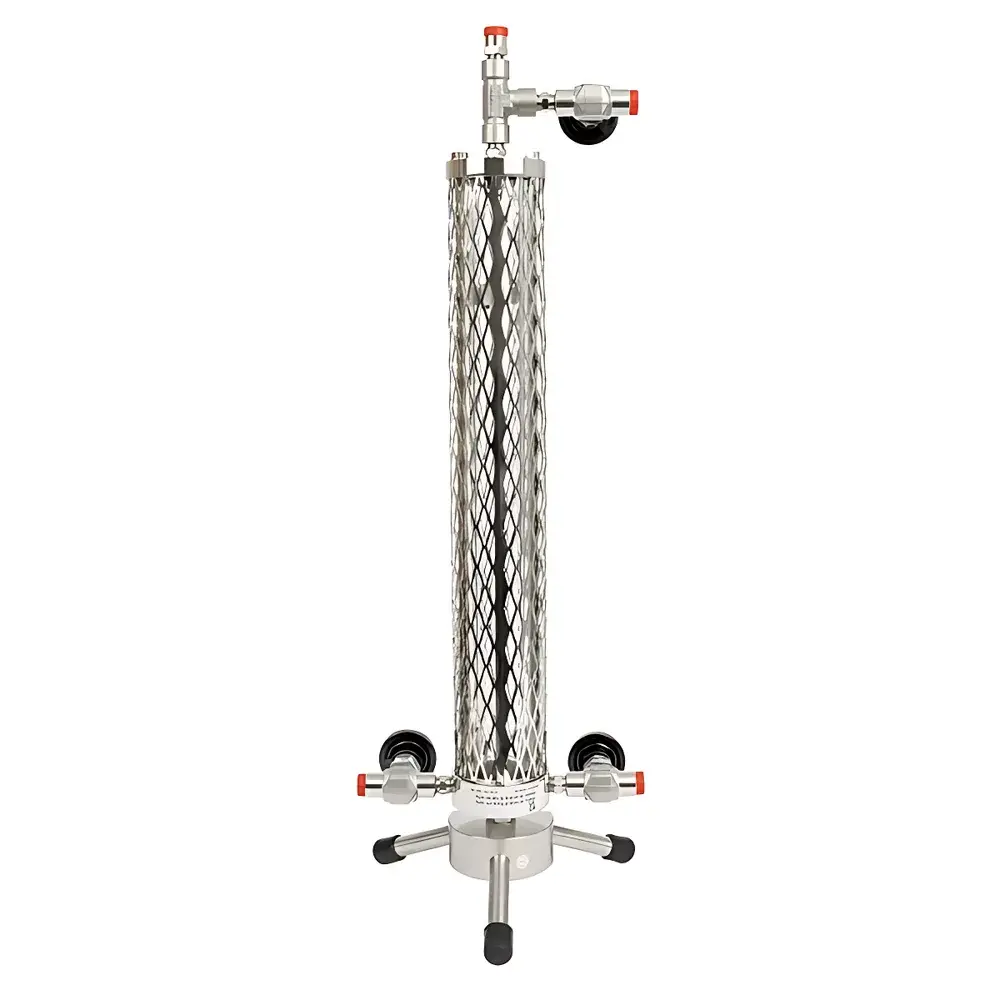
SETA Model 22100-0 Liquefied Petroleum Gas (LPG) Pressure-Density Analyzer
| Brand | SETA |
|---|---|
| Origin | United Kingdom |
| Model | 22100-0 |
| Maximum Operating Pressure | 1400 kPa (200 psi) |
| Temperature Range | −20 °C to +60 °C |
| Test Chamber Burst Pressure | 2800 kPa |
| Compliance | ASTM D1657, BS EN ISO 3993, IP 235, SH/T 0221 |
Overview
The SETA Model 22100-0 Liquefied Petroleum Gas (LPG) Pressure-Density Analyzer is a precision-engineered laboratory instrument designed for the accurate determination of density and vapor pressure of liquefied petroleum gas under controlled temperature and pressure conditions. It operates on the principle of hydrostatic pressure measurement in a sealed, thermostatically regulated test chamber, where sample density is derived from the relationship between applied pressure, measured liquid column height, and calibrated chamber geometry—fully aligned with gravimetric and thermodynamic foundations specified in international standard test methods. This analyzer is purpose-built for quality control laboratories, refinery testing facilities, and regulatory compliance units requiring traceable, repeatable results for propane, butane, and commercial LPG blends.
Key Features
- Robust transparent test chamber rated to 2800 kPa burst pressure, constructed from high-purity borosilicate glass for optical clarity and chemical resistance to hydrocarbon vapors.
- Integrated external stainless-steel safety cage providing full mechanical containment during high-pressure operation, compliant with IEC 61010-1 and laboratory risk mitigation protocols.
- Precision-machined brass and stainless-steel pressure train components, including calibrated Bourdon-tube pressure gauge and isolation valves, ensuring long-term metrological stability.
- Thermostatic compatibility across −20 °C to +60 °C enables testing at sub-ambient storage temperatures and elevated ambient conditions, supporting both winter-grade and summer-grade LPG specifications.
- Modular design allows straightforward disassembly for cleaning, calibration verification, and routine maintenance without specialized tools or vendor intervention.
Sample Compatibility & Compliance
The analyzer accommodates representative samples of commercial LPG mixtures—including propane-rich, butane-rich, and stabilized blends—as delivered in certified sampling cylinders per ASTM D1265 and ISO 4256. All wetted surfaces are inert to saturated and unsaturated C3/C4 hydrocarbons, eliminating adsorption artifacts or phase segregation during equilibration. The instrument meets the dimensional, procedural, and reporting requirements of ASTM D1657 (Standard Test Method for Density or Relative Density of Liquefied Petroleum Gases (LPG) by Pressure Hydrometer), BS EN ISO 3993 (Petroleum products — Liquefied petroleum gases (LPG) — Determination of density or relative density), IP 235 (Determination of density or relative density of Liquefied Petroleum Gases), and SH/T 0221 (Chinese standard for LPG density determination). Data generated supports GLP-compliant audit trails when used with documented calibration records and operator logs.
Software & Data Management
The SETA 22100-0 is a manually operated, analog-digital hybrid instrument with no embedded firmware or proprietary software. All measurements are recorded directly from calibrated analog gauges and temperature sensors, ensuring full transparency, independence from operating system dependencies, and long-term data integrity. Users maintain traceability through paper-based or LIMS-integrated manual entry of pressure (kPa), temperature (°C), and observed meniscus position. Calibration certificates for the pressure gauge and thermometer are provided with each unit and must be renewed annually per ISO/IEC 17025 requirements. The absence of electronic control logic eliminates validation complexity associated with FDA 21 CFR Part 11 compliance—making it suitable for environments where regulatory simplicity and deterministic measurement workflows are prioritized.
Applications
- Quality assurance of LPG feedstock entering alkylation, isomerization, or petrochemical cracking units.
- Verification of product specification compliance prior to bulk transport via railcar, marine vessel, or road tanker.
- Supporting custody transfer calculations where mass flow rate is derived from volumetric flow and real-time density.
- Research into phase behavior and compressibility effects of blended LPG under varying thermal gradients.
- Training and method validation in accredited petroleum testing laboratories conducting interlaboratory comparisons per ISO/IEC 17043.
FAQ
What standards does the SETA 22100-0 explicitly support?
ASTM D1657, BS EN ISO 3993, IP 235, and SH/T 0221 — all referenced in the instrument’s user manual and type examination documentation.
Is the test chamber suitable for hydrogen sulfide (H₂S)-containing LPG samples?
Yes, the borosilicate glass chamber and stainless-steel fittings are chemically resistant to low-concentration H₂S typical in sour LPG; however, extended exposure requires post-test purging with dry nitrogen and visual inspection for etching.
Can the instrument be used above 60 °C?
No — the specified upper limit of +60 °C reflects the thermal rating of the pressure seal materials and gauge calibration envelope; operation beyond this range invalidates measurement accuracy and voids warranty.
How often must the pressure gauge be recalibrated?
Annually, or after any impact event or pressure excursion exceeding 2000 kPa; calibration must be performed against a NIST-traceable deadweight tester per ISO 6789-2.
Does the analyzer require electrical power?
No — it is entirely mechanical and pneumatic; only external temperature control (e.g., refrigerated bath or heating mantle) requires power.





