
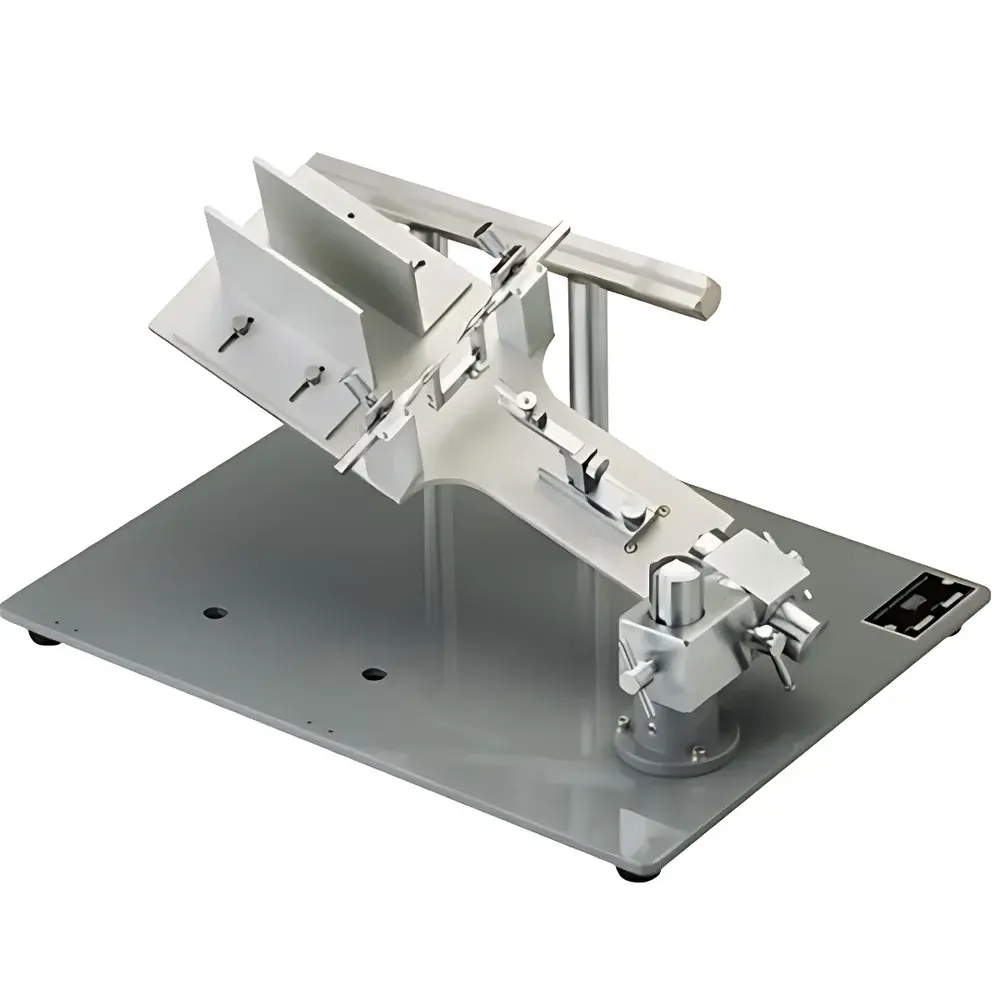
Narishige SR-50M-HT Small Animal Stereotaxic Instrument for Mice
| Brand | Narishige |
|---|---|
| Origin | Japan |
| Model | SR-50M-HT |
| Construction Material | Aerospace-grade aluminum alloy |
| Base Dimensions | 400 × 300 × 150 mm (W×D×H) |
| Weight | 10.4 kg |
| X/Y/Z Coarse Travel Range | ±25 mm |
| Micrometer Resolution | 0.1 mm |
| Tilt Range | ±45° (pitch and roll) |
| Head Fixation | Triple-point (dual ear bars + nose clamp) |
| Biocompatible Components | Medical-grade POM per ISO 10993 |
| Sterilization Compatibility | Autoclavable at 121°C for 20 min |
| Standard AP Bar | 18.7 mm square cross-section |
| Included Accessories | EB-3B mouse ear bars (pair), EB-5N auxiliary ear bars |
Overview
The Narishige SR-50M-HT Small Animal Stereotaxic Instrument for Mice is a precision-engineered mechanical platform designed for reproducible, high-fidelity intracranial interventions in murine neuroscience research. Built upon the foundational principles of stereotaxic coordinate geometry—referencing standardized brain atlases such as the Paxinos & Franklin mouse brain atlas—the SR-50M-HT enables accurate targeting of subcortical and cortical structures including the hippocampus, amygdala, entorhinal cortex, and auditory cortex. Its fully mechanical architecture eliminates electromagnetic interference, making it suitable for concurrent electrophysiological recording, optogenetic stimulation, and microinjection protocols where signal integrity is paramount. Unlike motorized or digitally controlled systems, the SR-50M-HT relies on calibrated micrometer-driven translation and angular adjustment mechanisms, ensuring long-term stability, zero drift, and compliance with GLP-aligned experimental documentation requirements.
Key Features
- Precision 3-axis positioning system with ±25 mm coarse travel range along X (anterior–posterior), Y (medial–lateral), and Z (dorsal–ventral) axes, complemented by 0.1 mm resolution micrometers for fine-depth control during electrode insertion or cannula placement.
- Independent dual-axis tilt mechanism (±45° pitch and roll) facilitates non-vertical approaches to deep or laterally oriented targets—such as the primary auditory cortex or ventral tegmental area—without requiring skull reorientation or craniotomy angle modification.
- Triple-point head fixation using EB-3B primary ear bars and EB-5N auxiliary ear bars, combined with an adjustable nose clamp, ensures rigid immobilization across extended experimental durations, supporting chronic implantation and longitudinal behavioral-electrophysiological correlation studies.
- Aerospace-grade aluminum construction provides exceptional rigidity and vibration damping; the 400 × 300 × 150 mm base footprint and 10.4 kg mass minimize resonance under standard laboratory bench conditions.
- All animal-contact components—including ear bars, nose clamp, and adapter plates—are fabricated from medical-grade polyoxymethylene (POM), certified compliant with ISO 10993-5 (cytotoxicity) and ISO 10993-10 (irritation/sensitization), enabling direct use in sterile surgical workflows.
- Full autoclavability (121°C, 20 min, saturated steam) of removable components supports strict biosafety protocols and minimizes inter-subject contamination risk in multi-session or multi-user facilities.
Sample Compatibility & Compliance
The SR-50M-HT is optimized exclusively for adult C57BL/6, BALB/c, and other common inbred/outbred mouse strains (typically 20–30 g). Skull morphology compatibility is ensured through adjustable ear bar spacing (12–18 mm inter-aural distance) and modular nose clamp height settings. The instrument conforms to widely adopted preclinical neurosurgical standards, including alignment with the bregma–lambda reference line and compatibility with digital stereotaxic planning software (e.g., Brain Explorer 2, Allen Mouse Brain Atlas). All metallic surfaces are anodized for corrosion resistance and ease of disinfection. While not an IVD or FDA-cleared device, its design adheres to ISO 13485-aligned manufacturing practices and supports audit readiness for institutions operating under AAALAC-accredited animal care programs and NIH OLAW-mandated protocol oversight.
Software & Data Management
The SR-50M-HT operates as a stand-alone mechanical platform but integrates seamlessly with Narishige’s HCC-Control Pro software via optional encoder-equipped motorized add-ons (e.g., SM-15R microdrive controllers). When paired, the system enables automated depth logging, synchronized injection volume tracking (with compatible syringe pumps), and timestamped coordinate registration—features essential for 21 CFR Part 11-compliant data archiving in regulated pharmacology or toxicology studies. Raw positional data export is supported in CSV and MATLAB-compatible formats. No embedded firmware or onboard memory resides within the SR-50M-HT itself, preserving electromagnetic silence and simplifying validation for electrophysiology labs subject to IEEE Std. 1003.1 (POSIX) or ISO/IEC 17025 traceability frameworks.
Applications
- Neuroanatomical tracing: Stereotactic delivery of fluorescent dextrans, biotinylated dextran amines (BDA), or AAV-based anterograde/retrograde tracers into defined nuclei for circuit mapping.
- In vivo electrophysiology: Stable, low-noise mounting of silicon probes, tetrodes, or Neuropixels arrays for single-unit and local field potential (LFP) recordings in awake, head-fixed mice.
- Optogenetic interrogation: Precise co-localization of optical fibers and electrodes to enable simultaneous photostimulation and neural activity monitoring in behaving animals.
- CNS drug delivery: Bilateral or unilateral microinjection of small molecules, peptides, or oligonucleotides into striatal, hippocampal, or hypothalamic targets for pharmacodynamic evaluation.
- Gene therapy validation: Localized CRISPR-Cas9 or base editor delivery to assess on-target editing efficiency and off-target effects in spatially restricted brain regions.
- Biomaterial interface studies: Implantation of neural probes, hydrogels, or scaffold-based constructs followed by histological assessment of glial scarring, neuronal density, and vascular integration.
FAQ
Is the SR-50M-HT compatible with rat stereotaxic procedures?
No—the SR-50M-HT is specifically engineered for murine anatomy. For rats, Narishige recommends the SR-6M or SR-10R models, which feature larger ear bar spacing, extended travel ranges, and reinforced load-bearing structures.
Can the tilt function be locked independently for pitch and roll?
Yes—each tilt axis incorporates a dedicated locking knob with calibrated detents, allowing independent fixation at any angle between –45° and +45° without affecting the orthogonal axis.
What sterilization methods are validated for the EB-3B ear bars?
EB-3B ear bars are validated for repeated autoclaving (121°C, 20 min, 15 psi), ethylene oxide (EtO) gas sterilization, and hydrogen peroxide plasma processing. Alcohol wiping is permitted for rapid surface decontamination between subjects.
Does the 18.7 mm AP bar support third-party microdrives?
Yes—the square-profile AP bar meets ISO 8015 dimensional tolerances and is mechanically compatible with standard 18.7 mm clamping interfaces used by Scientifica, New Scale Technologies, and other OEM micro-manipulator manufacturers.
Is technical documentation available in English with metrology traceability data?
Yes—Narishige provides English-language calibration certificates, dimensional inspection reports (per ISO 17025-accredited internal metrology lab), and full mechanical schematics upon request for institutional QA/QC review and equipment validation (IQ/OQ/PQ) processes.



