
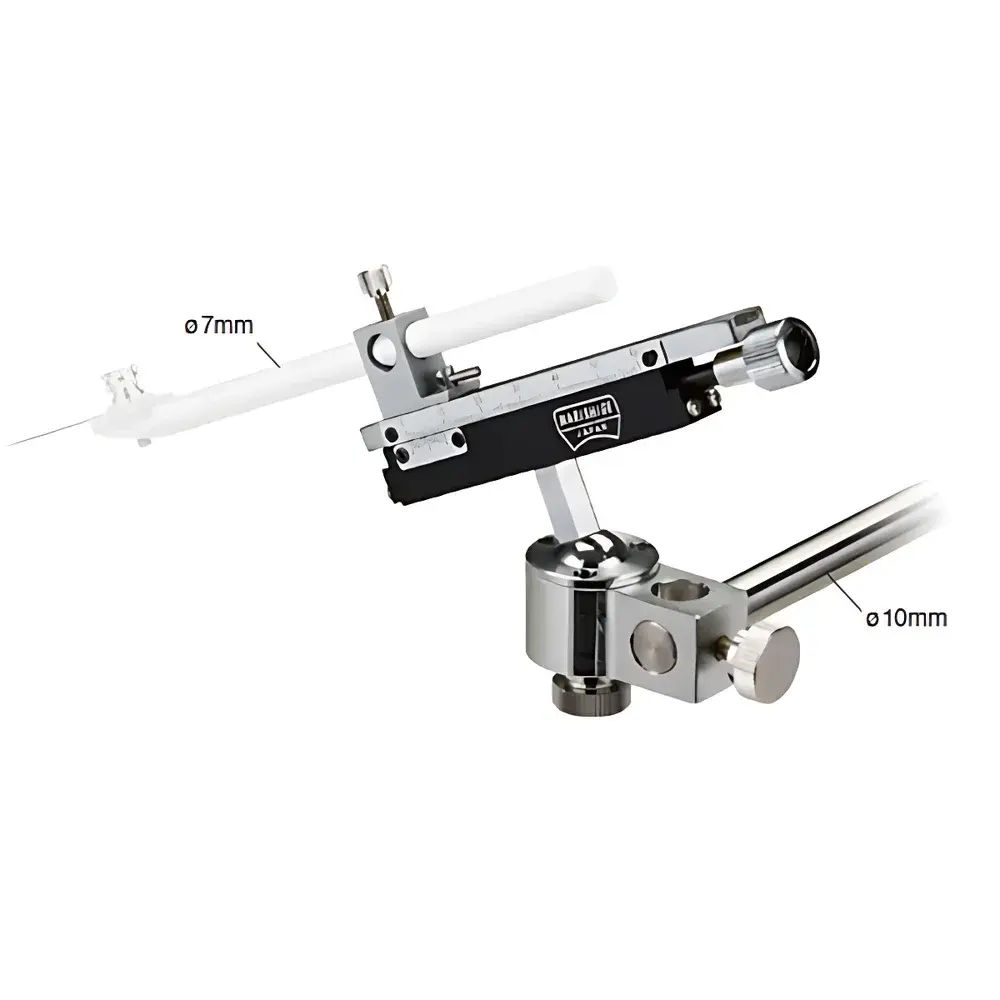
BE-8 Micromanipulator (NARISHIGE)
| Brand | NARISHIGE |
|---|---|
| Origin | Japan |
| Model | BE-8 |
| Travel Range (Coarse X-axis) | 40 mm |
| Mounting Interface | 10 mm diameter rod |
| Dimensions (W×D×H) | 140 × 25 × 95 mm |
| Weight | 210 g |
| Type | Single-Axis Coarse Micromanipulator |
| Application | Stereotactic Auxiliary Positioning |
Overview
The BE-8 Micromanipulator is a precision-engineered single-axis coarse positioning device developed by NARISHIGE (Japan) for integration into stereotactic and electrophysiological workstations. Designed specifically to support stable, repeatable manual positioning of microelectrodes, pipettes, or optical fibers in neuroscience, neurophysiology, and in vitro electrophysiology applications, the BE-8 operates on a robust mechanical translation principle—linear motion via high-tolerance threaded actuation—ensuring minimal backlash and consistent positional reproducibility. Its compact form factor and lightweight construction (210 g) do not compromise mechanical rigidity; instead, they facilitate flexible mounting on standard 10 mm support rods across diverse rig configurations—including custom-built stereotaxic frames, vibration-isolated optical tables, and commercial multi-axis manipulator systems. The device functions exclusively as a coarse adjustment unit, intended for macro-positioning prior to fine-scale manipulation using complementary piezoelectric or hydraulic micromanipulators.
Key Features
- Single-axis coarse X-direction travel of 40 mm, enabling rapid initial placement over a wide working envelope without requiring repositioning of the base mount.
- Ball-head mounting interface ensures full angular freedom (±90° tilt, 360° rotation), allowing precise alignment of the manipulator axis relative to the specimen plane or electrode trajectory.
- Standardized 10 mm diameter rod clamping mechanism guarantees compatibility with NARISHIGE’s full ecosystem of stands (e.g., SM-15, MO-101), as well as third-party support hardware compliant with ISO 9001–certified laboratory rig standards.
- Compact dimensions (140 × 25 × 95 mm) minimize spatial footprint—critical for dense multi-probe setups or confined recording chambers—while maintaining structural integrity under typical handling loads (≤5 N axial force).
- Machined aluminum alloy housing provides electromagnetic neutrality, thermal stability, and corrosion resistance—essential for long-term use in humidified CO₂ incubators, Faraday cages, or laminar flow hoods.
Sample Compatibility & Compliance
The BE-8 is not a sample-contacting analytical instrument but a mechanical positioning aid; therefore, it imposes no chemical or biological compatibility constraints on specimens. It is routinely deployed in GLP-compliant electrophysiology labs conducting patch-clamp, sharp-electrode intracellular recording, or extracellular field potential mapping. While the device itself carries no CE marking or FDA 510(k) classification (as it performs no measurement or signal generation), its mechanical design adheres to JIS B 7451 (Japanese Industrial Standard for micromanipulator dimensional tolerances) and supports workflows aligned with ISO/IEC 17025 requirements for uncertainty-aware experimental setup documentation. All fasteners and adjustment knobs meet RoHS Directive 2011/65/EU material restrictions.
Software & Data Management
The BE-8 is a fully manual, analog positioning device with no embedded electronics, firmware, or digital interface. Consequently, it does not require driver installation, calibration software, or data logging capabilities. Its operation is inherently traceable through documented mechanical settings: users record coarse position values via engraved scale markings (0.5 mm resolution) on the main slider body. When integrated into automated rigs (e.g., those controlled via National Instruments DAQ or MATLAB-based acquisition platforms), the BE-8’s static position serves as a fixed reference coordinate in the overall coordinate system—enabling post-hoc spatial reconstruction of electrode trajectories in conjunction with motorized fine-stage encoder data. No audit trail or electronic record is generated by the BE-8 itself, consistent with 21 CFR Part 11 definitions of “non-electronic records.”
Applications
- Stereotactic alignment of glass micropipettes during in vivo rat/mouse brain slice or intact animal recordings.
- Pre-positioning of tungsten or platinum-iridium electrodes in extracellular array experiments requiring millimeter-scale target localization.
- Supporting optical fiber placement for optogenetic stimulation or fiber photometry, where coarse alignment precedes micron-level focusing via XYZ piezo stages.
- Mounting platform for miniature cameras, LED light sources, or suction electrodes in developmental biology preparations (e.g., Xenopus oocyte voltage clamp setups).
- Modular add-on for teaching laboratories implementing foundational neurophysiology protocols under ISO/IEC 17025-accredited training curricula.
FAQ
Is the BE-8 compatible with non-NARISHIGE mounting systems?
Yes—the 10 mm rod interface conforms to industry-standard diameter tolerances (ISO 286-2 h6), enabling secure clamping on most commercial lab stands, including those from Leica, Scientifica, and Stoelting.
Does the BE-8 offer fine adjustment capability?
No—it is strictly a coarse manipulator. Fine positioning (sub-micron resolution) must be achieved using a dedicated fine-stage (e.g., NARISHIGE MN-4 or MP-285) mounted in series.
Can the BE-8 be used in vacuum or high-humidity environments?
It is rated for ambient laboratory conditions (15–35 °C, 30–70% RH, non-condensing). Extended use in >80% RH or vacuum is not recommended due to unlubricated metal-on-metal contact surfaces.
What maintenance is required?
Periodic inspection of thread integrity and cleaning of the slider rail with isopropyl alcohol; no scheduled lubrication is specified by the manufacturer.
Is technical documentation available in English?
Yes—NARISHIGE provides bilingual (EN/JP) operating manuals, dimensional drawings, and mounting instructions via their global support portal, compliant with IEC 62366-1 usability engineering requirements.





