
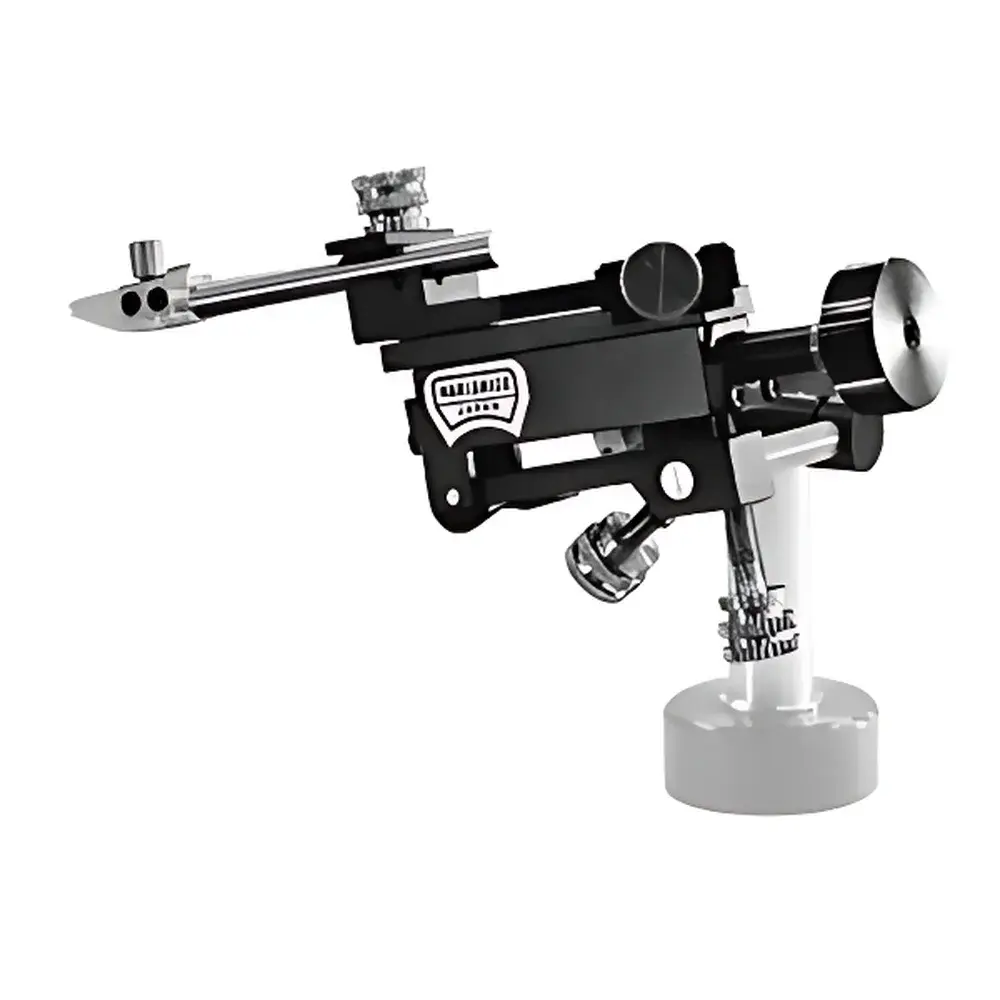
Narishige M-44 Micromanipulator
| Brand | Narishige |
|---|---|
| Origin | Japan |
| Model | M-44 |
| Mounting Interface | Ø4 mm rod |
| Gross Adjustment Range | 22 mm |
| Pivot Motion Axis | Y-axis |
| Tilt Motion Axis | Z-axis |
| Dimensions (W×D×H) | 65 × 25 × 50 mm |
| Weight | 70 g |
| Standard Accessories | H-7C Pipette Holder, Allen Wrench |
Overview
The Narishige M-44 Micromanipulator is a compact, manually operated mechanical manipulator engineered for precise gross positioning of microtools—such as glass micropipettes, electrodes, or microinjection needles—in conjunction with upright or inverted optical microscopes. Designed using proven lever- and cam-based kinematic principles, the M-44 delivers coordinated three-dimensional coarse motion (X–Y–Z) through a minimalistic, rigid architecture that eliminates backlash and ensures repeatable tool placement. Its operation relies on friction-locked linear translation and pivot/tilt coupling rather than motorized or piezoelectric actuation, making it ideal for applications requiring mechanical stability, zero electromagnetic interference, and full manual tactile control—particularly in electrophysiology, patch-clamp recording, microinjection, and single-cell manipulation workflows.
Key Features
- Mechanically coupled 3D coarse positioning: Achieves simultaneous X–Y–Z displacement via integrated orthogonal adjustment knobs; no external power or software required.
- Pivot-and-tilt functionality: Y-axis rotation enables controlled pivot motion around a fixed point near the tip, facilitating angular approach to target structures; Z-axis tilt adjusts the vertical orientation of the mounted tool, optimizing insertion angle during microinjection or electrode penetration.
- Ø4 mm rod-mount compatibility: Secures directly to standard microscope stages, custom-built rigs, or modular optical tables using any commercially available Ø4 mm support rod—ensuring seamless integration across imaging platforms from Nikon, Olympus, Zeiss, and Leica.
- Ultra-compact footprint & lightweight design: Measuring only 65 × 25 × 50 mm and weighing just 70 g, the M-44 imposes negligible load on vibration-sensitive microscope stages while maintaining structural rigidity under typical handling loads.
- Tool-holding versatility: Ships with the H-7C universal pipette holder—a low-profile, spring-loaded clamp accommodating capillary diameters from 1.0 to 1.5 mm—with optional adapters available for electrode holders, fiber optic probes, or custom microtools.
Sample Compatibility & Compliance
The M-44 is not a sample-analysis instrument but a positioning interface; therefore, it does not perform chemical or electrochemical measurements itself. However, its mechanical stability and dimensional repeatability support compliance-critical experimental protocols—including those aligned with GLP and GMP laboratory practices—where consistent tool placement reproducibility is essential for inter-operator and inter-session data comparability. When used in conjunction with certified electrophysiology amplifiers (e.g., Axon Instruments, HEKA), the manipulator contributes to traceable setup configurations documented per ISO/IEC 17025 requirements for calibration of measurement uncertainty in life science instrumentation. No electrical certification (e.g., CE, UL) applies, as the device contains no powered components.
Software & Data Management
The Narishige M-44 operates entirely without embedded electronics, firmware, or digital interfaces. Consequently, it generates no telemetry, requires no driver installation, and introduces no cybersecurity or data integrity concerns. All positional adjustments are recorded manually in lab notebooks or synchronized with third-party acquisition software (e.g., pCLAMP, PatchMaster, or MicroManager) via operator-entered metadata tags. This analog workflow inherently satisfies FDA 21 CFR Part 11 requirements for audit trails when paired with electronic lab notebook (ELN) systems that log timestamped configuration notes alongside electrophysiological recordings.
Applications
- Whole-cell patch-clamp electrophysiology on cultured neurons or brain slices
- Cytoplasmic or nuclear microinjection in zebrafish, Xenopus, or mammalian oocytes
- Single-cell aspiration and intracellular recording in developmental biology studies
- Positioning of carbon-fiber or metal microelectrodes for in vivo extracellular recording
- Alignment of optical fibers or photostimulation probes in optogenetics setups
- Manual positioning of AFM cantilevers or nanoindenters in hybrid microscopy-rheology experiments
FAQ
Is the M-44 compatible with motorized microscope stages?
Yes—the M-44 mounts independently via its Ø4 mm rod interface and does not interfere with motorized stage movement; however, it provides only manual coarse positioning and must be used in tandem with fine-positioning devices (e.g., hydraulic or piezo micromanipulators) for sub-micron resolution.
Can the pivot axis be locked during recording sessions?
Yes—mechanical friction locks on both Y- and Z-axis adjustment knobs allow secure immobilization of pivot and tilt angles once optimal orientation is achieved.
What is the maximum recommended load capacity?
Narishige specifies a nominal tool weight limit of ≤15 g for stable pivot/tilt performance; heavier tools (e.g., multi-barrel electrodes) may require supplementary support or alternative mounting solutions.
Does Narishige provide calibration documentation for the M-44?
No—being a purely mechanical positioning aid without transducers or encoders, the M-44 is not subject to metrological calibration; users verify positional consistency empirically using stage micrometers or calibrated graticules.
Are replacement parts such as the H-7C holder or Allen wrench available separately?
Yes—all standard accessories and wear components are stocked by Narishige distributors under part numbers H-7C, AM-1 (Allen wrench set), and MR-4 (rod adapter kit).





