
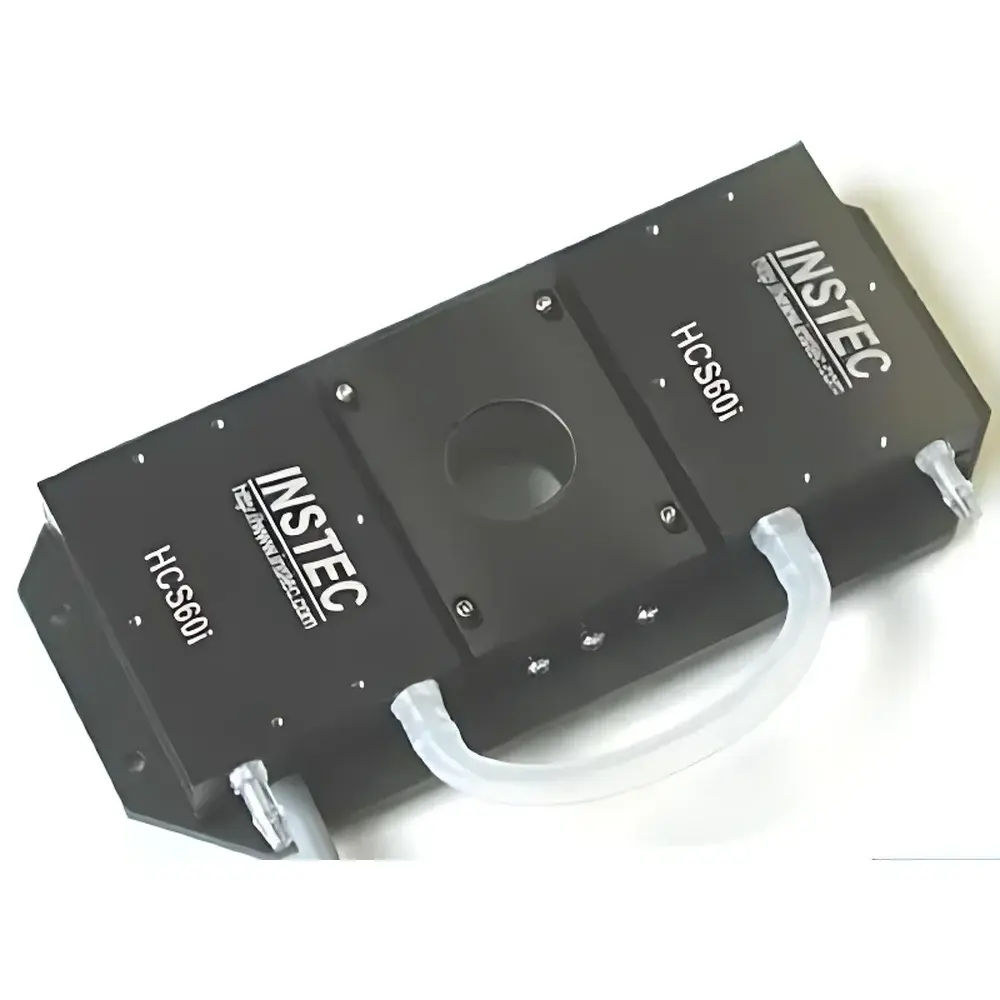
INSTEC HCS60 Programmable Heating and Cooling Stage for Microscopy
| Brand | Instec |
|---|---|
| Origin | USA |
| Model | HCS60 |
| Temperature Range | 5 °C to 60 °C (optional up to 95 °C) |
| Temperature Resolution | 0.01 °C |
| Temperature Stability | ±0.1 °C at 37 °C |
| Max. Heating Rate | +50 °C/min at 37 °C |
| Max. Cooling Rate | −50 °C/min at 37 °C |
| Min. Heating/Cooling Rate | ±0.1 °C/hour |
| Control Method | PID with Variable Bipolar DC Control |
| Sensor | 100 Ω Platinum RTD |
| Working Distance | 5.6 mm (with optional insert) |
| Condenser Distance | 19.1 mm |
| Sample Area | 35 mm diameter |
| Chamber Height | 19 mm |
| Viewing Aperture | 13 mm (with insert), 20 mm (without insert) |
Overview
The INSTEC HCS60 is a high-precision, programmable heating and cooling stage engineered for integration with upright and inverted optical microscopes—particularly in live-cell imaging, time-lapse microscopy, and flow cytometry-based cell analysis workflows. Unlike passive thermal platforms, the HCS60 employs active bipolar DC-controlled thermoelectric modules (TEMs) combined with a closed-loop PID algorithm and a calibrated 100 Ω platinum resistance temperature detector (RTD) to deliver rapid, bidirectional thermal modulation across biologically relevant temperature ranges. Its core measurement principle relies on real-time feedback-driven power modulation to the Peltier elements, enabling precise control from 5 °C to 60 °C (extendable to 95 °C with optional hardware), with stability of ±0.1 °C at physiological setpoints such as 37 °C. Designed specifically for compatibility with high-NA objectives and condensers, the HCS60 maintains a minimal optical path interruption while supporting standard microscope configurations—including transmitted light, phase contrast, DIC, and fluorescence modalities.
Key Features
- Programmable temperature ramping and soaking profiles via intuitive USB-connected software interface
- Bipolar thermoelectric architecture enabling both heating and cooling without external chillers or cryogens
- High-resolution thermal control (0.01 °C resolution) with sub-minute response times: ±50 °C/min maximum rate at 37 °C
- Optimized mechanical design featuring 0 mm minimum working distance (insert removed) and 19.1 mm condenser clearance for compatibility with long-working-distance condensers
- 35 mm sample area accommodates standard 22 × 22 mm coverslips, multi-well chambered slides, and custom microfluidic devices
- Robust aluminum housing with integrated thermal shielding minimizes ambient drift and cross-talk during extended acquisition sessions
- Compliant with CE and RoHS directives; electrical isolation meets IEC 61010-1 safety standards for laboratory instrumentation
Sample Compatibility & Compliance
The HCS60 supports a broad range of biological specimens—including adherent and suspension cells, primary cultures, spheroids, and organoids—under controlled thermal conditions compatible with ISO 13485-aligned cell culture practices. Its open-top chamber design allows direct access for micromanipulation, perfusion tubing, or electrode insertion. The 13–20 mm viewing aperture (configurable via removable insert) ensures unobstructed optical transmission for objectives with NA ≥ 0.75. All thermal protocols are fully traceable and exportable in CSV format, supporting GLP/GMP documentation requirements. While not FDA-cleared as a medical device, the system conforms to ASTM E2875-22 (Standard Guide for Thermal Calibration of Microscopy Stages) and supports audit-ready operation when used within validated laboratory workflows.
Software & Data Management
The HCS60 is operated via Instec’s proprietary StageControl™ software (Windows 10/11, 64-bit), which provides real-time temperature monitoring, multi-step program definition, and synchronized logging of thermal events alongside external triggers (e.g., camera exposure signals). Data streams include timestamped RTD readings, TEM voltage/current, and error flags—all recorded at user-defined intervals (10 ms to 1 s resolution). Exported logs comply with FAIR data principles and integrate natively with MATLAB, Python (via PySerial), and LabVIEW environments. For regulated environments, optional 21 CFR Part 11-compliant user authentication, electronic signatures, and audit trail modules are available under separate licensing.
Applications
- Thermally gated calcium imaging and electrophysiological assays requiring stable 37 °C baselines
- Dynamic studies of heat shock protein expression, cold-induced cytoskeletal reorganization, or fever-response pathways
- Calibration and validation of temperature-sensitive fluorescent probes (e.g., FRET-based thermometers)
- In situ thermal characterization of hydrogels, lipid bilayers, and extracellular matrix mimetics
- Integration with flow cytometry sample chambers to assess temperature-dependent cell adhesion, viability, or marker shedding kinetics
- Preclinical evaluation of hyperthermia-enhanced drug delivery systems under physiologically accurate thermal gradients
FAQ
Can the HCS60 be used with confocal or super-resolution microscopes?
Yes—the stage’s low-profile construction and absence of magnetic components ensure compatibility with most laser-scanning and structured-illumination systems, provided working distance and aperture constraints are observed.
Is vacuum or gas purging supported?
No built-in ports are provided, but custom O-ring sealed inserts and gas-tight gasket kits are available as accessories for hypoxic or CO2-controlled experiments.
Does the system support third-party automation via TTL or analog I/O?
TTL trigger input/output lines are available on the rear panel for synchronization with shutter controllers, stage positioners, or frame-grabbers.
What maintenance is required for long-term calibration stability?
Annual verification against NIST-traceable reference thermometers is recommended; no routine recalibration is needed under normal operating conditions.
How is thermal uniformity across the sample area characterized?
Typical spatial variation is ≤ ±0.3 °C over the central 20 mm diameter at steady state, verified per ASTM E2875 Annex A2 mapping procedures.





