
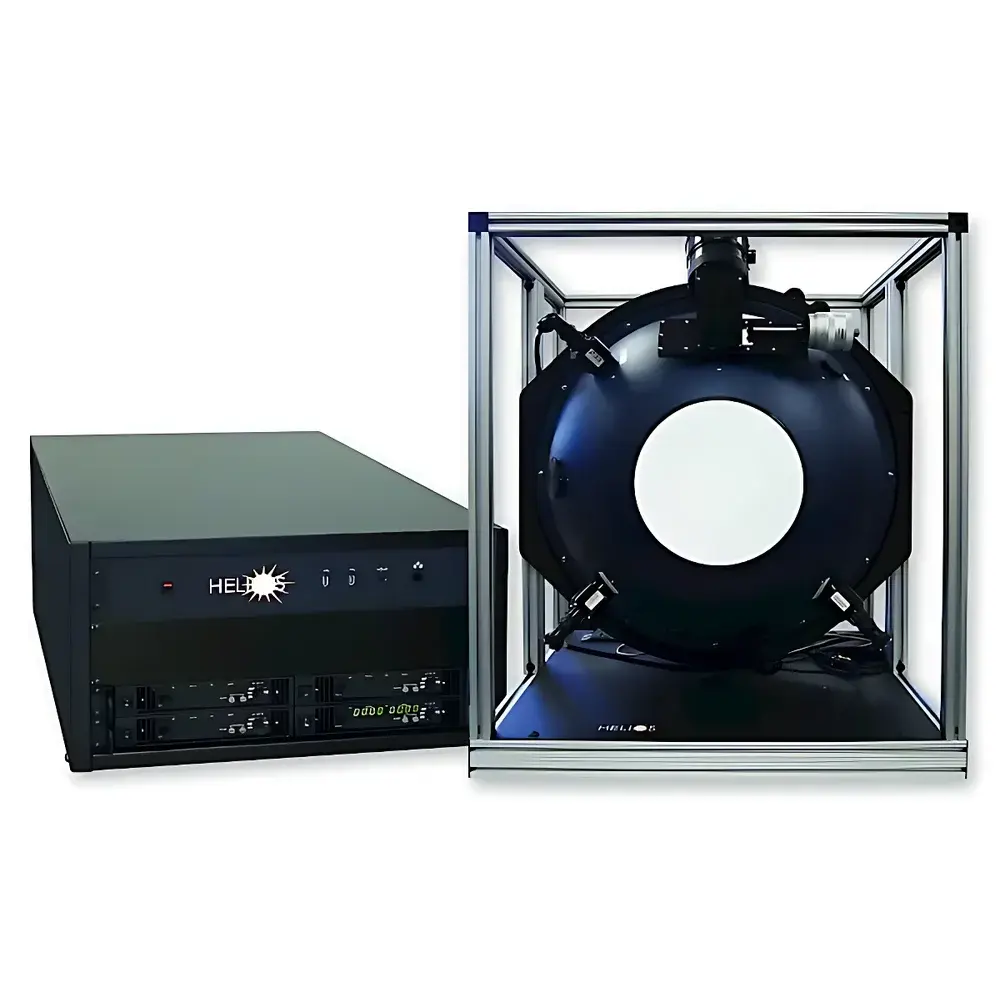
Labsphere HELIOS Radiometric Calibration Integrating Sphere Source System
| Brand | Labsphere |
|---|---|
| Origin | USA |
| Manufacturer Type | Authorized Distributor |
| Product Origin | Imported |
| Model | HELIOS |
| Pricing | Available Upon Request |
Overview
The Labsphere HELIOS Radiometric Calibration Integrating Sphere Source System is a precision-engineered, modular uniform light source platform designed specifically for radiometric and spectral radiance calibration of remote sensing instruments. Built upon Labsphere’s 36 years of expertise in optical integration and diffuse reflectance science, the HELIOS system employs Spectralon®-coated integrating spheres to generate spatially uniform, spectrally stable, and temporally reproducible radiance and irradiance outputs. Its core measurement principle relies on Lambertian diffusion within high-reflectance (>99% @ 400–1500 nm) spherical cavities, enabling traceable, NIST-traceable calibration across dynamic ranges spanning from starlight-level night vision (as low as 10⁻⁶ W·sr⁻¹·m⁻²) to solar-equivalent irradiance (up to 1.0 sun, AM1.5G). The system supports both absolute radiance and relative spectral responsivity characterization—critical for pre-launch validation, on-orbit vicarious calibration, and ground-based sensor intercomparison in compliance with ISO 17025-accredited laboratories.
Key Features
- Modular architecture with five configurable series (D, A, L, V, S) enabling application-specific customization without redesigning optical or control infrastructure
- Spectralon®-lined integrating spheres delivering >99% hemispherical reflectance from 250 nm to 2500 nm, ensuring minimal spectral distortion and long-term photometric stability
- High-dynamic-range output capability: up to 167 dB (D-series), 150 dB (A-series), and calibrated down to <10⁻⁶ W·sr⁻¹·m⁻² (L-series), supporting sensors with ≥16-bit digitization and effective bit depths exceeding 23–27 bits
- Embedded LabVIEW-compatible driver suite with full API documentation, enabling seamless integration into automated test benches and factory calibration lines
- Remote operation via Ethernet (TCP/IP) or USB; programmable shutter control, lamp power ramping, and real-time feedback monitoring of sphere temperature and lamp voltage
- Compliance-ready design: supports audit trails, electronic signatures, and data integrity features aligned with FDA 21 CFR Part 11 and ISO/IEC 17025 requirements when deployed in GLP/GMP environments
Sample Compatibility & Compliance
The HELIOS system accommodates a wide range of optical receivers—including push-broom and whisk-broom imaging spectrometers, focal plane arrays (FPAs), CMOS/CCD cameras, photodiode-based radiometers, and Fourier-transform infrared (FTIR) sensors. Its collimated or diffused output configurations are compatible with standard C-mount, F-mount, and custom optical interfaces. All series meet ASTM E275, ISO 9050, and USP guidelines for uniformity assessment. The A-series is characterized against NIST SRM 2242 and validated per ASTM E259 for solar simulator classification (Class AAA for spectral match, spatial uniformity ≤±2%, temporal stability ≤±0.5% over 4 h). The L-series conforms to MIL-STD-810H low-light sensor testing protocols and supports calibration traceability to NIST SRM 2032 (tungsten halogen standards).
Software & Data Management
HELIOS systems ship with Labsphere’s CalSoft™ v4.2 software—a Windows-based application supporting real-time irradiance/radiance mapping, multi-lamp sequencing, spectral correction tables (via user-loaded CSV or .spc files), and automated report generation in PDF/XLSX formats compliant with ISO/IEC 17025 clause 7.8. Raw data logs include timestamps, environmental sensor readings (sphere ambient temperature, humidity), lamp hours, and calibration certificate metadata. For enterprise integration, the LabVIEW driver package includes VI libraries for DAQmx synchronization, error handling per IEC 61508 SIL2, and support for SCPI command syntax. Audit trail records capture operator ID, parameter changes, and calibration event history—fully exportable for regulatory review.
Applications
- Pre-launch radiometric calibration of Earth observation payloads (e.g., VIIRS, OLI, MSI)
- Vicarious calibration of airborne hyperspectral imagers (AVIRIS-NG, HySpex) using ground reference targets illuminated by HELIOS-A
- Linearity verification and DN-to-radiance conversion coefficient derivation for satellite sensor Level 1 processing pipelines
- Dynamic range testing of low-light surveillance systems (L-series) under controlled dark-room conditions
- Inter-sensor cross-calibration campaigns coordinated by CEOS/WGCV and NASA’s RadCalNet infrastructure
- Validation of BRDF models and atmospheric correction algorithms requiring known radiance inputs
FAQ
What calibration standards does the HELIOS system support?
HELIOS systems are supplied with NIST-traceable calibration certificates for spectral radiance (W·sr⁻¹·m⁻²·nm⁻¹) and irradiance (W·m⁻²·nm⁻¹) at specified wavelengths and output levels. Certificates include uncertainty budgets per GUM (JCGM 100:2008) and are valid for 12 months under recommended operating conditions.
Can the HELIOS system be integrated into an existing automated test system?
Yes—full SCPI command set and LabVIEW drivers enable plug-and-play integration with PXI, GPIB, or EtherCAT-based test platforms. Custom Python/Matlab wrappers are available upon request.
Is spectral customization (e.g., UV-enhanced or SWIR-optimized output) possible?
Yes—optional quartz-halogen, xenon-arc, or LED-based lamp modules can be installed. Filter wheels with bandpass, ND, or dichroic filters may be added to any D-, A-, or L-series configuration.
How often does the integrating sphere require recalibration?
Annual recalibration is recommended; however, in-house verification using a transfer standard radiometer (e.g., NIST-calibrated photodiode) can extend intervals per ISO/IEC 17025 internal verification protocols.
Does the system support multi-wavelength simultaneous output?
Not natively—but time-multiplexed sequential output across discrete bands (e.g., 450 nm, 550 nm, 850 nm) is supported with sub-100 ms switching and synchronized trigger output for gated detector systems.



