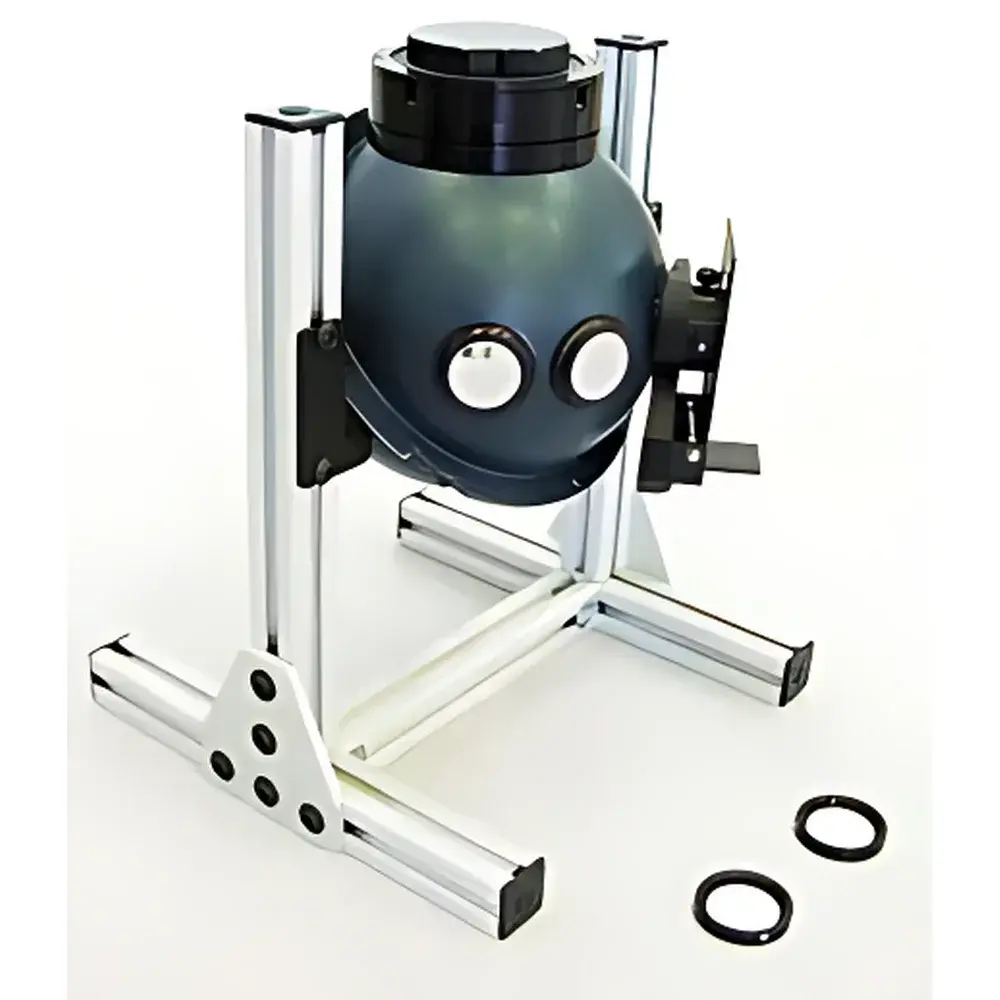
Labsphere CSTM-RTC Reflectance/Transmittance Integrating Sphere
| Brand | Labsphere |
|---|---|
| Origin | USA |
| Model | CSTM-RTC |
| Coating Options | Spectraflect® (300–2400 nm), Infragold® (0.7–20 µm) |
| Port Configuration | Five 1-inch ports (sample & 9° specular-reflected beam), 0.5-inch top detector port, bottom detector port (RTC), integrated central sample mount |
| Geometry | 9°/h reflectance, variable-angle incidence capability (RTC), specular trap included |
| Internal Baffle Design | Low-profile, minimized obstruction to maximize wall visibility |
| Aperture Edge | Knife-edge for wide-angle scatter collection |
| Compliance | ASTM E1331, ISO 13468, ISO 13469, USP <857>, compatible with GLP/GMP data integrity workflows |
Overview
The Labsphere CSTM-RTC Reflectance/Transmittance Integrating Sphere is an engineered optical measurement platform designed for high-fidelity, spectrally resolved characterization of diffuse and total reflectance, as well as diffuse and total transmittance across ultraviolet–visible–near-infrared (UV-VIS-NIR) and mid-infrared (MIR) spectral ranges. Based on the fundamental principle of spatial integration—where incident light undergoes multiple diffuse reflections within a highly uniform, Lambertian-coated spherical cavity—the CSTM-RTC delivers photometric equivalence between radiant flux incident on the sphere wall and that measured at the detector port. Its dual-port geometry (top and bottom detector access), combined with a central, kinematically adjustable sample mount, enables rigorous separation of specular and diffuse components under controlled angular illumination—critical for compliance with ASTM E1331 (for reflectance) and ISO 13468/13469 (for transmittance). The system supports both fixed-angle (9°/h configuration) and variable-angle incidence measurements, making it suitable for angular-resolved BRDF/BTDF studies without requiring external goniometric reconfiguration.
Key Features
- Modular dual-geometry design: RT base configuration for standard 9°/h reflectance and transmittance; RTC upgrade adds central sample stage for precise angular alignment (±0.5° repeatability) and independent control of incident and detection angles.
- Optimized internal architecture: Knife-edge apertures minimize vignetting and enhance collection efficiency for wide-angle scattered light; low-profile baffles ensure >92% unobstructed view of coated inner surface by detector.
- Coating-selectable performance: Spectraflect® coating (300–2400 nm, >98% average reflectance) for UV-VIS-NIR applications; Infragold® coating (0.7–20 µm, >95% reflectance in NIR-MIR) for thermal and IR spectroscopy workflows.
- Integrated specular trap: Mechanically isolated light trap absorbs non-diffuse (specular) components prior to wall integration—essential for accurate diffuse-only measurements per ISO 13468-1 Annex A.
- Dual detector porting: Top-mounted 0.5-inch port for conventional spectrometer coupling; bottom port (RTC-specific) enables vertical sample illumination/detection alignment, reducing stray light from optical bench surfaces.
Sample Compatibility & Compliance
The CSTM-RTC accommodates solid, liquid, and semi-opaque samples—including powders, films, coatings, ceramics, biological tissues, and turbid suspensions—within its standardized 1-inch sample port. Its open architecture supports custom sample holders, temperature-controlled stages (e.g., Peltier or LN₂-cooled mounts), and fiber-optic illumination paths. All configurations meet metrological requirements for traceable optical measurements: compliant with ASTM E1331-22 (Standard Test Method for Reflectance Factor of Opaque Specimens Using an Integrating Sphere), ISO 13468-1:2022 (Plastics — Determination of Total Luminous Transmittance), and ISO 13469:2022 (Plastics — Determination of Diffuse Transmittance). When paired with NIST-traceable reference standards (e.g., Spectralon® SRM 990), the system supports audit-ready calibration documentation required under FDA 21 CFR Part 11 and EU Annex 11 for regulated QC environments.
Software & Data Management
The CSTM-RTC integrates seamlessly with industry-standard spectrometers (e.g., Ocean Insight, Avantes, Horiba) and third-party acquisition software (SpectraSuite, AvaSoft, LabVIEW-compatible drivers). Raw spectral data (reflectance %, transmittance %, absolute radiance) are output in CSV or HDF5 format, preserving wavelength metadata, integration time, and instrument configuration tags. For GxP-regulated labs, optional Labsphere SphereSuite™ software provides full 21 CFR Part 11 compliance: electronic signatures, role-based access control, automated audit trails, and immutable raw-data archiving. All measurement sequences—including reference/background acquisition, dark correction, and geometric normalization—are scriptable and repeatable, supporting IQ/OQ/PQ validation protocols.
Applications
- Material optical property quantification: Diffuse/total reflectance of paints, pigments, solar absorbers, and architectural coatings.
- Turbidity-corrected transmittance: Measurement of cloudy liquids (e.g., pharmaceutical suspensions, dairy products) per USP .
- Colorimetric analysis: CIE XYZ, L*a*b*, and spectral reflectance curves for quality control in textile, automotive, and display industries.
- Infrared emissivity and reflectivity mapping: Thermal management R&D for aerospace composites and semiconductor packaging.
- BRDF/BTDF modeling input: Angular-resolved datasets for ray-tracing simulations in optical design (Zemax, LightTools).
- Calibration transfer: Reference sphere used to validate secondary integrating spheres or handheld colorimeters against primary standards.
FAQ
What spectral ranges are supported by the CSTM-RTC?
The system supports UV-VIS-NIR (300–2400 nm) with Spectraflect® coating and NIR-MIR (0.7–20 µm) with Infragold® coating—coating selection must be specified at time of order.
Can the CSTM-RTC measure both reflectance and transmittance on the same sample?
Yes—via configurable port masking and detector repositioning; transmittance requires a second integrating sphere or a dual-sphere setup for absolute measurement per ISO 13469.
Is the central sample mount motorized or manual?
The standard CSTM-RTC includes a precision manual rotation stage (±0.1° graduation); motorized goniometric options (with encoder feedback) are available as OEM add-ons.
How is stray light minimized during measurement?
Through knife-edge apertures, optimized baffle geometry, and a dedicated specular light trap—validated via Labsphere’s internal stray-light test protocol (ASTM E275-compliant).
Does the system include NIST-traceable calibration standards?
No—calibration standards (e.g., Spectralon® 99% reflectance tile, certified transmittance filters) are sold separately and must be selected based on target wavelength and application class.