
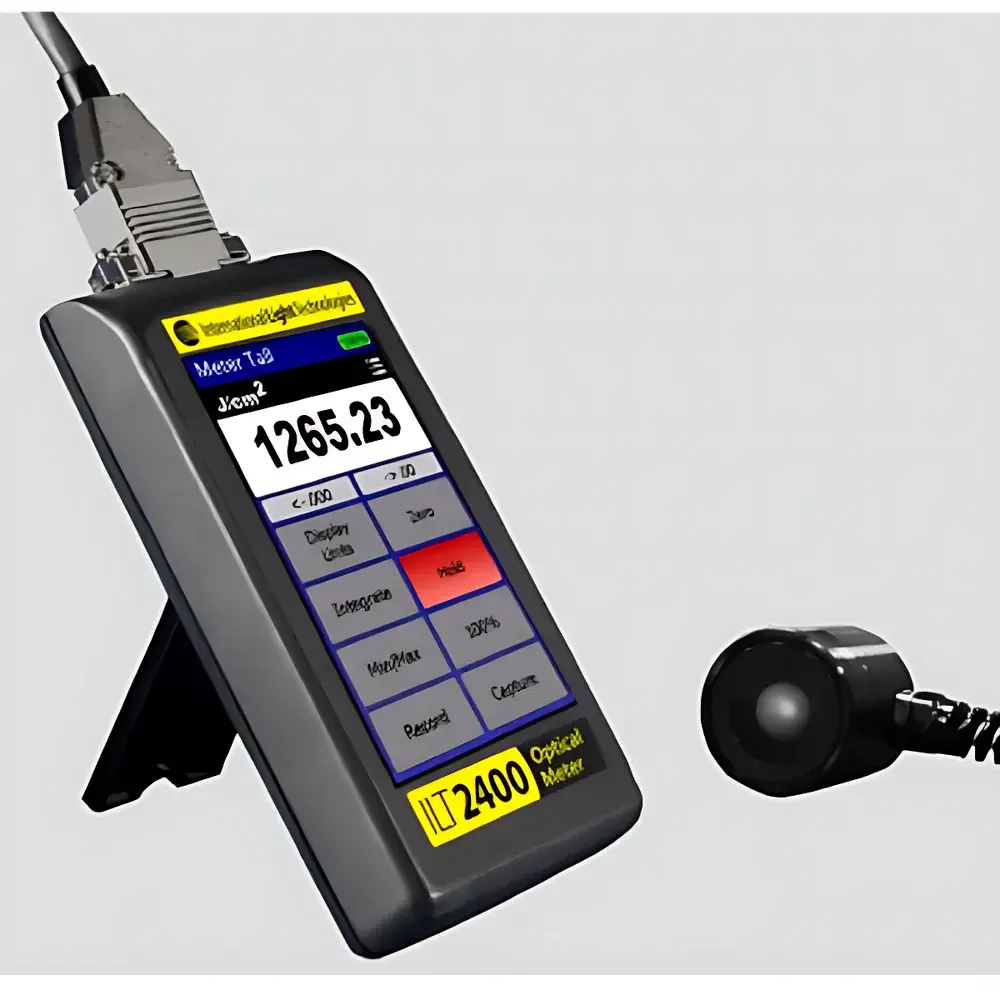
ILT2400-UVC Handheld UVC Radiometer System with NIST-Traceable SiC Detector and ISO/IEC 17025 Calibration
| Brand | Labsphere |
|---|---|
| Origin | USA |
| Model | ILT2400-UVC |
| Detector Type | SED270C/W SiC Photodiode |
| Spectral Range | 230–280 nm |
| Peak Sensitivity | 265 nm |
| Irradiance Range | 100 nW/cm² to 1 W/cm² |
| Dose Range | 100 nJ/cm² to >1 MJ/cm² |
| Calibration | ISO/IEC 17025 Accredited, NIST-Traceable |
| Display | Integrated Touchscreen Interface |
| Connectivity | USB Mini & Micro (Data Transfer + Charging) |
| Software | Datalight III (macOS & Windows Compatible) |
| Enclosure | Rugged Carry Case with Integrated Stand |
| Detector Cable Length | 2.1 m (7 ft) |
| Optical Element | Fused Silica Diffuser |
| Filter | Built-in UVC Bandpass Filter |
Overview
The ILT2400-UVC is a purpose-engineered handheld radiometer system designed for traceable, high-fidelity measurement of germicidal ultraviolet-C (UVC) irradiance and radiant exposure (dose) in the critical 230–280 nm spectral band. It operates on the principle of calibrated photodetection using a silicon carbide (SiC) photodiode—material inherently solar-blind and insensitive to visible and near-UV radiation—ensuring selective response to UVC without spectral contamination from UVB or UVA. The integrated 265 nm peak-optimized optical architecture, including a fused silica diffuser and precision UVC bandpass filter, aligns with the peak microbial inactivation cross-section of DNA/RNA, particularly relevant for pathogens including SARS-CoV-2, Escherichia coli, and Staphylococcus aureus. Unlike generic broadband UV meters, the ILT2400-UVC delivers wavelength-specific metrology validated per ISO/IEC 17025 requirements, with full NIST-traceable calibration documentation provided for each SED270C/W detector unit. Its portable form factor, real-time touchscreen interface, and robust mechanical design enable field-deployable validation under GMP-aligned environmental monitoring protocols.
Key Features
- True germicidal UVC metrology: calibrated spectral responsivity across 230–280 nm, with certified peak at 265 nm
- NIST-traceable, ISO/IEC 17025-accredited calibration certificate included with each SED270C/W detector
- Solar-blind SiC photodiode eliminates interference from ambient lighting, fluorescent fixtures, or UVB leakage
- Real-time irradiance (W/cm²) and cumulative dose (J/cm²) calculation with auto-integration and timestamped logging
- Integrated 2.1 m (7 ft) low-noise coaxial cable minimizes operator UVC exposure during surface or air disinfection validation
- Detachable fused silica cosine-corrected diffuser ensures angular response compliance per CIE 69:1987 and IEC 62471
- On-device touchscreen interface with intuitive navigation, configurable averaging, and immediate pass/fail threshold alerts
- Ruggedized carry case includes fold-out stand for hands-free positioning and sensor alignment stability
Sample Compatibility & Compliance
The ILT2400-UVC is compatible with all common UVC-emitting sources used in healthcare, HVAC, water treatment, and laboratory biosafety applications—including low-pressure mercury lamps (254 nm), KrCl excimer lamps (222 nm), and UVC-LED arrays (265–280 nm). Its SED270C/W detector is specifically characterized to reject response beyond 280 nm, eliminating UVB contribution that could otherwise inflate reported germicidal efficacy. The system conforms to key regulatory and quality frameworks: calibration uncertainty budgets comply with ISO/IEC 17025:2017 clause 7.8; measurement traceability satisfies FDA 21 CFR Part 11 requirements when used with Datalight III audit-trail enabled; and irradiance reporting meets ANSI/IES RP-27.3-22 recommendations for UVGI safety and performance verification. For GLP/GMP environments, raw data export supports 21 CFR Part 11-compliant electronic records when paired with validated software configurations.
Software & Data Management
Datalight III is a platform-independent application supporting macOS 10.15+ and Windows 10/11, enabling full configuration, real-time streaming, post-acquisition analysis, and report generation. The software provides spectral correction tables, time-stamped irradiance/dose overlays, statistical summaries (mean, SD, min/max), and customizable pass/fail criteria based on CDC, WHO, or facility-specific UVGI validation thresholds. All datasets are stored in open CSV and XML formats, facilitating integration into LIMS or enterprise QA systems. Audit trail functionality logs user actions, parameter changes, and calibration events—meeting ALCOA+ principles for data integrity. Firmware updates and detector recalibration schedules are managed directly through the software interface, with version-controlled calibration files archived alongside measurement sessions.
Applications
- Validation of UVC disinfection cycles for hospital room surfaces, PPE, and medical devices
- Commissioning and routine monitoring of upper-room UVGI air disinfection systems
- Verification of UVC dose delivery in water sterilization reactors and point-of-use units
- Accelerated aging and photostability testing of UVC-sensitive materials (e.g., polymers, filters)
- Research-grade quantification of pathogen inactivation kinetics under controlled UVC fluence
- Regulatory submission support for FDA 510(k), EPA registration, or CE marking of UVGI devices
FAQ
What makes the SED270C/W detector suitable for germicidal UVC measurements?
Its silicon carbide (SiC) active layer provides intrinsic solar blindness, with negligible response above 280 nm and no thermal drift under continuous UVC exposure—critical for long-duration dose integration.
Can the ILT2400-UVC measure pulsed UVC sources?
Yes—the system’s 10 µs minimum sampling interval and real-time digital integration engine capture transient irradiance profiles from flash lamps and modulated UVC-LEDs without aliasing.
Is the calibration valid for use with different diffusers or accessories?
No—each calibration is detector-specific and includes the supplied fused silica diffuser; substitution invalidates NIST traceability and requires recharacterization.
How often should the system be recalibrated?
Labsphere recommends annual recalibration against NIST-traceable standards, or after any physical impact, extreme thermal cycling, or exposure exceeding 10⁶ J/cm² cumulative dose.
Does Datalight III support automated report generation for internal QA audits?
Yes—customizable templates generate PDF reports with embedded calibration certificates, metadata, statistical summaries, and digital signatures compliant with ISO 13485 and 21 CFR Part 11.




