
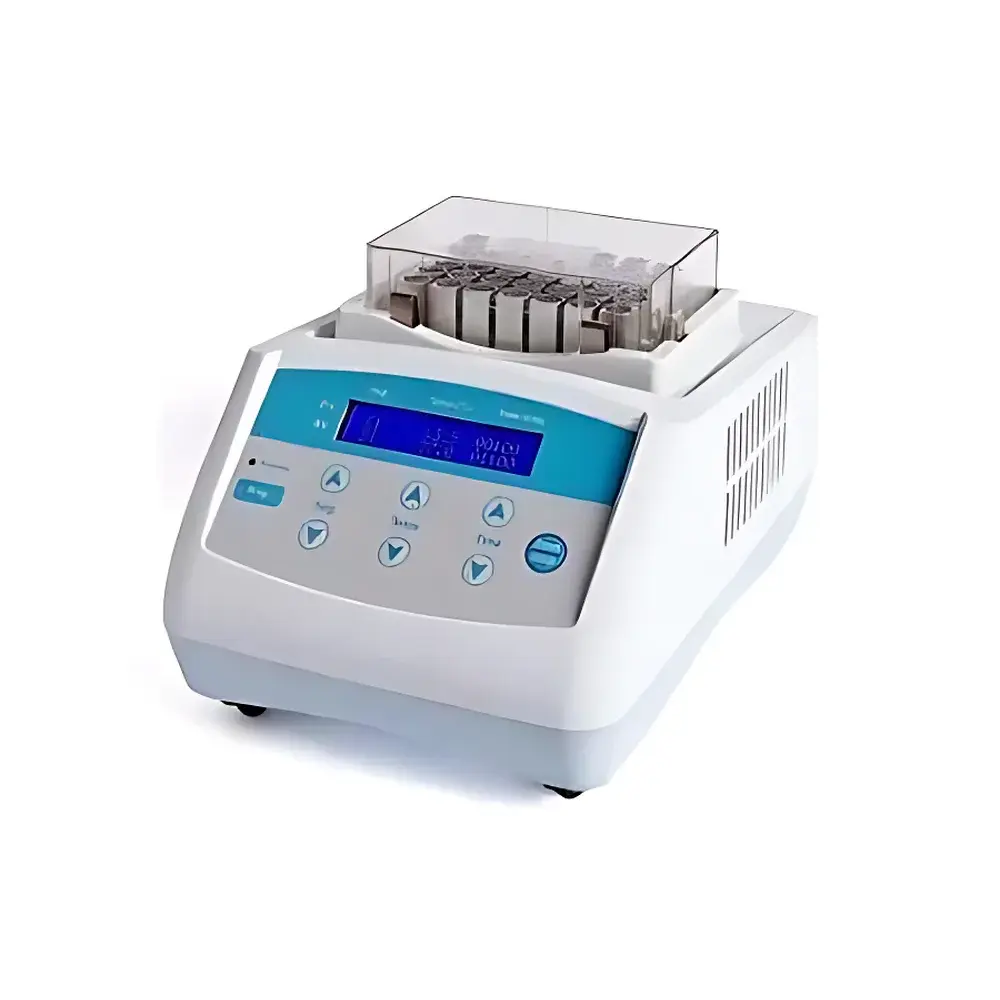
JIAYUAN MK-20 Refrigerated Dry Block Heater
| Brand | JIAYUAN |
|---|---|
| Model | MK-20 |
| Type | Refrigerated Dry Block Heater (Metal Bath) |
| Temperature Range | –10°C to 100°C |
| Temperature Stability @100°C | ≤±0.5°C |
| Block Uniformity @40°C | ≤±0.3°C |
| Display Resolution | 0.1°C |
| Heating Time | ≤15 min (20°C → 100°C) |
| Cooling Time | ≤30 min (ΔT = –30°C, ambient ≤26°C) |
| Max Power | 150 W |
| Net Weight | 2.2 kg |
| Dimensions (W×D×H) | 270 × 190 × 170 mm |
| Programmable Timer | Up to 99 h 59 min |
| Module Compatibility | Interchangeable blocks for 0.2–50 mL tubes, microplates, and custom slots |
Overview
The JIAYUAN MK-20 Refrigerated Dry Block Heater is a microprocessor-controlled thermal management system engineered for precise, stable, and bidirectional temperature regulation across laboratory workflows requiring both heating and active cooling. Unlike conventional water baths—prone to contamination, evaporation, and inconsistent thermal transfer—the MK-20 employs solid aluminum heating/cooling blocks with optimized thermal mass and Peltier-based refrigeration to deliver rapid, uniform, and repeatable temperature control from –10°C to 100°C. Its design eliminates fluid media entirely, supporting GLP-compliant sample integrity in applications where cross-contamination, condensation, or microbial growth must be rigorously avoided. The unit operates on thermoelectric (Peltier) principles for cooling and resistive heating for warming, enabling fast ramp rates (≤15 min to 100°C; ≤30 min for 30°C cooling from ambient ≤26°C), minimal thermal overshoot, and high reproducibility across parallel sample positions.
Key Features
- Microprocessor-based PID temperature control with real-time feedback loop ensures ≤±0.5°C stability at 100°C and ≤±0.3°C block uniformity at 40°C.
- High-resolution blue LCD display with dual independent setpoints: simultaneous time and temperature programming, countdown timer, and live temperature readout (0.1°C resolution).
- Integrated safety architecture includes over-temperature cutoff, self-diagnostic fault detection, audible alarm, and automatic shutdown upon sensor failure or thermal runaway.
- Modular block system supports rapid interchange of standardized aluminum inserts—compatible with common tube formats (0.2 mL PCR strips, 0.5/1.5/2.0 mL centrifuge tubes), 96-well plates, square wells, and custom geometries (e.g., 5 mL, 15 mL, and 50 mL vessels).
- Compact footprint (270 × 190 × 170 mm) and low power draw (150 W max) enable benchtop deployment in space-constrained environments including biosafety cabinets, cleanrooms, and QC laboratories.
- Calibration offset function allows user-initiated temperature bias correction without external service tools—critical for traceable compliance with ISO/IEC 17025 and internal SOP validation protocols.
Sample Compatibility & Compliance
The MK-20 accommodates diverse sample containers via 14 interchangeable block configurations—including standard 96-well PCR plates (flat-bottom), multi-format hybrid blocks (e.g., 32×0.2 mL + 25×1.5 mL), and deep-well reservoirs (103×67×30 mm). All blocks are CNC-machined from anodized aluminum for chemical resistance, thermal conductivity, and ease of decontamination (autoclavable up to 121°C for non-refrigerated use only). The device meets IEC 61010-1:2010 safety requirements for laboratory electrical equipment and complies with electromagnetic compatibility (EMC) standards EN 61326-1. While not FDA-cleared as a medical device, its performance characteristics align with ASTM E2872 (Standard Guide for Validation of Thermal Cyclers) and USP for thermal uniformity testing in pharmaceutical stability studies.
Software & Data Management
The MK-20 operates as a standalone instrument with no proprietary software dependency. All configuration, operation, and diagnostics occur via the front-panel interface. However, it supports external data logging through optional RS-232 or USB-to-serial adapters (not included), enabling integration into LIMS or ELN platforms via ASCII command protocol. Timestamped temperature logs can be exported for audit trails required under 21 CFR Part 11 when paired with validated third-party acquisition software and electronic signature controls. The built-in timer maintains programmable hold times up to 99 hours and 59 minutes, supporting unattended overnight incubations or timed coagulation assays without manual intervention.
Applications
- Blood serum coagulation studies (e.g., PT, APTT, fibrinogen assays) requiring strict –10°C to 37°C thermal staging.
- DNA denaturation and pre-PCR sample conditioning at 95°C with controlled cooling to 4°C for enzyme preservation.
- Enzyme activity profiling across defined thermal gradients (e.g., 25°C–65°C ramps) with minimized inter-sample variance.
- Stability testing of reference standards, calibration materials, and reagents per ICH Q5C guidelines.
- QC/QA workflows in food safety (pathogen enrichment), environmental testing (microbial enumeration), and clinical diagnostics (serum separation, antigen retrieval).
FAQ
What is the minimum operating ambient temperature for reliable refrigeration performance?
The MK-20 achieves rated cooling performance (≤30 min to –30°C delta) only when ambient temperature remains ≤26°C. Operation above this threshold reduces cooling capacity and extends stabilization time.
Can the MK-20 be used inside a cold room or refrigerator?
No. Ambient temperatures below 10°C may impair Peltier efficiency and trigger thermal protection circuits. The unit must operate within 10–30°C ambient range.
Are all modules compatible with both MK-10 (heating-only) and MK-20 (refrigerated) units?
Yes—mechanical and thermal interfaces are identical across the MK-10/MK-20 series. However, refrigerated operation requires the MK-20’s integrated cooling assembly and firmware.
Is the device suitable for GLP or GMP-regulated environments?
Yes, provided users perform periodic verification using NIST-traceable thermometers and document calibration offsets, timer accuracy, and temperature uniformity per internal SOPs aligned with ISO/IEC 17025 Clause 6.4.
Does the MK-20 support remote start/stop or network connectivity?
Not natively. Remote control requires external serial-to-Ethernet gateways and custom scripting. No Wi-Fi, Bluetooth, or cloud interface is embedded.



