
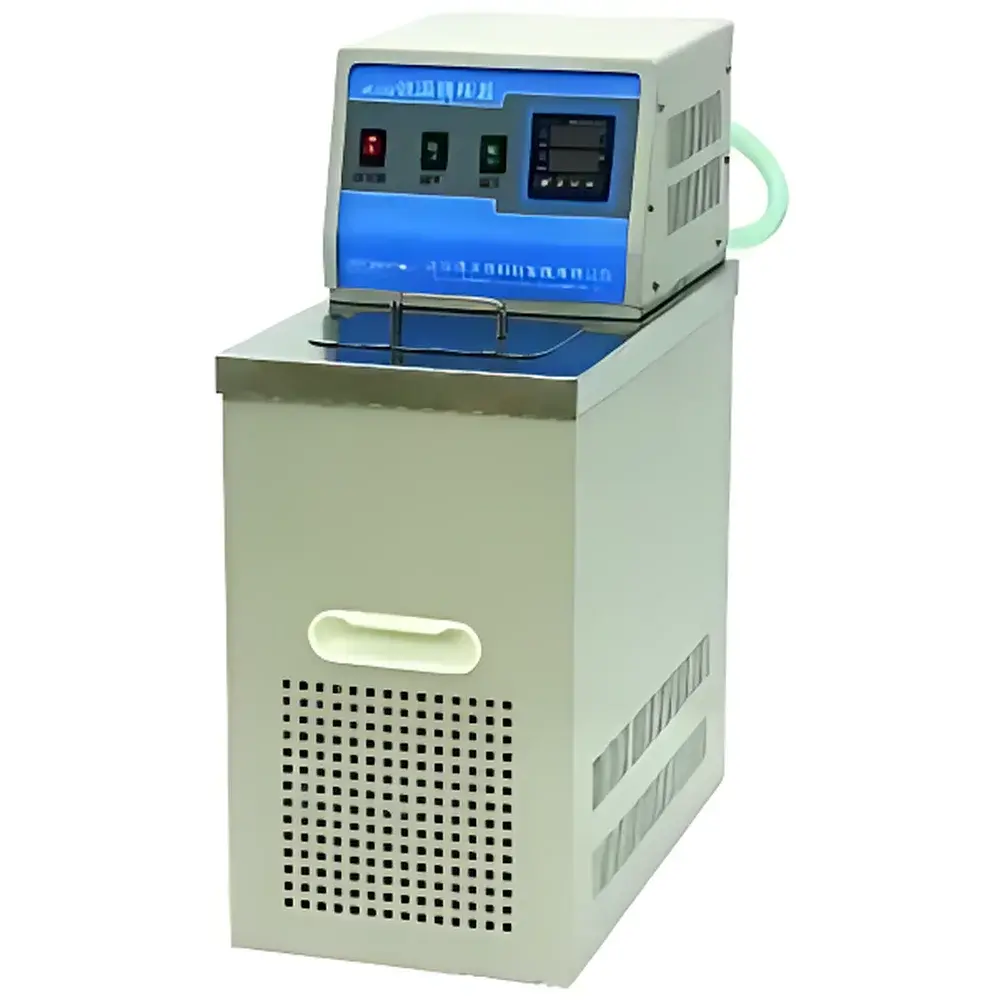
HX-1050 Cryogenic Constant Temperature Circulator
| Origin | Beijing, China |
|---|---|
| Manufacturer Type | Authorized Distributor |
| Origin Category | Domestic (PRC) |
| Model | HX-1050 |
| Price | USD 820 (FOB Beijing) |
| Temperature Range | −10 to +50 °C |
| Temperature Stability | ±0.1 °C |
| Refrigeration Capacity | 200 W |
| Circulation Flow Rate | 10 L/min |
| Bath Volume | 4 L |
| Opening Dimensions | 130 × 87 mm |
| External Dimensions (W×D×H) | 200 × 350 × 480 mm |
| Display | Digital LED for Setpoint & Actual Temperature |
| Pump Type | Stainless Steel Centrifugal Circulating Pump |
| Construction | 304 Stainless Steel Bath & Work Surface |
| Noise Level | <45 dB(A) |
| Weight | 18.5 kg |
Overview
The HX-1050 Cryogenic Constant Temperature Circulator is an engineered thermal management system designed for precise, stable temperature control in life science laboratories and analytical instrument support applications. Based on vapor-compression refrigeration with a fully enclosed hermetic compressor, it delivers consistent cooling and heating performance across a wide operational range of −10 °C to +50 °C. Its core function is to maintain high-fidelity thermal equilibrium—either within its integrated 4-liter stainless steel bath or via external closed-loop circulation at up to 10 L/min—enabling reliable thermal conditioning of peripheral equipment such as rotary evaporators, electrophoresis units, viscometers, cryotherapy devices, and vacuum system components (e.g., diffusion pumps, ion pumps, and electron microscopes). The unit employs PID-controlled digital temperature regulation with ±0.1 °C stability under static bath conditions and ≤±0.3 °C deviation during dynamic external load operation—meeting the repeatability requirements of ISO/IEC 17025-accredited calibration workflows and GLP-compliant experimental protocols.
Key Features
- Fully enclosed refrigeration system with high-efficiency hermetic compressor, delivering 200 W nominal cooling capacity at 20 °C ambient
- 304 stainless steel bath and work surface—resistant to corrosion from aqueous, ethanol-, or glycol-based heat transfer fluids; easy to sanitize and maintain
- Digital LED display showing both setpoint and real-time bath temperature with 0.1 °C resolution
- Low-noise centrifugal circulation pump (stainless steel impeller and housing) rated for continuous duty and compatible with common coolant mixtures (e.g., water/ethylene glycol)
- Compact footprint (200 × 350 × 480 mm) and lightweight design (18.5 kg), optimized for benchtop integration in space-constrained labs
- Front-access bath opening (130 × 87 mm) facilitating sample immersion and probe placement without obstruction
- Over-temperature, low-level, and dry-run protection circuits ensuring operational safety and equipment longevity
Sample Compatibility & Compliance
The HX-1050 supports a broad range of thermal applications involving biological samples, reagents, and instrumentation requiring stable thermal environments. It is compatible with standard laboratory coolants—including deionized water, 30% ethylene glycol/water, and low-conductivity silicone oils—subject to viscosity and freezing point constraints within its operating range. The unit complies with IEC 61010-1:2010 for electrical safety in laboratory equipment and meets EMC requirements per EN 61326-1:2013. While not certified for medical device use under ISO 13485, its temperature stability and traceable control logic align with supporting roles in FDA-regulated environments where ancillary thermal control must satisfy 21 CFR Part 11 data integrity expectations when interfaced with compliant software systems.
Software & Data Management
The HX-1050 operates as a standalone analog-digital hybrid controller with no built-in USB/Ethernet interface or proprietary software. Temperature setpoints and real-time readings are accessible only via front-panel display. For integration into automated or audit-trail-capable workflows, users may connect external calibrated PT100 probes (not included) to validated third-party data loggers compliant with ISO/IEC 17025 traceability standards. Optional RS-485 Modbus RTU communication modules are available through authorized distributors for OEM integration into centralized lab infrastructure monitoring platforms—enabling remote setpoint adjustment, alarm logging, and time-stamped temperature history export in CSV format.
Applications
- Thermal stabilization of rotary evaporation condensers and cold traps in organic synthesis labs
- Temperature-controlled electrophoresis buffer tanks for nucleic acid and protein separation
- Active cooling of high-power analytical instruments: SEM/TEM cooling stages, RF generators, and microwave ablation systems
- Controlled hypothermia simulation in preclinical biomedical research using cold caps or therapeutic blankets
- Viscosity measurement support for rotational rheometers and capillary viscometers requiring bath-isothermal conditions
- Calibration of temperature-sensitive sensors (e.g., thermistors, RTDs) across sub-zero to physiological ranges
FAQ
What coolant types are recommended for operation below 0 °C?
A 30–40% (v/v) aqueous ethylene glycol mixture is recommended for sustained operation between −10 °C and 0 °C. Pure water must not be used below 4 °C due to risk of freezing-induced damage.
Can the HX-1050 be used for heating-only applications?
Yes—the unit features resistive heating elements alongside refrigeration, enabling precise temperature control across the full −10 °C to +50 °C range without external heaters.
Is the circulation pump flow rate adjustable?
No—the pump operates at fixed speed; flow modulation must be achieved externally using calibrated needle valves or bypass manifolds.
Does the unit include fluid level or temperature alarms?
Yes—integrated low-level and over-temperature cutoffs trigger audible alerts and automatic shutdown to prevent dry-run or thermal runaway events.
What maintenance intervals are recommended for long-term reliability?
Compressor oil and refrigerant integrity should be verified annually by qualified service personnel; stainless steel bath surfaces require routine cleaning with neutral pH detergents to prevent mineral buildup.





