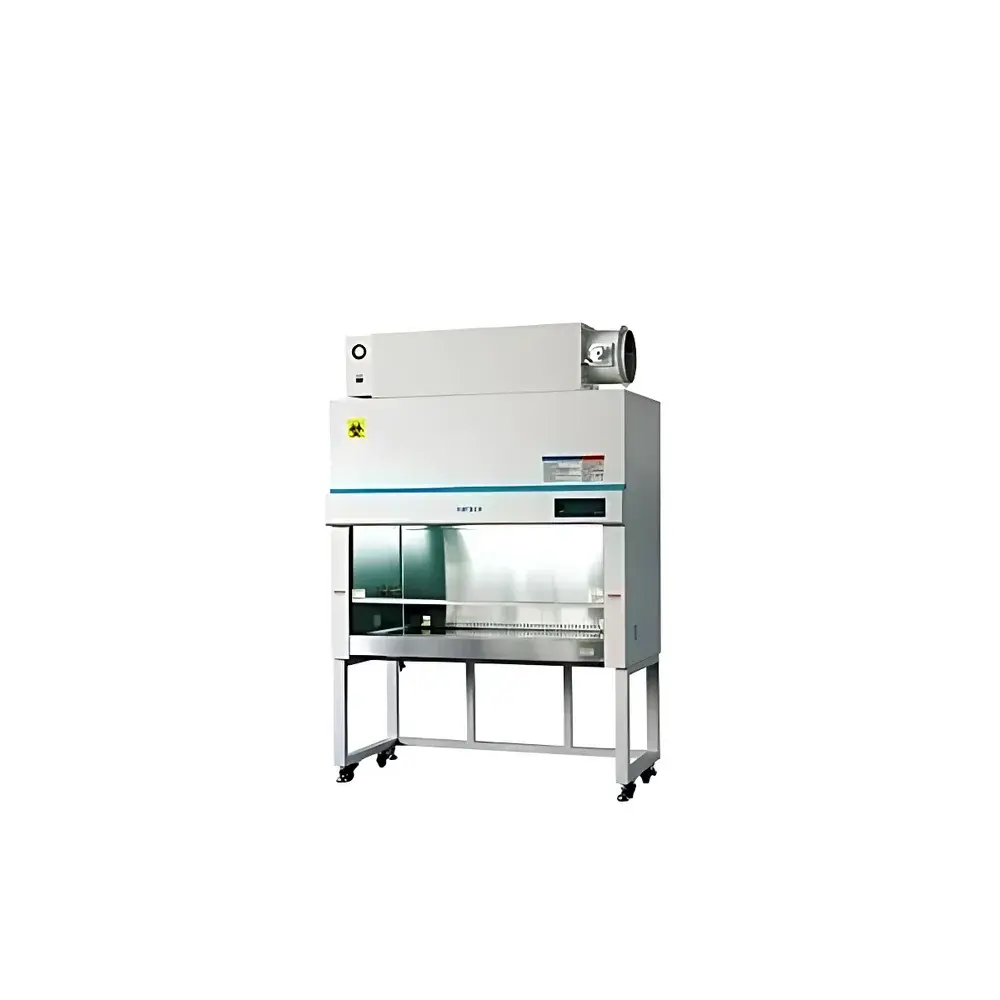
BHC-1300IIA2 Class II Type A2 Biological Safety Cabinet
| Origin | Jiangsu, China |
|---|---|
| Manufacturer Type | Authorized Distributor |
| Product Category | Domestic (China-Made) |
| Model | BHC-1300IIA2 |
| Cabinet Type | Class II, Type A2 (30% Exhaust / 70% Recirculated) |
| External Dimensions (L×W×H) | 1500 × 815 × 2270 mm |
| Internal Work Area Dimensions (L×W×H) | 1300 × 600 × 640 mm |
| Filter Efficiency | HEPA ≥99.995% @ 0.3 µm |
| Downflow Velocity | 0.33 m/s |
| Inflow Velocity | 0.55 m/s |
| Noise Level | ≤58 dB(A) |
| Lighting Intensity | ≥650 lux |
| Power Supply | AC 220 V, 50 Hz |
| Total Power Consumption | 2.0 kW (including dedicated GFCI outlets) |
| Net Weight | 340 kg |
| Lighting | Two 30 W fluorescent lamps + one 20 W UV lamp |
| Exhaust Options | Left, right, or top discharge |
| User Capacity | Dual-operator configuration |
Overview
The BHC-1300IIA2 is a certified Class II, Type A2 biological safety cabinet engineered for simultaneous protection of personnel, product, and environment in microbiological, pharmaceutical, and clinical laboratory settings. It operates on the principle of inward airflow (personnel protection), downward laminar flow (product protection), and filtered recirculation with partial exhaust (environmental containment). Air is drawn through the front work opening at a minimum inflow velocity of 0.55 m/s, ensuring effective capture of aerosols generated during open manipulations. Approximately 70% of the total airflow is recirculated within the work area after passing through a high-efficiency particulate air (HEPA) filter, while the remaining 30% is exhausted externally—either into the room via a dedicated canopy or ducted to an external exhaust system. This dual-path airflow architecture complies strictly with NSF/ANSI 49–2022 and EN 12469:2000 standards for Class II Type A2 cabinets, making it suitable for work involving low-to-moderate risk biological agents (BSL-1, BSL-2, and select BSL-3 applications when used with appropriate protocols).
Key Features
- Dual-layer negative-pressure enclosure with full SUS304 stainless steel construction—including seamless, radius-rounded interior corners for enhanced cleanability and reduced microbial retention.
- Integrated 4-liter capacity stainless steel liquid collection tray beneath the work surface, corrosion-resistant and autoclavable.
- Patented unobstructed rear air return design ensures uniform downflow velocity across the entire 1300 mm work surface, minimizing turbulence and cross-contamination risk.
- Ergonomic, removable curved forearm rest reduces operator fatigue during extended procedures and facilitates equipment repositioning.
- Intuitive Chinese-language LCD interface with real-time monitoring of critical parameters: inflow/downflow velocities, HEPA/ULPA filter lifetime estimation, fan operational status, blockage alarms, cumulative runtime, and UV lamp usage hours.
- Interlocked safety systems: UV lamp automatically deactivates when sash is raised above safe operating height; lighting and sterilization circuits are electrically isolated to prevent accidental exposure.
- Front sash height limiter with audible and visual alarm ensures compliance with minimum inflow velocity requirements per NSF/ANSI 49.
- Imported variable-frequency drive (VFD) blower with intelligent airflow compensation maintains stable velocity profiles despite filter loading or minor duct resistance changes.
Sample Compatibility & Compliance
The BHC-1300IIA2 supports a broad range of biosafety-sensitive operations including cell culture, media preparation, antibiotic susceptibility testing, recombinant DNA handling, and diagnostic specimen processing. Its ISO Class 5 (100) clean work area—verified via particle count testing per ISO 14644-1—ensures sterility-critical workflows remain contamination-free. Performance validation includes rigorous leak testing of both cabinet structure and filter seals using quantitative polyalphaolefin (PAO) challenge and photometer scanning (per ISO 14644-3 Annex B). Microbial containment efficacy meets or exceeds NSF/ANSI 49 acceptance criteria: personnel protection ≤10 CFU per test (impact sampling) or ≤5 CFU (slit sampling); product protection ≤5 CFU; cross-contamination ≤2 CFU. The cabinet is compatible with standard laboratory utilities, featuring two GFCI-protected 20 A power outlets and integrated gas shutoff valves for compressed air or nitrogen supply.
Software & Data Management
While the BHC-1300IIA2 does not incorporate cloud-based software, its embedded microcontroller logs all operational events—including sash position history, filter pressure differentials, fan runtime, alarm triggers, and UV exposure duration—in non-volatile memory. Audit trails are exportable via USB interface for GLP/GMP documentation and internal quality review. All firmware adheres to IEC 62304 medical device software lifecycle requirements. Optional data logging modules support integration with LIMS environments via RS-485 Modbus RTU protocol, enabling traceable recordkeeping aligned with FDA 21 CFR Part 11 principles for electronic records and signatures.
Applications
This cabinet is routinely deployed in academic research laboratories conducting mammalian or insect cell line maintenance; hospital clinical microbiology labs performing routine culture isolation and identification; biopharmaceutical QC facilities executing aseptic fill simulations; and public health laboratories engaged in pathogen surveillance under BSL-2 containment. Its 1300 mm work width accommodates dual-user collaboration and large-format equipment such as centrifuges, pipetting robots, or multi-well plate handlers—without compromising airflow integrity. When connected to building exhaust with proper balancing, it supports volatile chemical use up to 5% v/v of the total exhaust volume (per NSF/ANSI 49 Section 6.5.2), extending utility beyond pure biosafety to hybrid chemistry-biology workflows.
FAQ
What certification standards does the BHC-1300IIA2 meet?
It is independently tested and certified to NSF/ANSI 49–2022 and EN 12469:2000 for Class II, Type A2 biological safety cabinets.
Can this cabinet be installed without external ducting?
Yes—it may operate in recirculating mode with canopy exhaust into the lab, provided room air exchange rates meet local ventilation codes (minimum 12 ACH recommended).
Is ULPA filtration available as a factory option?
Yes—ULPA filters (≥99.999% @ 0.12 µm) are available as configurable upgrades for applications requiring ISO Class 4 (10) cleanliness.
How often must the HEPA/ULPA filters be replaced?
Typical service life is 5–7 years under normal use; replacement intervals are dynamically estimated by the onboard controller based on cumulative runtime and pressure drop trends.
Does the unit support remote monitoring or IoT integration?
Standard configuration includes local display and USB data export; optional RS-485 Modbus RTU module enables SCADA/LIMS connectivity for centralized facility management.
Related Products