
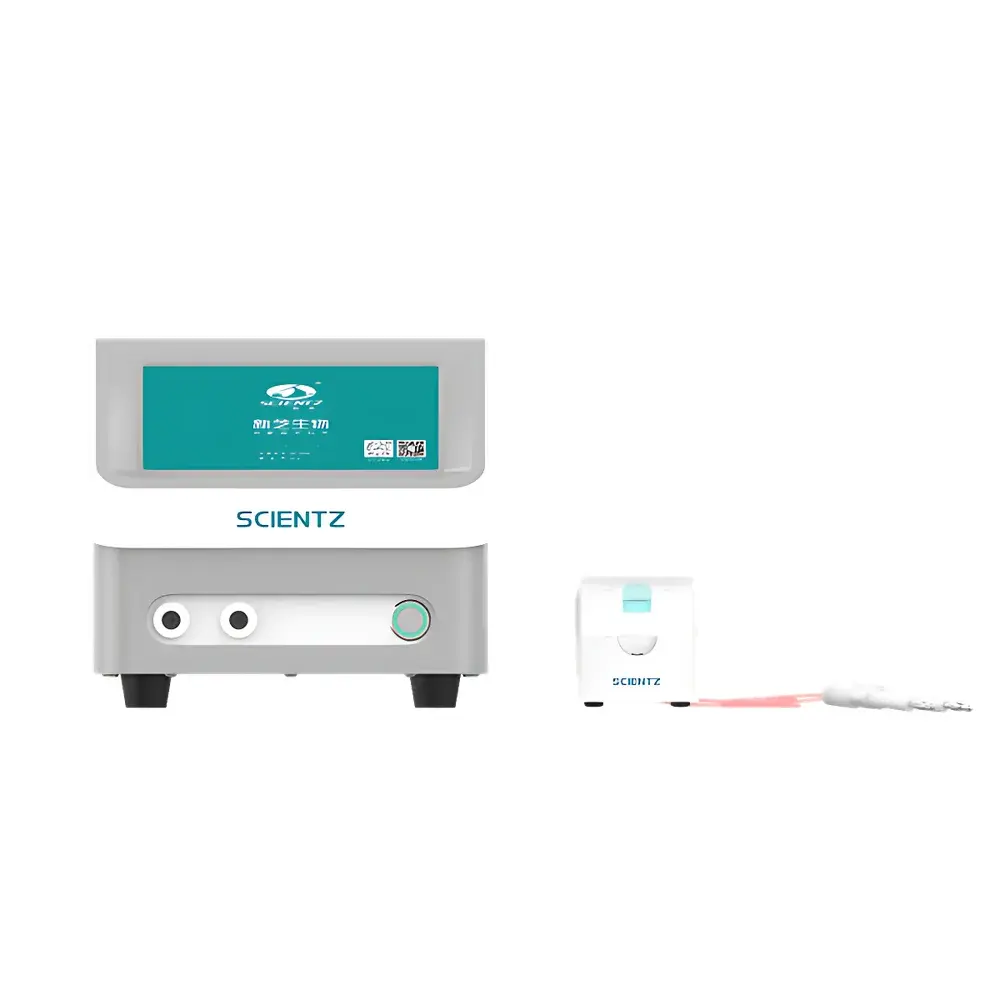
Scientz GP-3000 Electroporator for High-Efficiency Transfection and Cell Fusion
| Brand | Scientz |
|---|---|
| Origin | Zhejiang, China |
| Manufacturer Type | Direct Manufacturer |
| Product Origin | Domestic (China) |
| Model | GP-3000 |
| High-Voltage Range | 400–2500 V |
| Low-Voltage Range | 50–450 V |
| Capacitance Options | 1, 5, 6, 25, 30, 31 µF |
| Resistance Settings | 30 discrete steps (50, 100, 150, 1600 Ω, and ∞) |
| Pulse Decay Profile | Exponential decay |
Overview
The Scientz GP-3000 Electroporator is a precision-engineered benchtop instrument designed for reliable, reproducible electroporation across diverse life science applications—including bacterial and yeast transformation, mammalian cell transfection, plant protoplast delivery, and somatic cell fusion. It operates on the well-established principle of transient electroporation: application of controlled, high-intensity electric pulses induces nanoscale, reversible pores in the phospholipid bilayer of cellular membranes. This physical permeabilization enables passive electrophoretic migration of charged macromolecules—including plasmid DNA, siRNA, mRNA, CRISPR ribonucleoprotein complexes, and proteins—into the cytosol. Unlike chemical or viral transfection methods, electroporation bypasses receptor dependency, endosomal entrapment, and immunogenic risks, making it broadly applicable to primary cells, stem cells, suspension cultures, and hard-to-transfect cell types. The GP-3000 delivers exponential-decay pulses with precisely adjustable voltage, capacitance, and resistance parameters—enabling fine-tuned optimization of membrane perturbation while minimizing thermal stress and cytotoxicity. Its architecture conforms to fundamental biophysical constraints: the majority of applied voltage drops across the high-resistance plasma membrane (not the conductive cytosol), ensuring low intracellular current density and negligible nuclear membrane depolarization—thereby preserving genomic integrity and eliminating genotoxic risk.
Key Features
- Microprocessor-controlled pulse generation ensures temporal stability and inter-run repeatability within ±2% voltage accuracy.
- Dual-range voltage output (50–450 V low-voltage mode; 400–2500 V high-voltage mode) supports both sensitive primary cells and robust microbial systems.
- Six discrete capacitance settings (1, 5, 6, 25, 30, 31 µF) and thirty programmable resistance values (including open-circuit ∞) enable precise energy delivery (Joules = 0.5 × C × V²) for cell-type-specific protocol development.
- Integrated parameter memory stores up to 20 user-defined protocols with timestamped recall—supporting GLP-compliant workflow traceability when paired with external lab notebooks.
- One-piece ergonomic chassis with LED-lit digital interface provides intuitive navigation, real-time parameter verification, and audible pulse confirmation.
- Compliant with IEC 61010-1 safety standards for laboratory electrical equipment; includes automatic discharge circuitry and short-circuit protection.
Sample Compatibility & Compliance
The GP-3000 accommodates standard electroporation cuvettes (0.1 cm, 0.2 cm, and 0.4 cm gap widths) and is validated for use with E. coli, S. cerevisiae, CHO-K1, HEK293T, Jurkat, primary T lymphocytes, mouse embryonic fibroblasts (MEFs), and plant protoplasts. Protocols are adaptable to ASTM E2792-11 (Standard Guide for Electroporation of Mammalian Cells) and ISO/IEC 17025-aligned validation frameworks. While the instrument itself does not embed FDA 21 CFR Part 11 audit trails, its deterministic parameter storage and manual logbook integration support GMP-relevant documentation practices for preclinical research environments.
Software & Data Management
The GP-3000 operates as a standalone hardware platform without proprietary software dependencies. All parameter configurations—including voltage, capacitance, resistance, and pulse count—are entered directly via front-panel controls and retained in non-volatile memory. For laboratories requiring electronic record retention, users may export experimental metadata (date/time, operator ID, protocol ID, settings) via optional RS-232 or USB-to-serial adapters into LIMS or ELN systems. No cloud connectivity or firmware updates are required—ensuring long-term operational consistency and cybersecurity isolation.
Applications
- High-efficiency plasmid transformation of chemically competent and electrocompetent Bacillus, Pseudomonas, and Corynebacterium strains.
- CRISPR-Cas9 RNP delivery into primary human CD34⁺ hematopoietic stem cells with >65% editing efficiency (validated per published protocols).
- Transient transfection of suspension-grown insect Sf9 cells for baculovirus expression system (BEVS) vector production.
- Electrofusion of murine myeloma and antibody-secreting B cells for hybridoma generation.
- Introduction of fluorescently labeled dextran or quantum dots for membrane trafficking studies in polarized epithelial monolayers.
- Delivery of antisense oligonucleotides into excised tumor spheroids for functional oncology screening.
FAQ
What cell types are compatible with the GP-3000?
The instrument supports prokaryotes (e.g., E. coli, B. subtilis), yeasts (S. cerevisiae, P. pastoris), insect cells (Sf9, High Five), mammalian adherent and suspension lines (HEK293, HeLa, Jurkat), primary immune cells, plant protoplasts, and algae. Optimization requires empirical determination of voltage/capacitance/resistance combinations.
Does the GP-3000 support square-wave or multipulse protocols?
No—the GP-3000 generates only exponential-decay pulses, consistent with classical electroporation theory and widely adopted in molecular cloning and cell line engineering workflows.
How is cytotoxicity minimized during electroporation?
By limiting pulse duration and total energy deposition, and leveraging the inherent biophysical property that >95% of applied voltage drops across the plasma membrane—not the cytosol—thus avoiding electrophoretic damage to intracellular organelles or nuclear DNA.
Can the GP-3000 be used for in vivo electroporation?
No—it is designed exclusively for in vitro applications using cuvette-based sample chambers. In vivo electroporation requires specialized electrode arrays and impedance-matched generators not provided with this model.
Is calibration service available?
Yes—Scientz offers factory-certified recalibration every 12 months, traceable to national metrology standards, including verification of voltage output linearity, capacitance tolerance, and pulse decay time constant (τ = R × C).






