
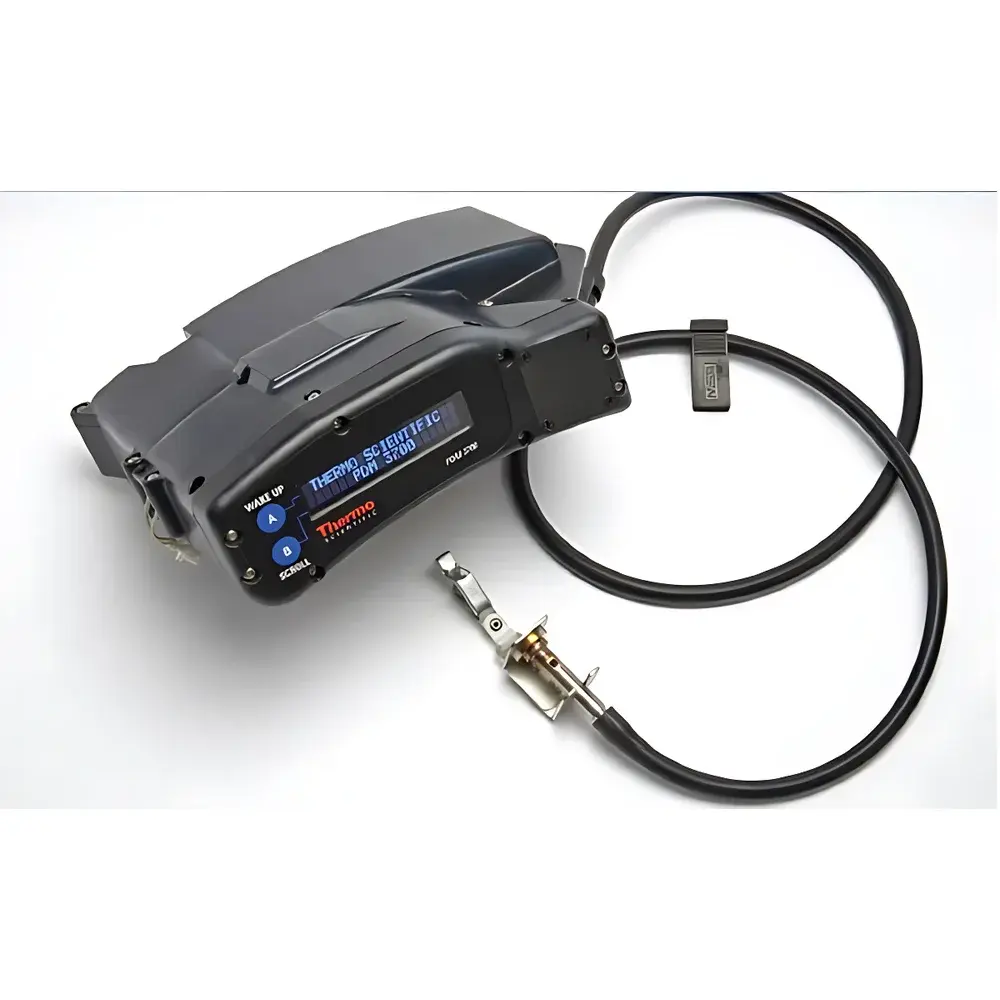
Thermo Scientific PDM3700 Personal Dust Monitor
| Brand | Thermo Fisher |
|---|---|
| Origin | USA |
| Manufacturer | Thermo Fisher Scientific |
| Product Type | Imported Instrument |
| Model | PDM 3700 |
| Measurement Principle | Tapered Element Oscillating Microbalance (TEOM™) |
| Safety Rating | Intrinsically Safe (MSHA/NIOSH Certified) |
| Measurement Range | 0–200 mg/m³ |
| Resolution | ±25% of reference method (for concentrations >0.2 mg/m³) |
| Accuracy | ±2% (2σ, laboratory), ±5% (2σ, underground coal mine) |
| Relative Error | ±25% of reference method (for concentrations >0.2 mg/m³) |
| Sampling Flow Rate | 2.2 L/min (±2% at lab, ±5% in mine) |
| Mass Sensitivity | 0.05 mg/m³ (1σ, 30-sec average) |
| Operating Temperature | −20 °C to +40 °C |
| Sensor Temperature Range | 0 °C to +60 °C |
| Relative Humidity | 0–100% RH (non-condensing) |
| Minimum Detectable Load | 0.1 mg |
| Maximum Load Capacity | 4 mg |
| Power Supply | Rechargeable Li-ion battery pack |
| Compliance | NIOSH TC-74CPDM-02, MSHA 18-A140015-0, PA BFE 2-15, 30 CFR Part 74, EN 61326-1:2005, FCC Part 15 Subpart B, UN 3480 (Li-ion transport) |
Overview
The Thermo Scientific™ PDM3700 Personal Dust Monitor is an intrinsically safe, real-time respirable dust monitoring instrument engineered specifically for occupational health surveillance in underground coal mining environments. It employs the Tapered Element Oscillating Microbalance (TEOM™) measurement principle—a gravimetric technique that continuously quantifies airborne particulate mass concentration by detecting resonant frequency shifts of a vibrating tapered element as dust accumulates on its surface. Unlike optical or beta-attenuation methods, TEOM provides direct, real-time mass-based measurements traceable to NIST standards and compliant with U.S. regulatory requirements under 30 CFR Part 74. The PDM3700 is designed for personal sampling—worn within the worker’s breathing zone—to deliver time-resolved exposure data critical for assessing compliance with permissible exposure limits (PELs) and implementing effective engineering controls.
Key Features
- Intrinsically safe design certified to MSHA 18-A140015-0 and NIOSH TC-74CPDM-02 for use in explosive atmospheres (Class I, Division 1, Groups A–D).
- Ergonomic, lightweight wearable form factor with anti-static, IP65-rated housing optimized for extended underground deployment.
- Real-time tri-parameter output: instantaneous respirable dust concentration (mg/m³), cumulative exposure (mg·min/m³), and % of PEL reached—calculated per MSHA-defined exposure algorithms.
- Integrated TEOM sensor with active temperature and flow control ensures stability across wide ambient conditions (−20 °C to +40 °C; 0–100% RH non-condensing).
- Automated gravimetric analysis eliminates manual filter handling, reducing analytical turnaround time and eliminating weighing-related variability.
- Dual auxiliary measurement capability allows concurrent secondary sampling (e.g., silica fraction, size-selective cutpoint verification) without interrupting primary data acquisition.
- Onboard memory stores >30 days of second-by-second data; synchronized timestamps support retrospective exposure reconstruction and shift-level reporting.
Sample Compatibility & Compliance
The PDM3700 utilizes a standardized cyclone inlet (4.0 µm D50 cutpoint per ISO 7708 and MSHA criteria) to isolate respirable fractions from ambient air. Its sampling train meets all physical and aerodynamic specifications outlined in 30 CFR §70.301 and §74.101. The instrument satisfies full conformance with U.S. federal regulatory frameworks governing coal mine dust monitoring—including mandatory calibration, field verification, and recordkeeping requirements under 30 CFR Part 74. Additional certifications include EN 61326-1:2005 (EMC), FCC Part 15 Subpart B (radio emissions), and UN 3480 for safe lithium-ion battery transportation. Pennsylvania Bureau of Forestry and Environmental Services (BFE) approval BFE 2-15 further validates its suitability for state-regulated mining operations.
Software & Data Management
Data retrieval and configuration are performed via the Thermo Scientific PDM Configuration & Reporting Software, compatible with Windows-based systems. The software supports secure download of raw time-series datasets, automatic generation of MSHA-compliant exposure reports (including daily, shift, and task-based summaries), and visualization of exposure trends against historical baselines. Audit trails capture all user-initiated actions—including calibration events, parameter changes, and data exports—in accordance with GLP-aligned documentation practices. Export formats include CSV and PDF, enabling integration into enterprise EHS management platforms. Firmware updates are digitally signed and validated to ensure integrity and traceability in regulated environments.
Applications
- Continuous personal exposure assessment for coal miners subject to MSHA-mandated respirable dust monitoring programs.
- Engineering control evaluation—quantifying reductions in respirable dust levels following ventilation upgrades, water spray optimization, or cutting parameter adjustments.
- Task-based exposure profiling to identify high-risk work activities (e.g., roof bolting, continuous miner operation, conveyor loading).
- Compliance verification during federal and state inspections under 30 CFR Part 70 and Part 74.
- Occupational epidemiology studies requiring high-temporal-resolution exposure metrics correlated with health outcomes.
- Supplemental monitoring in metal/nonmetal mines where respirable crystalline silica (RCS) exposure assessment is required under OSHA 1910.1053.
FAQ
What regulatory standards does the PDM3700 meet for underground coal mining?
The PDM3700 is fully compliant with 30 CFR Part 74, certified by NIOSH (TC-74CPDM-02) and MSHA (18-A140015-0), and approved by the State of Pennsylvania (BFE 2-15). It satisfies all performance, calibration, and reporting requirements for mandatory personal dust monitoring in U.S. coal mines.
How does the TEOM technology differ from traditional filter-based gravimetric methods?
Unlike offline filter weighing—which requires post-sampling lab analysis and introduces delays and handling errors—the PDM3700 performs continuous, in-situ mass measurement using oscillating microbalance physics. This enables real-time feedback, eliminates inter-laboratory variability, and supports immediate intervention when exposure thresholds are approached.
Can the PDM3700 be used outside of coal mining applications?
While optimized for MSHA-defined respirable dust protocols, the instrument may be deployed in other industrial settings requiring real-time, intrinsically safe gravimetric monitoring—such as tunneling, foundry operations, or demolition—provided appropriate cyclone selection and calibration validation are performed per ISO 7708 and local regulatory guidance.
What is the battery life under typical underground operating conditions?
A fully charged lithium-ion battery supports ≥10 hours of continuous sampling at 2.2 L/min, sufficient for a full mining shift. Battery status is monitored in real time and logged with all exposure data.
Is the PDM3700 compatible with existing mine-wide EHS data infrastructure?
Yes—CSV export functionality and structured metadata tagging allow seamless ingestion into third-party environmental health and safety (EHS) information systems. Optional API access (via Thermo’s Enterprise Integration Framework) supports automated data ingestion and dashboarding in validated GxP or ISO 45001 environments.
Related Products







