
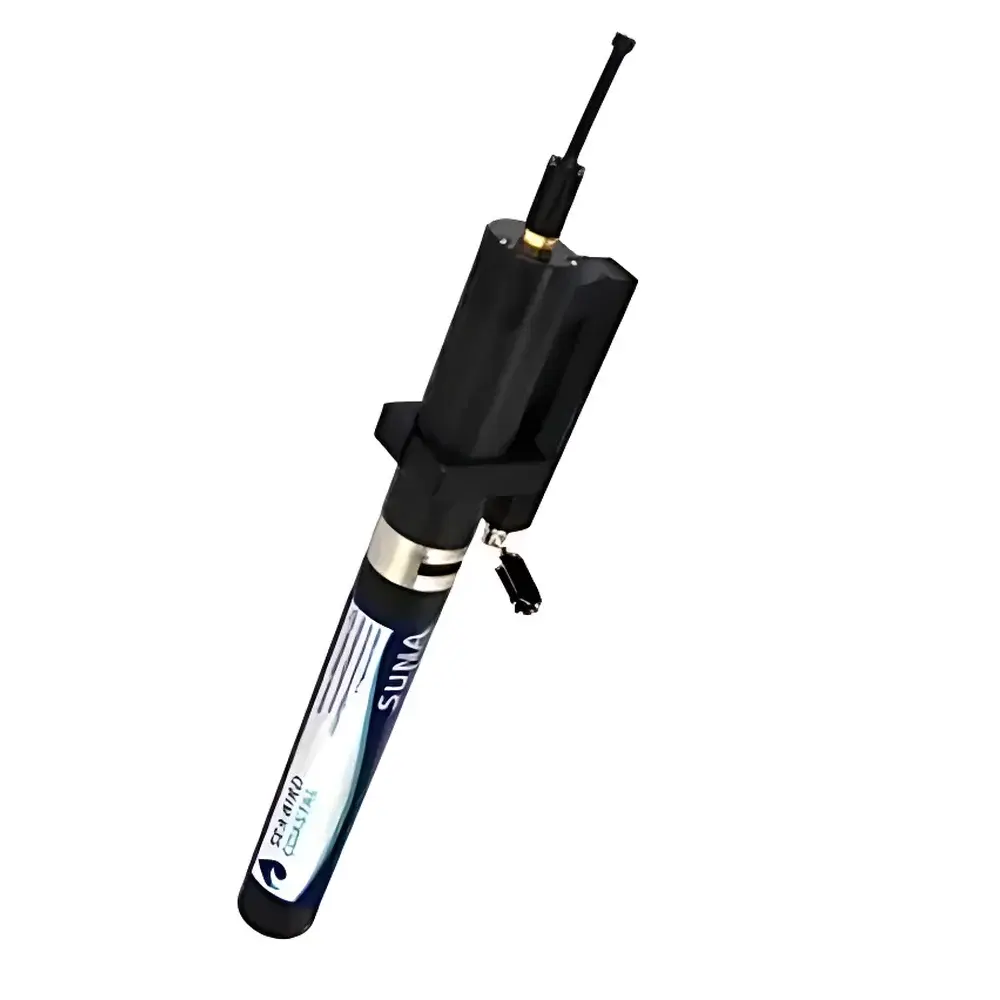
Sea-Bird Scientific SUNA V2 Submersible UV Nitrate Analyzer
| Brand | Sea-Bird Scientific |
|---|---|
| Manufacturer | Satlantic (Canada) |
| Model | SUNA V2 |
| Detection Principle | In-Situ Ultraviolet Spectroscopy (ISUS) |
| Measurement Target | Nitrate-N (NO₃⁻) |
| Form Factor | Submersible, Online-Ready |
| Path Length Options | 5 mm or 10 mm |
| Detection Range | 0.5–4000 µM (0.007–56 mg/L as N) |
| Accuracy | ±2 µM (10 mm) / ±4 µM (5 mm) or ±10% |
| Short-Term Precision (3σ) | 0.3 µM (freshwater/seawater T-S corrected) |
| Long-Term Drift | ≤0.3 µM/h (T-S corrected) |
| Turbidity Tolerance | 625 NTU (10 mm), 1250 NTU (5 mm) |
| Wavelength Range | 190–370 nm |
| Lamp Lifetime | 900 h |
| Operating Voltage | 8–18 VDC (8–15 VDC with biowiper) |
| Power Consumption | 7.5 W (0.625 A @ 12 V) |
| Housing Material | Titanium / Acetal |
| Maximum Depth Rating | 500 m (100 m with biowiper) |
| Weight | 2.5 kg (3.1 kg with biowiper) |
Overview
The Sea-Bird Scientific SUNA V₂ Submersible UV Nitrate Analyzer is an in-situ, reagent-free optical sensor engineered for high-fidelity, continuous nitrate-nitrogen (NO₃⁻-N) quantification in natural aquatic systems. It implements the In-Situ Ultraviolet Spectroscopy (ISUS) methodology originally developed by the Monterey Bay Aquarium Research Institute (MBARI) and industrialized under strict quality control by Satlantic (Halifax, Canada). Unlike colorimetric or electrochemical methods, the SUNA V₂ measures nitrate concentration directly via absorption spectroscopy in the deep ultraviolet range (190–370 nm), eliminating chemical consumption, waste generation, and calibration drift associated with wet-chemistry analyzers. Its dual-path-length design (5 mm or 10 mm) enables adaptive deployment across diverse hydrodynamic and optically challenging environments—from turbid estuaries and CDOM-rich coastal waters to oligotrophic open-ocean moorings and low-conductivity freshwater streams.
Key Features
- Reagent-Free UV Absorption Technology: Based on first-principles Beer-Lambert modeling of nitrate’s characteristic UV absorption bands, enabling trace-level detection without consumables or hazardous reagents.
- Adaptive Optical Sampling: Intelligent firmware dynamically adjusts integration time and lamp duty cycle to maintain signal-to-noise ratio under variable CDOM loading and suspended solids concentrations.
- Integrated Biofouling Mitigation: Fully sealed, motor-driven biowiper system actively cleans the optical windows prior to each measurement cycle—validated for >6-month unattended operation in biofouling-prone estuarine and aquaculture settings.
- Configurable Path Length: Field-selectable 5 mm path length option enhances response time and reduces scattering artifacts in high-turbidity (>600 NTU) or high-velocity flow regimes.
- Thermosalinographic Compensation: Onboard temperature and conductivity (T-S) sensors enable real-time refractive index correction, critical for accuracy across salinity gradients (0–40 psu) and thermal stratification.
- Rugged Submersible Architecture: Titanium-acetal housing rated to 500 m depth; compliant with ISO 9001 manufacturing protocols and tested per IEC 60529 IP68 specifications.
Sample Compatibility & Compliance
The SUNA V₂ is validated for direct immersion in freshwater, brackish, and full-strength seawater matrices without dilution or pretreatment. Its optical design accommodates turbidity up to 1250 NTU (5 mm path) while maintaining <±10% deviation from reference chemiluminescence or ion chromatography results. The analyzer meets ASTM D3867–22 (Standard Test Method for Nitrate in Water by UV Spectrophotometry) and supports GLP/GMP data integrity requirements through audit-trail-enabled firmware logging. All internal timestamps are synchronized to UTC via optional NMEA 0183 or PPS input, ensuring traceability for regulatory reporting under EPA Method 353.2 and EU WFD monitoring frameworks.
Software & Data Management
SUNACom — the official configuration and data retrieval utility — provides cross-platform support for Windows and macOS. It enables zero-configuration USB or RS-232 setup, real-time spectral visualization, in-field T-S calibration validation, and batch export of raw absorbance spectra (ASCII CSV) alongside processed nitrate concentration time series. Firmware v3.2+ supports embedded SD card storage (up to 32 GB) with configurable sampling intervals (1–3600 s), automatic file rotation, and CRC-32 checksum integrity verification. For networked deployments, SUNA V₂ integrates seamlessly with Sea-Bird’s SBE Data Processing Suite and third-party SCADA platforms via Modbus RTU/ASCII or ASCII serial protocols—fully compatible with IO-Link and MQTT edge gateways for cloud telemetry.
Applications
- Long-term nutrient flux monitoring at riverine discharge points and wastewater outfalls
- High-resolution profiling of nitrate dynamics in stratified reservoirs and drinking water source lakes
- Real-time eutrophication early-warning systems in shellfish aquaculture leases and marine protected areas
- Autonomous platform integration (gliders, AUVs, moored profilers) for synoptic coastal mapping
- Validation and ground-truthing of satellite-derived ocean color products (e.g., Sentinel-3 OLCI, Landsat 9 OLI-2)
- Process control feedback in denitrification bioreactors and constructed wetlands
FAQ
Does the SUNA V₂ require routine laboratory calibration?
No. The instrument employs factory-characterized spectral baselines and onboard dark-current compensation. Field verification using certified nitrate standards (e.g., NIST SRM 3183) is recommended every 3–6 months depending on deployment severity.
Can it operate continuously on battery power?
Yes. With average duty cycling (1-min sampling interval), a 24 Ah LiFePO₄ battery sustains >30 days of operation. Power management firmware includes low-voltage shutdown and wake-on-serial-event capability.
Is spectral data export supported for custom algorithm development?
Yes. Full-resolution absorbance spectra (1 nm steps, 190–370 nm) are logged alongside metadata (T, S, timestamp, lamp intensity) and accessible via SUNACom or direct SD card readout.
How is biofouling performance validated?
Satlantic publishes independent 12-month fouling trials conducted at WHOI’s Martha’s Vineyard Coastal Observatory (MVCO), demonstrating <0.5 µM median drift in ambient nitrate (15–35 µM) under seasonal diatom/barnacle pressure.
What certifications apply to its electrical safety and EMC compliance?
The SUNA V₂ conforms to IEC 61000-6-2 (immunity) and IEC 61000-6-4 (emissions), and carries CE marking under the EU Electromagnetic Compatibility Directive 2014/30/EU and Low Voltage Directive 2014/35/EU.
Related Products







