
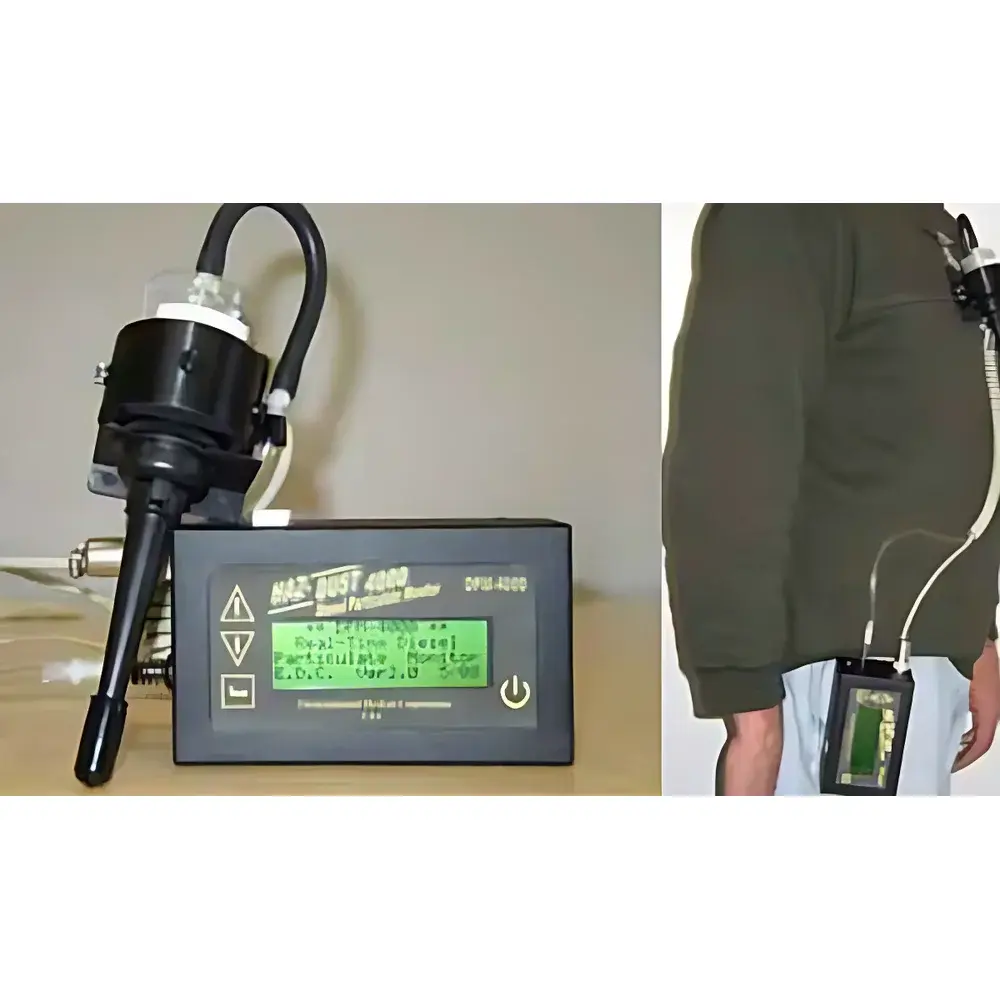
EDC DPM-4000 Diesel Particulate Monitor
| Brand | EDC |
|---|---|
| Origin | USA |
| Model | DPM-4000 |
| Instrument Type | Aerosol Detector |
| Measurement Range | 1–20,000 µg/m³ |
| Resolution | ±2 µg/m³ |
| Accuracy | ±10% |
| Particle Size Range | <1–10 µm |
| Sampling Flow Rate | 1.0–3.3 L/min (recommended 1.7 L/min) |
| Display | 4-line × 20-character LCD (units: µg/m³, mg/m³, TWA, STEL, min/max) |
| Data Storage | 21,500 points (>5 years retention) |
| Logging Interval | 1 sec to 21 weeks |
| Alarm | 90 dB at 3 ft |
| Operating Temp | 0–50 °C |
| Storage Temp | −20–70 °C |
| Humidity | ≤95% RH non-condensing |
| Power | Rechargeable battery (>8 h runtime |
| Dimensions | 140 × 83 × 70 mm |
| Weight | 1.0 kg |
| Compliance | NIOSH 5040 compatible, NIST-traceable calibration support, OSHA-compliant exposure assessment |
Overview
The EDC DPM-4000 Diesel Particulate Monitor is a portable, real-time aerosol mass concentration meter engineered for occupational and environmental monitoring of diesel particulate matter (DPM) and other respirable airborne particulates. It operates on the principle of light scattering (nephelometry), calibrated against gravimetric reference methods per NIOSH 5040, enabling direct quantification of mass concentration in real time (µg/m³ or mg/m³). Unlike optical particle counters that report number-based distributions, the DPM-4000 delivers mass-weighted concentration data—critical for regulatory compliance with OSHA, MSHA, and ACGIH exposure limits for respirable dusts including elemental carbon, welding fume, silica, lead, and pharmaceutical powders. Its compact form factor (140 × 83 × 70 mm, 1.0 kg), integrated rechargeable battery, and ruggedized housing make it suitable for personal sampling, area surveys, and mobile source emission characterization—including diesel-powered transport hubs, construction sites, mining operations, and industrial maintenance zones.
Key Features
- Real-time nephelometric measurement of respirable particulate mass concentration (1–20,000 µg/m³) with ±10% accuracy and ±2 µg/m³ resolution
- Configurable logging intervals from 1 second to weekly averages, supporting TWA, STEL, and ceiling value calculations per OSHA 29 CFR 1910.1000
- Onboard 4-line alphanumeric LCD display showing instantaneous concentration, time-stamped min/max values, exposure metrics (TWA/STEL), and system status
- Dual-mode sampling architecture: real-time optical readout + physical collection via interchangeable 37 mm filter cassettes (e.g., quartz fiber for NIOSH 5040 carbon analysis)
- GS-1 cyclone inlet included for size-selective sampling (cut-point ~4 µm aerodynamic diameter), compliant with ISO 7708 and EN 481 conventions for respirable fraction
- RS-232 serial interface for data export and firmware updates; Windows-compatible desktop software for statistical reporting, trend visualization, and audit-ready PDF export
- RFI/EMI-hardened electronics certified to IEC 61326-1 for reliable operation in electrically noisy industrial environments
Sample Compatibility & Compliance
The DPM-4000 supports multi-modal sample acquisition. Real-time optical data are validated against gravimetric standards traceable to NIST SRM 1648a (Urban Dust) and calibrated per NIOSH Manual of Analytical Methods (NMAM) Chapter 2. The included GS-1 cyclone and 37 mm quartz filter cassette enable concurrent physical collection for post-sampling analysis—including thermal-optical carbon fractionation (NIOSH 5040), XRF for metals (e.g., Pb, Cr, Ni), or SEM-EDS for morphology. All hardware and firmware comply with GLP-aligned data integrity requirements: time-stamped records include operator ID, location tag, calibration history, and instrument serial number. The device meets essential requirements of EU Directive 2014/30/EU (EMC) and is routinely deployed in FDA-regulated pharmaceutical manufacturing facilities where particulate exposure assessments support 21 CFR Part 11-compliant exposure control plans.
Software & Data Management
The bundled Windows application provides full lifecycle data management: raw time-series import, automatic calculation of 8-hour TWA and 15-minute STEL per OSHA PELs, exposure ratio mapping, and customizable report generation (CSV, Excel, PDF). Audit trails record all user actions—including parameter changes, calibration events, and data exports—with immutable timestamps. Data files include embedded metadata (GPS coordinates if paired with external module, temperature/humidity logs, flow rate verification flags), ensuring traceability for regulatory submissions. Firmware supports secure over-the-air updates via encrypted RS-232 handshake, preserving configuration integrity across deployments.
Applications
- Occupational hygiene assessments in diesel-powered transport sectors: bus depots, rail yards, port terminals, and long-haul freight facilities
- Respirable crystalline silica (RCS) monitoring during concrete cutting, abrasive blasting, and masonry work per OSHA 29 CFR 1926.1153
- Pharmaceutical cleanroom operator exposure screening for potent compound handling
- Welding fume characterization in fabrication shops and shipyards
- Environmental baseline studies near heavy-duty vehicle corridors and underground mining ventilation exhausts
- Research on cardiopulmonary health endpoints linked to ultrafine diesel soot (<100 nm) using size-fractionated correlation with real-time mass readings
FAQ
Does the DPM-4000 meet OSHA’s requirements for diesel particulate monitoring?
Yes—it delivers mass concentration data aligned with OSHA’s definition of DPM as “elemental carbon” and supports exposure assessments per 29 CFR 1910.1000 and 1926.1153 through NIOSH 5040-compatible filter collection and real-time nephelometric trending.
Can the instrument be used for PM2.5 or PM10 regulatory reporting?
While not EPA-designated for ambient PM2.5/PM10 compliance, its GS-1 cyclone inlet provides respirable fraction sampling consistent with ISO/CEN size-selective criteria; supplemental PM10/PM2.5 inlets are available as optional accessories.
Is calibration traceable to national standards?
Field calibration uses NIST-traceable dust standards (e.g., Arizona Road Dust, SRM 1648a); factory calibration certificates include uncertainty budgets per ISO/IEC 17025 guidelines.
How is data integrity maintained during extended unattended logging?
All stored records include CRC-32 checksums, write-protected timestamps, and internal diagnostics logs—enabling forensic reconstruction of instrument state at any recorded epoch.
What maintenance is required between calibrations?
Optical path cleaning every 30 days (isopropyl alcohol wipe), flow rate verification before each sampling campaign, and annual factory recalibration recommended for GLP/GMP environments.







