
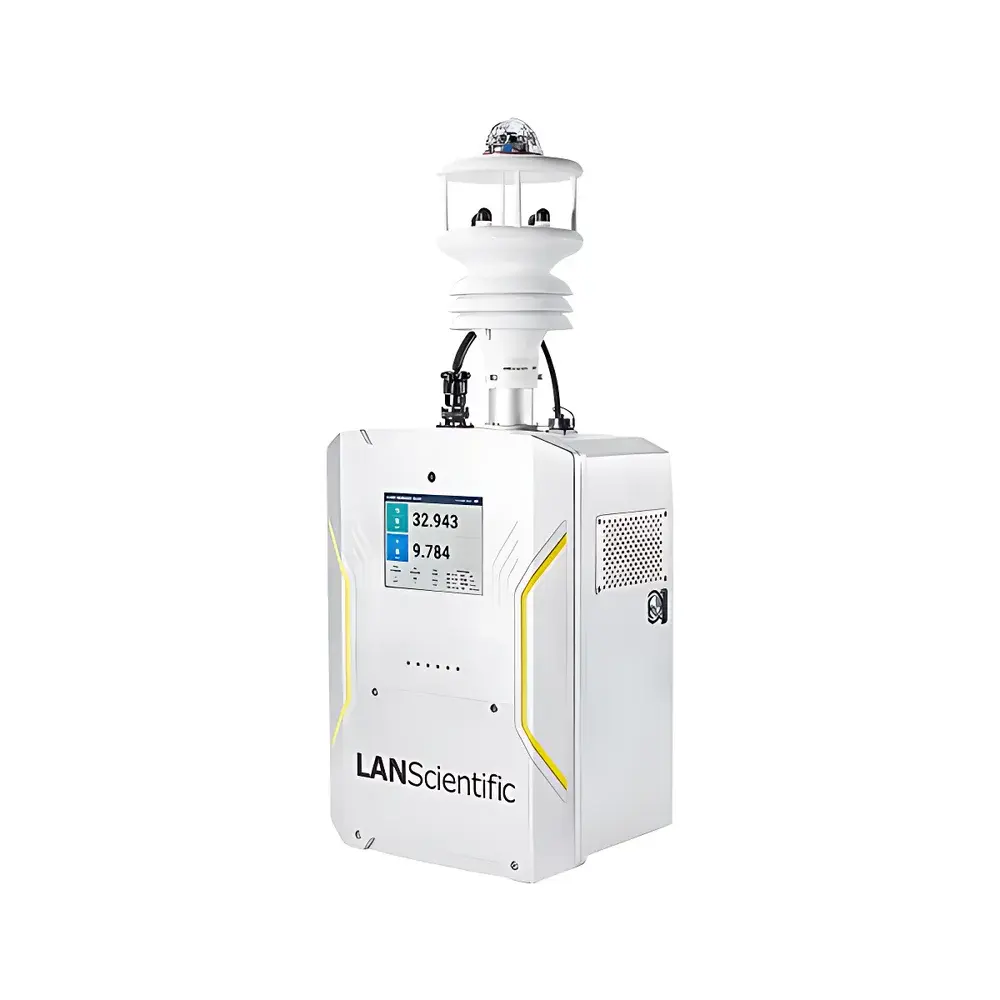
LANScientific GaOA Miniature Atmospheric Heavy Metal Online Analyzer
| Brand | LANScientific |
|---|---|
| Origin | Jiangsu, China |
| Manufacturer Type | Manufacturer |
| Product Category | Atmospheric Heavy Metal Analyzer |
| Model | GaOA |
| Measurement Principle | X-ray Fluorescence (XRF) Spectrometry |
| Measurement Range | 0–100 µg/m³ |
| Detection Limit | 1 ng/m³ (1-hour sampling at 16.7 L/min) |
| Filter Tape Replacement Interval | One roll lasts ~30 days under hourly sampling |
| Operating Temperature | −40 °C to +50 °C |
| Operating Relative Humidity | 0–90% RH (non-condensing) |
| Ambient Pressure Range | 80–106 kPa |
Overview
The LANScientific GaOA Miniature Atmospheric Heavy Metal Online Analyzer is an engineered solution for real-time, unattended quantification of trace heavy metals in ambient airborne particulate matter (PM2.5/PM10). Based on energy-dispersive X-ray fluorescence (ED-XRF) spectrometry, the instrument combines automated particle collection via continuous filter tape advancement with on-line spectral acquisition and quantitative analysis. Unlike laboratory-based XRF or ICP-MS methods requiring offline sample preparation, the GaOA performs direct, non-destructive elemental analysis—enabling high-temporal-resolution monitoring (hourly or sub-hourly data points) without chemical reagents or consumables beyond the filter tape. Its compact footprint (≤35 L volume), low power consumption (<120 W), and robust environmental tolerance make it suitable for deployment in remote locations, mobile platforms, and dense urban sensor networks where space, infrastructure, and operational continuity are constrained.
Key Features
- Miniaturized ED-XRF architecture optimized for field-deployable atmospheric metal monitoring
- Dual-axis automatic spectral calibration: simultaneous energy (keV) and intensity (count rate) correction using integrated reference sources and internal calibration standards
- On-board internal standardization: built-in radioactive 241Am source enables real-time matrix-effect compensation and long-term drift correction
- Continuous filter tape system with programmable sampling intervals (1–24 hours); one tape roll supports ≥720 cycles (30 days at hourly operation)
- Radiation safety certified: fully shielded X-ray path with interlocked beam shutter and dose-rate compliance ≤0.1 µSv/h at 5 cm (per GBZ 126–2011 and IEC 61000-4-3)
- Environmental resilience: operational across −40 °C to +50 °C and 0–90% RH, validated per IEC 60068-2 environmental stress testing protocols
- Secure wireless telemetry: TLS 1.2-encrypted data transmission compliant with HJ/T 212–2005 for environmental monitoring systems
Sample Compatibility & Compliance
The GaOA analyzes airborne particulate mass collected on standard 25-mm diameter quartz or PTFE filter tapes. It quantifies up to 26 elements—including Pb, Cd, Cr, As, Sb, Hg, Ni, Zn, Cu, Mn, Fe, and V—with demonstrated linearity (R² > 0.999) across the 0.01–100 µg/m³ range. Calibration is traceable to NIST SRM 2783 (Air Particulate on Filter Media) and ISO 8518:2021 (XRF analysis of airborne particulates). The system meets requirements for regulatory-grade ambient air monitoring under China’s HJ 657–2013 and EU’s EN 14902:2005. Data integrity adheres to GLP principles, with full audit trail logging (user actions, calibration events, spectral metadata) stored locally and synchronized to cloud archives.
Software & Data Management
The GaOA operates with LANScientific’s CloudLink™ Environmental Data Platform—a secure, role-based web interface supporting multi-site fleet management. Raw spectra, calibrated concentrations, QA/QC metrics (e.g., peak-to-background ratio, FWHM stability), and environmental metadata (T, RH, pressure) are timestamped and archived with SHA-256 hashing. The platform supports configurable alerting (email/SMS) for exceedances, auto-generation of daily/weekly compliance reports (PDF/CSV), and API access for integration with municipal air quality dashboards or third-party GIS tools. All firmware updates and method configurations are delivered over-the-air with digital signature verification.
Applications
- Urban ambient air quality networks: high-density deployment for spatial mapping of industrial or traffic-related metal hotspots
- Fenceline monitoring at smelters, waste incinerators, battery recycling facilities, and electroplating plants
- Mobile source characterization: roadside and tunnel monitoring of brake/tire wear emissions (Cu, Sb, Ba) and exhaust-derived Pb/Cd
- Emergency response: rapid deployment following industrial accidents or hazardous material releases to track plume evolution
- Research applications: time-series studies of seasonal metal speciation, long-range transport modeling, and source apportionment via positive matrix factorization (PMF)
FAQ
What regulatory standards does the GaOA comply with for data reporting?
It satisfies HJ/T 212–2005 (China’s data transmission protocol), HJ 657–2013 (XRF methodology validation), and supports export-ready formats aligned with EU Air Quality Directive (2008/50/EC) Annex IX reporting templates.
Can the instrument detect mercury vapor in addition to particulate-bound mercury?
No—the GaOA measures only filter-collected particulate-phase metals; gaseous Hg requires complementary cold-vapor AAS or CVAFS instrumentation.
Is remote firmware update supported?
Yes—signed OTA updates are delivered via encrypted MQTT channels with rollback capability and version-controlled changelogs.
How is spectral interference between adjacent elements (e.g., As Kα and Pb Lα) resolved?
Deconvolution uses a constrained non-negative least-squares (NNLS) algorithm trained on empirical reference spectra; user-adjustable peak fitting constraints maintain accuracy in complex matrices.
Does the system support external meteorological sensor integration?
Yes—RS-485 and analog 4–20 mA inputs accept co-located temperature, humidity, wind speed/direction, and PM2.5 sensors for multivariate correlation analysis.







