
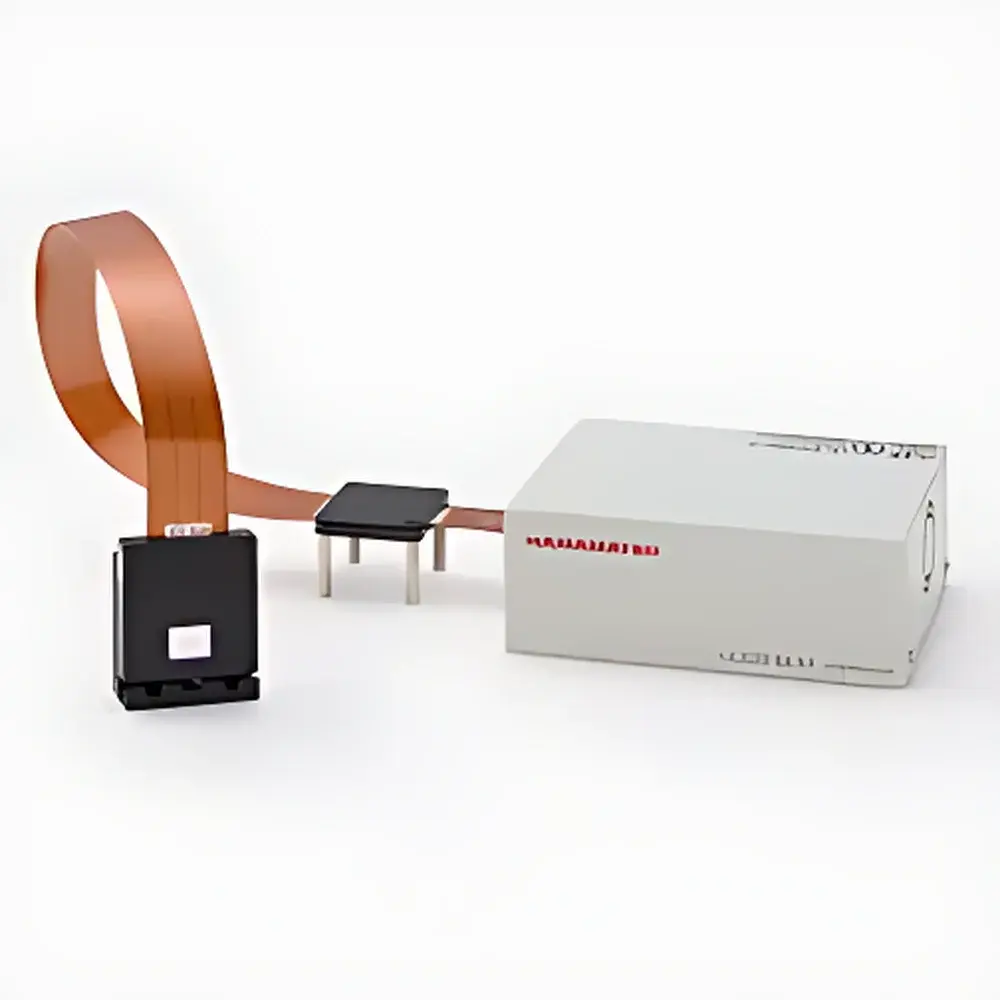
Hamamatsu LCOS-SLM X15213-02R Reflective Pure-Phase Spatial Light Modulator
| Brand | Hamamatsu |
|---|---|
| Origin | Japan |
| Manufacturer Type | Original Equipment Manufacturer (OEM) |
| Import Status | Imported |
| Model | X15213-02R |
| Pricing | Upon Request |
| Pixel Pitch | 12.5 µm |
| Active Area | 15.9 × 12.8 mm |
| Resolution | 1272 × 1024 pixels (SXGA) |
| Fill Factor | 96% |
| Input Interface | DVI-D + USB-B (USB 2.0 High-Speed) |
| DVI Frame Rate | 60 Hz |
| Gray Levels | 256 (8-bit) |
| Rise Time | 30 ms |
| Fall Time | 80 ms |
| Operating Wavelength | 800 ± 50 nm |
| Optical Efficiency | 97% (measured at λ = 785 nm) |
| Maximum Spatial Frequency | 40 lp/mm |
| Modulation Type | Reflective, Pure-Phase |
Overview
The Hamamatsu LCOS-SLM X15213-02R is a high-performance reflective spatial light modulator engineered for precision wavefront control in advanced optical systems. Based on silicon-on-insulator liquid crystal on silicon (LCOS) technology, it operates as a pure-phase modulator—introducing controlled phase delays across the incident beam without significant amplitude modulation. This enables diffraction-limited beam shaping, adaptive optics correction, holographic optical trapping, and ultrafast pulse shaping in research-grade laser laboratories. Designed specifically for high-power near-infrared applications (centered at 800 nm with ±50 nm bandwidth), the device features a robust thermal architecture that maintains stable phase response under continuous-wave or pulsed illumination up to multi-watt average power levels. Its monolithic silicon substrate ensures mechanical stability and long-term calibration retention, critical for quantitative interferometric and closed-loop adaptive optics applications.
Key Features
- Reflective pure-phase modulation architecture optimized for minimal absorption and maximal optical efficiency (97% at 785 nm)
- High fill factor (96%) and fine pixel pitch (12.5 µm) enabling high spatial resolution (up to 40 line pairs/mm) and reduced zero-order diffraction noise
- Dual-interface control: native DVI-D input for real-time phase pattern streaming at 60 Hz frame rate, supplemented by USB-B (USB 2.0 HS) for firmware updates and calibration data exchange
- Linearized phase response achieved via factory-characterized LUTs (Look-Up Tables) and real-time controller-based distortion compensation—including LC-induced wavefront aberrations and voltage-response nonlinearity
- Active area of 15.9 × 12.8 mm supports large-aperture beam manipulation while maintaining sub-microradian phase stability over temperature fluctuations (±0.5 °C)
- Engineered for integration into ISO-classified optical tables and vacuum-compatible enclosures; no outgassing materials used in optical path assembly
Sample Compatibility & Compliance
The X15213-02R is compatible with standard collimated free-space optical trains operating in the 750–850 nm range, including Ti:sapphire oscillators, Yb-fiber amplifiers, and diode-pumped solid-state lasers. It meets RoHS Directive 2011/65/EU and REACH Regulation (EC) No. 1907/2006 for hazardous substance restrictions. While not certified to IEC 61000-6-3 (EMC emissions) or IEC 61000-6-2 (immunity) as a standalone component, the module complies with Hamamatsu’s internal electromagnetic compatibility guidelines when installed with recommended grounding and shielded cabling per application note LSLM-AN-002. For GLP/GMP-regulated environments, traceable calibration reports (NIST-traceable interferometric phase verification) are available upon request and support audit-ready documentation workflows.
Software & Data Management
Hamamatsu provides the proprietary SLM Control Studio software suite (Windows 10/11, 64-bit), which includes preloaded phase hologram generators (e.g., vortex, Bessel, kinoform, and Gerchberg-Saxton algorithms), real-time intensity profiling tools, and batch-mode pattern sequencing. All phase maps are stored in IEEE 754-compliant 32-bit floating-point format (.slm binary or .tiff), ensuring bit-exact reproducibility across platforms. The USB interface supports secure firmware signing (SHA-256 verified) and encrypted calibration profile loading—enabling compliance with FDA 21 CFR Part 11 requirements for electronic records and signatures when deployed in regulated R&D settings. Exported datasets include full metadata: timestamp, ambient temperature, DVI sync status, and controller revision ID.
Applications
- Adaptive optics in multiphoton microscopy and astronomical telescopes
- Dynamic holographic optical tweezers for single-cell manipulation
- Programmable diffractive optical elements (DOEs) for structured illumination and beam splitting
- Ultrafast pulse shaping in coherent control experiments (e.g., quantum interference, CARS spectroscopy)
- Calibration reference for Shack-Hartmann wavefront sensors and interferometers
- Optical neural network training via analog photonic matrix multiplication
FAQ
Is the X15213-02R suitable for femtosecond laser pulse shaping?
Yes—its low group delay dispersion ( 1 J/cm² for 100-fs pulses at 1 kHz) make it compatible with Ti:sapphire and Yb-based ultrafast systems when used with appropriate beam expansion and fluence management.
Can multiple X15213-02R units be synchronized?
Yes—via external TTL trigger input (BNC, 3.3 V CMOS compatible) supporting master-slave configuration with sub-frame jitter < 1 µs; synchronization protocol documented in Application Note LSLM-SYNC-001.
Does Hamamatsu provide custom phase calibration for specific wavelengths?
Yes—wavelength-specific phase response characterization (including wavelength-dependent retardance and residual birefringence) is available as an optional service, delivered with NIST-traceable uncertainty budgets.
What is the recommended optical alignment procedure?
A three-step process is specified: (1) retroreflection alignment using a HeNe laser, (2) DVI-pattern-based centroid registration, and (3) interferometric flatness validation using a Fizeau cavity—detailed in Installation Manual IM-X15213-EN Rev. 3.2.





