
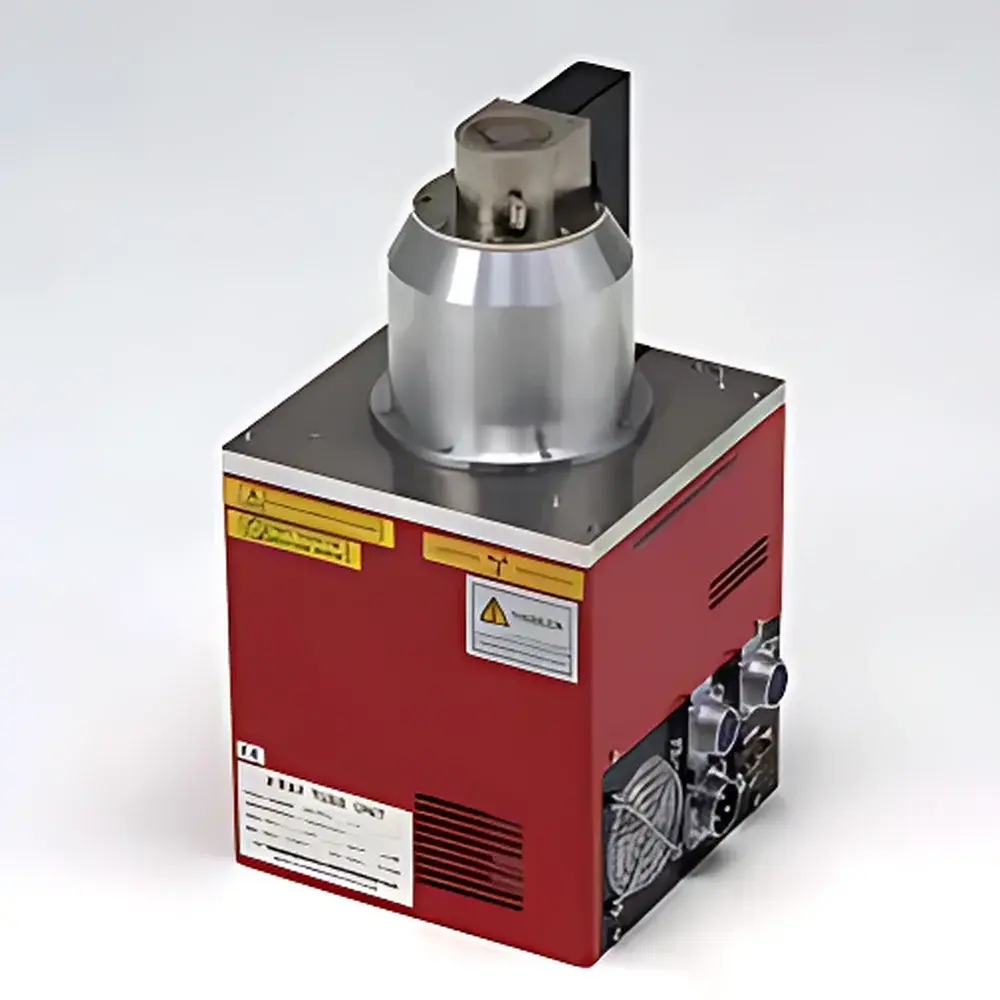
Hamamatsu Microfocus X-ray Source L9181-02
| Brand | Hamamatsu |
|---|---|
| Origin | Japan |
| Manufacturer Type | Original Equipment Manufacturer (OEM) |
| Product Category | Imported |
| Model | L9181-02 |
| Voltage Range | 40–130 kV |
| Maximum Output Power | 39 W |
| Focal Spot Size | 5 µm (at 4 W) |
| Beam Cone Angle | 45° |
| Focus-to-Object Distance (FOD) | 13 mm |
| Control Interface | RS-232C |
| Tube Type | Sealed Transmission Target |
Overview
The Hamamatsu Microfocus X-ray Source L9181-02 is a high-stability, sealed transmission-type X-ray tube engineered for precision micro-CT, high-resolution radiography, and non-destructive testing (NDT) applications in industrial and research laboratories. Operating on the principle of electron-beam bombardment of a metallic transmission target (typically tungsten or molybdenum), it generates a highly collimated, conical X-ray beam with a nominal focal spot size of 5 µm at low-power operation (4 W), enabling sub-micron spatial resolution in projection imaging and tomographic reconstruction. Its compact sealed-tube architecture eliminates the need for external high-voltage cabling—integrating the high-voltage generator directly into the housing—thereby reducing electromagnetic interference, simplifying system integration, and enhancing long-term operational reliability. Designed for continuous-duty operation under controlled thermal management, the L9181-02 delivers stable photon flux across its full voltage range (40–130 kV), supporting material contrast optimization for diverse sample compositions—from low-Z polymers to high-Z metals.
Key Features
- Microfocus performance: 5 µm focal spot size at 4 W, scalable to ≤10 µm at maximum output (39 W), ensuring high geometric magnification and sharp edge definition in radiographic imaging.
- Integrated high-voltage generator: Eliminates external HV cables and associated safety interlocks, reducing system footprint and installation complexity while improving electrical noise immunity.
- RS-232C serial interface: Enables full remote control of tube voltage, current, exposure timing, and status monitoring via standard ASCII command protocol—compatible with LabVIEW, Python-based automation frameworks, and OEM system controllers.
- Optimized beam geometry: 45° cone angle and fixed 13 mm focus-to-object distance (FOD) facilitate straightforward optical path design for benchtop CT gantries and inline inspection stations.
- Sealed transmission-target construction: Ensures vacuum integrity over >10,000 hours of operation; no consumable cathodes or replaceable windows required under normal operating conditions.
- Thermally robust housing: Aluminum alloy body with integrated heat-sink fins and optional forced-air or water-cooling interfaces support sustained duty cycles at rated power.
Sample Compatibility & Compliance
The L9181-02 is routinely deployed in QA/QC workflows compliant with ASTM E1441 (Standard Practice for Computed Tomography), ISO 15737 (Non-destructive testing — Industrial computed tomography), and IPC-A-610 (Acceptability of Electronic Assemblies). Its energy tunability (40–130 kV) allows differential attenuation optimization for heterogeneous samples including multilayer PCBs, solder-joint void analysis, encapsulated semiconductor packages, injection-molded plastic housings, and sintered metal components. The 5 µm focal spot enables detection of sub-20 µm defects (e.g., hairline cracks, porosity, delamination) in samples up to 50 mm in diameter when paired with high-DQE flat-panel detectors. All mechanical interfaces conform to ISO 80000-10 and IEC 61340-5-1 (ESD-safe mounting), and electrical control logic meets IEC 61000-6-2/6-3 immunity/emission standards.
Software & Data Management
The L9181-02 operates as a deterministic hardware node within larger imaging systems—not as a standalone instrument—and therefore does not include embedded firmware UI or proprietary acquisition software. Instead, it is fully controllable via ASCII command set over RS-232C, allowing seamless integration into custom or commercial CT reconstruction pipelines (e.g., VGStudio MAX, Dragonfly, or open-source tools such as TomoPy). Command logging, exposure timestamping, and real-time voltage/current telemetry support GLP-compliant audit trails when interfaced with host systems implementing 21 CFR Part 11–compliant electronic records (e.g., timestamped CSV metadata export, user-authenticated command history, and hardware-level error flagging).
Applications
- High-resolution X-ray computed tomography (micro-CT) of electronic assemblies for void fraction quantification and BGA solder joint integrity assessment.
- In-line NDT of automotive plastic connectors and battery module housings for wall-thickness variation and internal weld seam verification.
- Failure analysis labs performing cross-sectional imaging of MEMS devices without physical sectioning.
- Academic materials science studies involving pore network characterization in additively manufactured metal lattices.
- Pharmaceutical packaging inspection for blister seal integrity and tablet coating uniformity.
FAQ
Is the L9181-02 compatible with pulsed or gated X-ray acquisition modes?
Yes—the RS-232C interface supports TTL-compatible external trigger input (optional accessory), enabling synchronization with detector readout or rotational stage position for phase-resolved CT or laminography.
What cooling methods are supported?
Standard configuration includes passive convection cooling; forced-air cooling (≥20 CFM) is recommended above 20 W; water-cooling plates (custom order) support continuous 39 W operation in thermally constrained enclosures.
Does Hamamatsu provide calibration certificates traceable to NIST or JCSS?
Yes—factory calibration reports (voltage accuracy ±0.5%, current accuracy ±1.0%, focal spot verification per ISO 10649) are available upon request and are traceable to JCSS-accredited primary standards.
Can the tube be operated below 40 kV?
No—40 kV is the minimum rated anode voltage; operation below this threshold is not guaranteed and may result in unstable electron emission or arcing.
Is radiation shielding included?
No—the L9181-02 is supplied as a bare source module; users must integrate it into a shielded enclosure meeting local regulatory requirements (e.g., IEC 61331-1, FDA 21 CFR 1020.40).




