
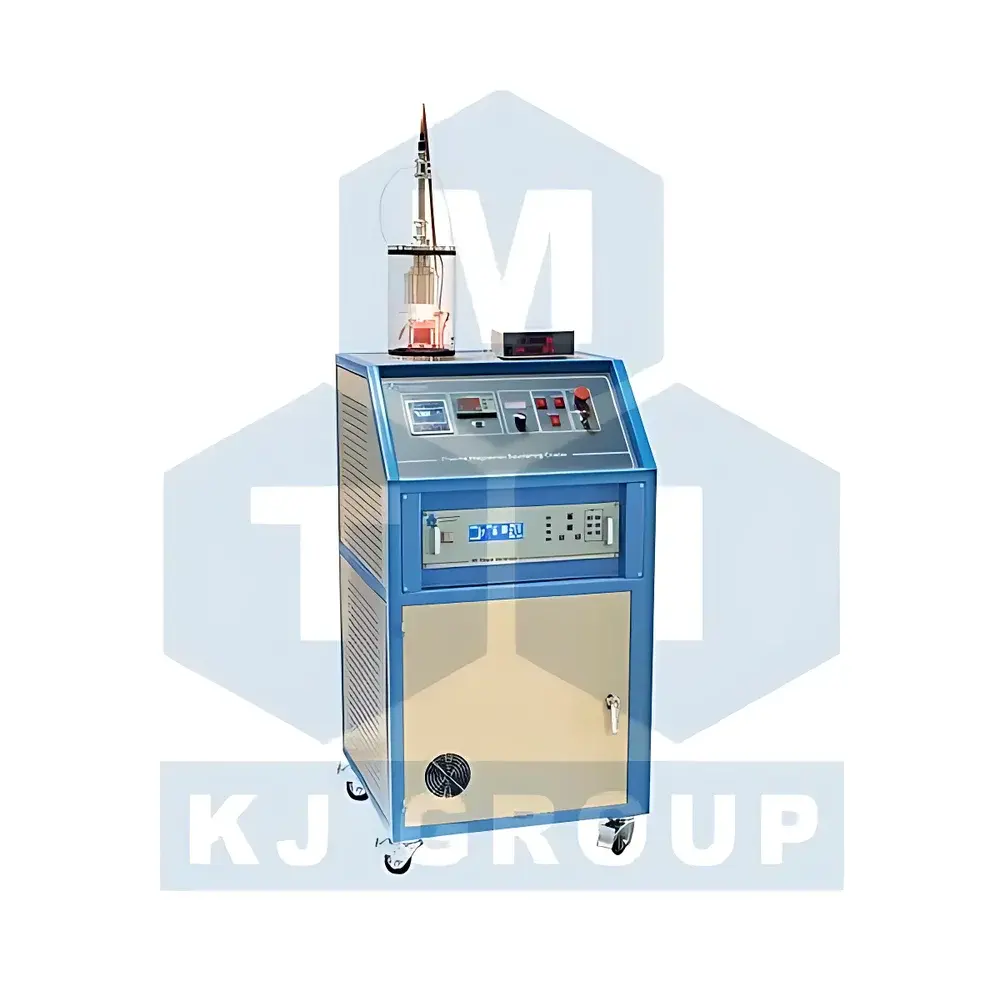
English Product Name
| Brand | KJ-Science |
|---|---|
| Origin | Anhui, China |
| Model | VTC-2RF |
| RF Power | 300 W, 13.56 MHz |
| Target Diameter | 50 mm (2") |
| Chamber Material | High-purity quartz (OD 160 mm × ID 150 mm × H 250 mm) |
| Base Pressure | ≤1×10⁻³ Torr (with dual-stage rotary vane pump) / ≤1×10⁻⁵ Torr (with optional turbomolecular pump) |
| Substrate Holder | Rotatable (1–20 rpm), heated up to 700 °C (short-term), 500 °C continuous |
| max. substrate size | 50 mm dia. (accommodates 2" wafers) |
| Cooling | Integrated recirculating chiller (16 L/min flow rate |
| required flow at sputter head | ≥10 L/min) |
| Thickness Monitoring | In-situ quartz crystal microbalance (QCM) with 0.1 Å resolution and LED display |
| Compliance | CE-certified |
| Warranty | 12 months |
Overview
The KJ-Science VTC-2RF is a compact, benchtop radio frequency (RF) magnetron sputtering system engineered for high-reproducibility thin-film deposition of conductive, semiconductive, and insulating materials—including metal oxides (e.g., ZnO), nitrides, and dielectrics—onto single-crystal or polished substrates. Operating on the principle of RF plasma generation in argon (or Ar/N₂/H₂ gas mixtures), the system sustains stable glow discharge at frequencies of 13.56 MHz, enabling efficient sputtering of electrically insulating targets without arcing or target poisoning. Its integrated design features a 2-inch water-cooled magnetron head, high-transparency quartz vacuum chamber, and precision temperature-controlled rotating substrate stage—making it especially suited for epitaxial or textured film growth under moderate vacuum conditions (10⁻³–10⁻⁵ Torr). Unlike DC sputtering systems, the VTC-2RF supports non-conductive target materials without requiring conductive backing plates or reactive gas tuning, significantly expanding its applicability in oxide thin-film research and prototyping.
Key Features
- 300 W RF power supply (13.56 MHz) mounted in a mobile cabinet for EMI shielding and service accessibility
- 2-inch water-cooled magnetron sputter head with quick-connect flange interface and manual shutter (stainless-steel blade, manually actuated)
- High-purity fused quartz chamber (160 mm OD × 150 mm ID × 250 mm H) enclosed by grounded aluminum shielding mesh to contain RF field emissions
- Rotating and resistively heated substrate stage (50 mm diameter, compatible with 2″ wafers), adjustable from 1–20 rpm with ±10 °C thermal stability
- Integrated quartz crystal microbalance (QCM) thickness monitor with real-time 0.1 Å resolution, LED readout, and user-configurable material density input
- Recirculating chiller (16 L/min capacity) pre-installed to meet mandatory cooling requirements (≥10 L/min at magnetron head)
- Modular vacuum architecture supporting either dual-stage rotary vane pump (base pressure ≤1×10⁻³ Torr) or optional turbomolecular pump upgrade (≤1×10⁻⁵ Torr)
Sample Compatibility & Compliance
The VTC-2RF accommodates standard 2-inch substrates—including Si, sapphire, quartz, glass, and flexible polymer foils—within its thermally isolated, rotationally symmetric stage. Its low base pressure capability and inert-gas compatibility enable deposition of oxygen-sensitive films (e.g., ZnO, ITO, TiO₂) when used with purified argon (≥5.0 N, post-purification to <1 ppm O₂/H₂O). For optimal stoichiometry control in oxide films, users may perform in-chamber gas conditioning using 5% H₂/95% N₂ purge cycles prior to sputtering. The system conforms to CE safety directives (2014/30/EU EMC and 2014/35/EU LVD) and is designed for operation in ISO Class 7 (10,000) cleanroom environments. All electrical interfaces and vacuum seals comply with IEC 61000-6-3 (EMI emission) and ASTM F2627-07 (vacuum chamber leak integrity testing) guidelines.
Software & Data Management
While the VTC-2RF operates via dedicated front-panel controls for RF power, rotation speed, heater setpoint, and QCM parameters, optional RS-232 or USB-to-serial interface enables integration with third-party data acquisition software (e.g., LabVIEW, Python-based logging scripts). The QCM module stores cumulative thickness, deposition rate, and time-stamped process logs locally on its embedded controller. For GLP/GMP-aligned labs, external PC-based recording—paired with timestamped metadata (gas flow, pressure, power, temperature)—supports audit-ready documentation. Though not natively 21 CFR Part 11 compliant, the system’s deterministic analog control architecture allows full traceability when combined with validated electronic lab notebooks (ELNs) and calibrated external sensors.
Applications
- Growth of c-axis oriented ZnO thin films for piezoelectric MEMS and transparent conducting oxide (TCO) research
- Deposition of Al₂O₃, SiO₂, and HfO₂ gate dielectrics for semiconductor device prototyping
- Preparation of metallic interlayers (e.g., Ti, Cr, Ni) for adhesion promotion in multilayer stack fabrication
- In-situ thickness calibration and rate profiling during co-sputtering experiments
- Low-cost thin-film electrode fabrication for electrochemical sensors and battery test cells
- Teaching laboratories: demonstration of plasma physics, thin-film nucleation kinetics, and vacuum science fundamentals
FAQ
What vacuum level is required for oxide film deposition?
For reproducible ZnO or other metal oxide films, a base pressure ≤5×10⁻⁴ Torr is recommended. With the standard rotary vane pump, this is achievable after extended pumping and gas purging; upgrading to a turbomolecular pump reduces pump-down time and improves residual gas composition control.
Can the system deposit films on flexible substrates?
Yes—provided the substrate remains flat and thermally stable below 700 °C. Polyimide or PET films must be clamped securely and pre-baked to remove adsorbed moisture before loading.
Is RF impedance matching included?
The VTC-2RF incorporates a fixed-tuned RF matching network optimized for 50 Ω output impedance and typical oxide target impedances. No manual tuning is required during normal operation.
How is oxygen contamination mitigated during sputtering?
By combining high-purity argon (5N+), in-chamber H₂/N₂ plasma cleaning, and optional inline gas purifiers (e.g., SAES MonoTorr™), residual O₂ and H₂O partial pressures can be reduced to sub-ppm levels prior to deposition.
What maintenance intervals are recommended?
Quartz chamber cleaning every 20–30 runs; O-ring replacement annually or after exposure to aggressive chemistries; RF window inspection quarterly; chiller fluid exchange biannually.



