
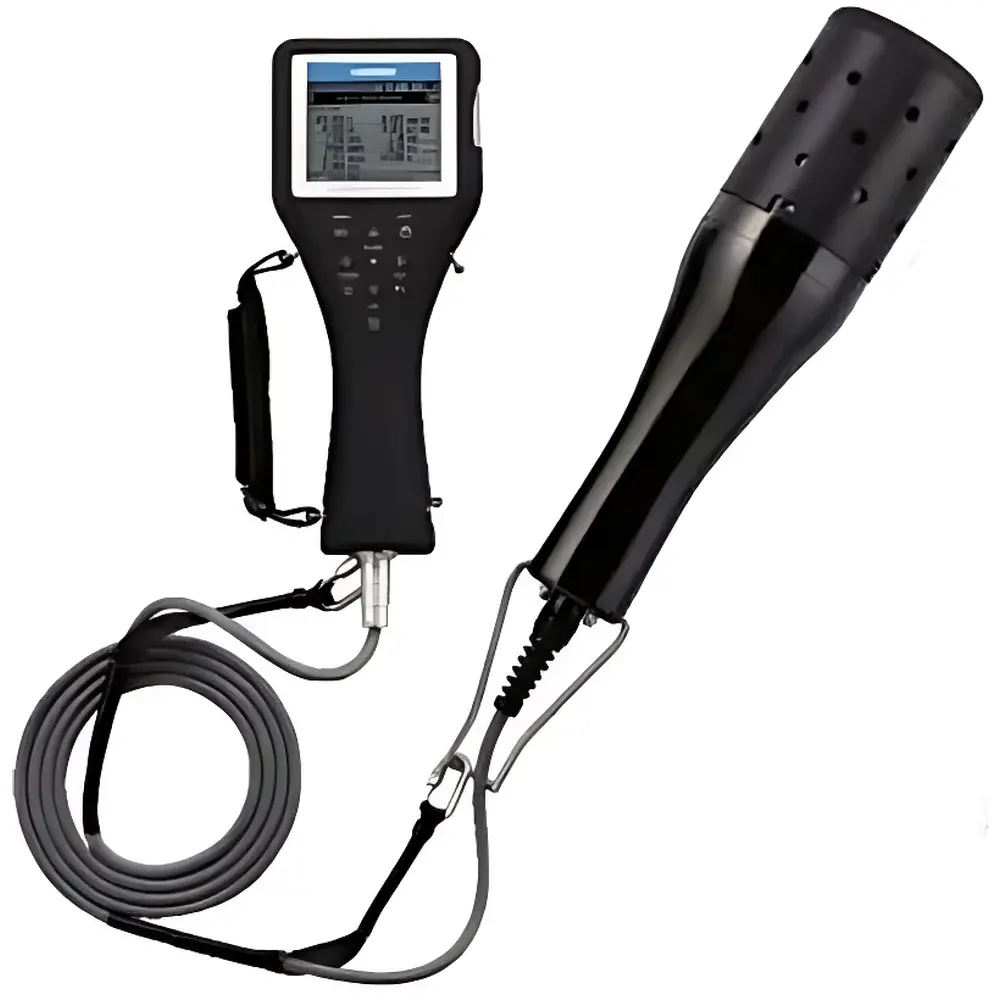
HORIBA U-50 Series Portable Multi-Parameter Water Quality Analyzer
| Brand | HORIBA |
|---|---|
| Origin | Japan |
| Model | U-50 Series (U-51 / U-52 / U-52G / U-53 / U-53G / U-54 / U-54G) |
| Instrument Type | Portable / Handheld Water Quality Analyzer |
| Measurable Parameters | pH, ORP, Dissolved Oxygen (DO), Conductivity, Salinity, TDS, Specific Gravity (Seawater), Temperature, Turbidity (LED or Tungsten Lamp), Water Depth (model-dependent), GPS (U-52G/U-53G/U-54G) |
| Turbidity Standards | U-53 complies with US EPA Method 180.1 |
| IP Rating | IP68 (JIS Protection Class 8 for probe), IP67 (JIS Protection Class 7 for main unit with cable connected) |
| Operating Temperature | −5 to +45 °C |
| Storage Temperature | −10 to +60 °C |
| Battery Life | Up to 70 hours (alkaline AA × 4, backlight off) |
| Data Storage | 10,000 measurement sets |
| Communication Interface | USB |
Overview
The HORIBA U-50 Series is a field-deployable, multi-parameter water quality analyzer engineered for high-reliability environmental monitoring in diverse aquatic environments—including rivers, lakes, groundwater wells, wastewater treatment plants, and coastal zones. Built on electrochemical and optical sensing principles, the system integrates seven core sensor modalities into a single ruggedized probe assembly: glass electrode-based pH measurement, platinum redox electrode for ORP, Clark-type polarographic dissolved oxygen (DO) sensing with temperature-compensated salinity correction, four-electrode AC conductivity detection, LED- or tungsten-lamp-based turbidity measurement per standardized light-scattering geometries, pressure-based depth profiling, and optional integrated GPS geotagging. All models support automatic temperature compensation (ATC) and dual-point calibration protocols compliant with standard laboratory practice. The modular architecture allows configuration-specific deployment—ranging from basic pH/DO/conductivity (U-51) to full-spectrum analysis with EPA-compliant turbidity and real-time GPS positioning (U-53G/U-54G).
Key Features
- Rugged IP68-rated probe housing constructed from PPS, titanium, SUS316L stainless steel, FKM elastomers, PEEK, and FEP membranes—engineered for long-term immersion in aggressive freshwater, brackish, and seawater matrices.
- Simultaneous real-time display of up to 11 parameters on a high-contrast 320 × 240 monochrome LCD with backlight—enabling rapid on-site decision-making without external software.
- Multi-standard turbidity detection: U-53 probe implements forward-scatter LED geometry per US EPA Method 180.1 (0–800 NTU); U-54 probe uses 90° LED scatter per EN ISO 7027 (0–1000 NTU), both featuring auto-cleaning brush mechanisms to mitigate biofouling in extended deployments.
- Enhanced DO response time and simplified polarographic membrane maintenance—reducing field recalibration frequency and improving measurement reproducibility across diurnal temperature gradients.
- Integrated GPS receiver (12-channel) on G-series models (U-52G/U-53G/U-54G) enables georeferenced data logging—critical for regulatory reporting, spatial trend analysis, and GIS integration in watershed management programs.
- Intuitive multilingual interface supporting English, Japanese, Russian, Spanish, and Portuguese—facilitating cross-border field operations and international training workflows.
- USB data export capability and onboard storage for 10,000 measurement records—including timestamps, GPS coordinates (where equipped), and sensor diagnostics—supporting audit-ready data capture under GLP/GMP-aligned field protocols.
Sample Compatibility & Compliance
The U-50 Series is validated for direct immersion in natural and anthropogenic water matrices, including surface water (ISO 5667-3), groundwater (ASTM D3370), municipal and industrial effluents (EPA 40 CFR Part 136), and marine environments (ISO 10523, ISO 7888). Turbidity modules meet regulatory method equivalency: U-53 conforms to US EPA Method 180.1 for drinking water and ambient monitoring; U-54 satisfies EN ISO 7027 for process control and compliance verification. Conductivity and salinity measurements adhere to ISO 7888 and ASTM D1125 standards. All electrochemical sensors comply with JIS Z 8401 accuracy classifications for field instrumentation. The system supports traceable calibration using NIST-traceable standard solutions (pH 4.01/7.00/10.01, ORP Zobell’s solution, DO saturation standards), and its firmware maintains full calibration history—including date, operator ID, and reference values—for regulatory audit trails.
Software & Data Management
Data acquisition and post-processing are supported via HORIBA’s proprietary U-50 Utility Software (Windows-compatible), enabling configuration file management, firmware updates, batch download of stored datasets, and export to CSV or Excel formats. Each logged record includes parameter values, measurement uncertainty estimates (per manufacturer specifications), sensor status flags (e.g., membrane integrity, electrode polarization), and—on G-series units—WGS84 latitude/longitude, altitude, and UTC timestamp. The system logs calibration events with operator input and stores up to 20 calibration histories per parameter. While not FDA 21 CFR Part 11 certified out-of-the-box, the audit trail structure (immutable timestamps, user-defined IDs, change logs) aligns with ALCOA+ principles for data integrity in environmental QA/QC applications subject to EPA, ISO/IEC 17025, or EU Water Framework Directive reporting requirements.
Applications
- Regulatory ambient water quality monitoring per national and regional frameworks (e.g., US Clean Water Act Section 304, EU WFD Article 8).
- Wastewater treatment plant influent/effluent characterization and process optimization.
- Groundwater contamination plume mapping and remediation progress tracking.
- Coastal eutrophication studies requiring concurrent DO, salinity, turbidity, and temperature profiling.
- Educational field laboratories and university environmental science curricula.
- Emergency response assessments following chemical spills, algal blooms, or flood-related contamination events.
FAQ
What turbidity standards does the U-50 Series support?
The U-53 probe complies with US EPA Method 180.1 (forward-scatter LED); the U-54 probe meets EN ISO 7027 (90° LED scatter). Both offer 0.01 NTU resolution and integrated cleaning brushes.
Does the instrument support automatic calibration?
Yes—automatic two-point pH calibration using pH 4.01 buffer is supported across all models. Other parameters require manual calibration with certified standards, but the system stores full calibration metadata.
Can the U-50 operate in seawater?
Yes—the probe materials (titanium, SUS316L, FEP) and salinity compensation algorithms (0–70 ppt) are explicitly rated for continuous seawater exposure.
What is the maximum operational depth?
The pressure sensor supports up to 30 meters water column (3 bar), with ±0.3 m absolute accuracy and 0.05 m resolution.
Is GPS functionality available on all models?
No—integrated GPS is exclusive to U-52G, U-53G, and U-54G variants. Non-G models lack satellite positioning capability.
How is data integrity ensured during field use?
All measurements include embedded timestamps, model-specific sensor IDs, and optional operator codes. Calibration logs are immutable and time-stamped, satisfying foundational ALCOA+ data governance criteria for environmental monitoring.
Related Products







