
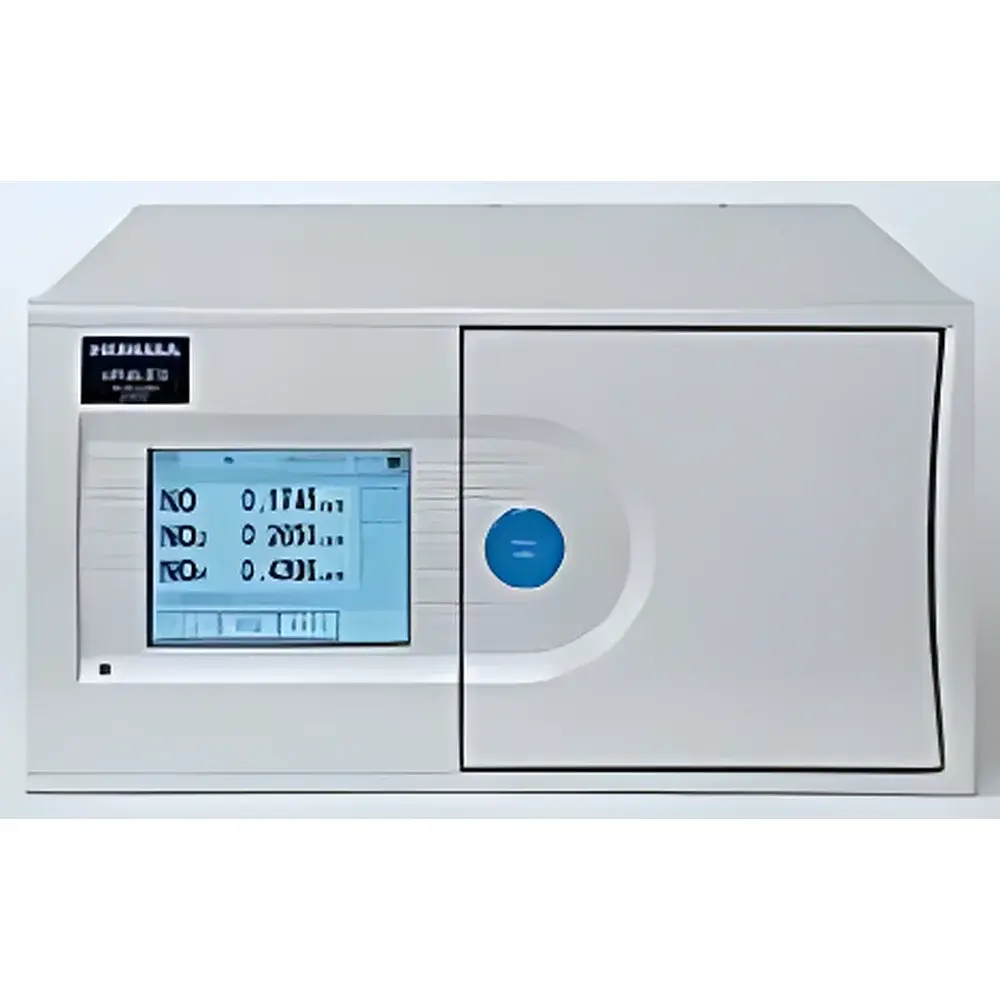
HORIBA APNA-370 Dual-Channel Chemiluminescence NO/NO₂/NOₓ Analyzer
| Brand | HORIBA |
|---|---|
| Origin | Japan |
| Model | APNA-370(G) |
| Instrument Type | Online Continuous Emission Monitor |
| Measured Gases | Nitric Oxide (NO), Nitrogen Dioxide (NO₂), Total Nitrogen Oxides (NOₓ) |
| Response Time (T90) | ≤120 s |
| Detection Limit | 0.5 ppb (2σ, ≤0.2 ppm range) / 1.0% F.S. (2σ, >0.2 ppm range) |
| Measurement Range | 0–10 ppm (4 selectable sub-ranges, max span ratio 10:1) |
| Accuracy | ±1.0% F.S. (linearity & repeatability) |
| Zero Drift | ±1.0 ppb/day or ±1.0% F.S./day (whichever greater) |
| Span Drift | ±1.0% F.S./day |
| Sample Flow Rate | ~0.8 L/min |
| Operating Temperature | 5–40 °C |
| Power Supply | 100–240 VAC, 50/60 Hz |
| Dimensions | 430 × 550 × 221 mm (W×D×H) |
| Weight | ~21 kg |
Overview
The HORIBA APNA-370 is a high-performance, online chemiluminescence-based analyzer engineered for continuous, real-time quantification of nitric oxide (NO), nitrogen dioxide (NO₂), and total nitrogen oxides (NOₓ) in ambient air and stack gas applications. It employs a patented dual-channel, alternating flow modulation chemiluminescence detection principle—specifically optimized for low-pressure CLD (Chemiluminescence Detection)—to eliminate cross-sensitivity between NO and NO₂ while maintaining exceptional signal stability and baseline integrity. Unlike conventional single-detector CLD systems, the APNA-370 integrates an internal catalytic molybdenum converter with precise thermal management to ensure quantitative NO₂-to-NO reduction without ozone interference or converter saturation. The instrument’s core optical path utilizes a high-efficiency photomultiplier tube (PMT) coupled with semiconductor-based signal conditioning electronics, delivering long-term detector stability and minimal maintenance requirements over multi-year deployment cycles.
Key Features
- Dual-channel alternating flow modulation architecture enables simultaneous, independent measurement of NO and NO₂ with no hardware switching or valve cycling—reducing mechanical wear and improving measurement continuity.
- Integrated zero-air generation system with built-in desiccant dryer and ozone generator ensures stable, moisture-free reaction gas supply; eliminates need for external dry air or compressed gas sources.
- Self-contained ozone destruction unit prevents residual ozone carryover into sample lines, critical for compliance with ISO 7935 and EPA Method 7E interference specifications.
- Full internal calibration capability: automatic zero/span verification using onboard reference gas generation (no external cylinders required for routine QA/QC).
- Modular design accommodates field-upgradable firmware and configurable I/O: analog outputs (0–1 V, 0–10 V, or 4–20 mA), isolated digital I/O, RS-232C serial interface, and optional Ethernet (TCP/IP) for SCADA integration.
- CF card slot supports local data logging (up to 1 year at 1-minute intervals), firmware updates, and remote diagnostics—enabling unattended operation in remote monitoring stations.
Sample Compatibility & Compliance
The APNA-370 is validated for use with ambient air, flue gas (after appropriate particulate and moisture conditioning), and urban background monitoring networks. Its measurement methodology conforms to international regulatory frameworks including EPA Method 7E (for NOₓ in stationary source emissions), ISO 7935:1990 (ambient air quality—determination of NO and NO₂), and EN 14211:2012 (ambient air—specification and performance requirements for automated measuring systems). The analyzer meets CE marking requirements under the EU Measuring Instruments Directive (MID) and supports audit-ready data handling per GLP and ISO/IEC 17025 documentation standards. All calibration events, alarm states, and maintenance logs are time-stamped and stored with user-accessible metadata—facilitating 21 CFR Part 11-compliant electronic record retention when deployed with validated software environments.
Software & Data Management
The APNA-370 operates via an embedded Linux-based controller with a multilingual GUI (English, German, French, Japanese) accessible via front-panel touchscreen or remote web interface. Data acquisition supports multiple averaging modes: instantaneous value, rolling 1-, 8-, or 24-hour dynamic averages, and integrated mass concentration totals. Raw sensor outputs, diagnostic parameters (e.g., PMT voltage, converter temperature, ozone pressure), and event logs are exportable in CSV or XML format. Optional HORIBA DataStation software provides centralized fleet monitoring, automated report generation (daily/weekly/monthly compliance summaries), and configurable alarm escalation (email/SMS via SMTP gateway). All firmware updates undergo cryptographic signature verification to ensure traceability and integrity.
Applications
- Ambient air quality monitoring networks (AQN) operated by national environmental agencies and municipal authorities.
- Continuous emissions monitoring systems (CEMS) for thermal power plants, cement kilns, and waste incinerators subject to NOₓ emission limits under EU IED or U.S. NSPS Subpart Da.
- Research-grade atmospheric chemistry studies requiring high temporal resolution (<60 s) and sub-ppb detection sensitivity.
- Indoor air quality assessment in transportation hubs, tunnels, and industrial facilities where NOₓ exposure thresholds must be verified against OSHA PEL or WHO guidelines.
- Calibration laboratory reference standard for transfer calibration of portable NOₓ analyzers and diffusion tube networks.
FAQ
What measurement principle does the APNA-370 use?
It uses low-pressure alternating flow modulation chemiluminescence detection (CLD), with separate optical channels for NO and NO₂, eliminating reliance on mechanical valves or external converters.
Does the APNA-370 require external calibration gases?
No—zero air is generated internally via a desiccated air source and ozone generator; span calibration can be performed using onboard NO permeation tubes or optional certified gas cylinders.
Can the APNA-370 operate unattended for extended periods?
Yes—its integrated drying, ozone generation, and CF card logging enable fully autonomous operation for >6 months without intervention, provided ambient temperature remains within 5–40 °C.
Is the instrument compatible with EPA or EU regulatory reporting formats?
Yes—it natively supports QAL2/QAL3 validation protocols per EN 15267 and generates compliant data files aligned with EPA 40 CFR Part 60 Appendix B reporting templates.
What maintenance intervals are recommended?
Desiccant replacement every 6 months; PMT gain verification annually; full optical path inspection and converter cleaning every 24 months—documented in the built-in maintenance scheduler.







