
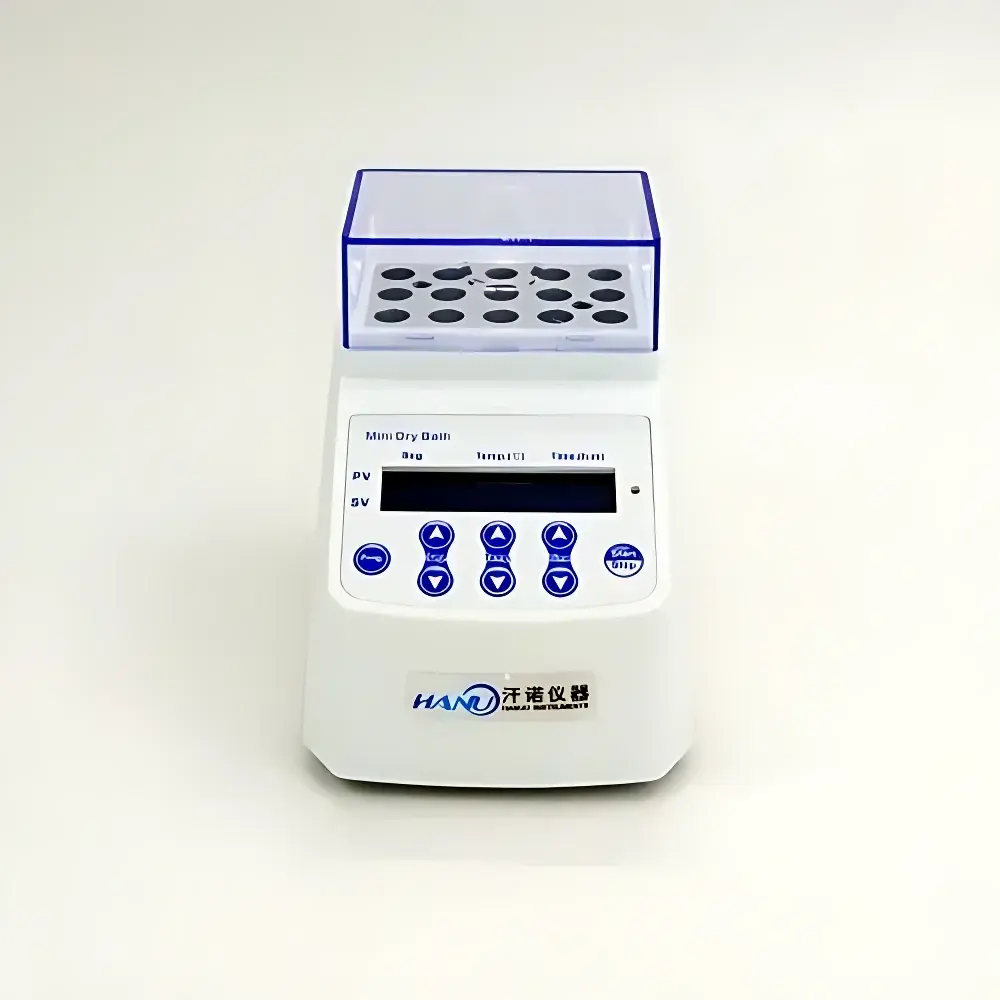
Hanuo MINIB-100 Portable Heated Metal Block Bath
| Brand | Hanuo |
|---|---|
| Origin | Shanghai, China |
| Model | MINIB-100 |
| Temperature Range | RT + 5°C to 100°C |
| Temperature Accuracy | ±0.3°C (at 100°C) |
| Temperature Uniformity | ≤ ±0.5°C across block |
| Block Temperature Gradient at 40°C | 0.3°C |
| Heating Time | ≤15 min (20°C → 100°C) |
| Display Resolution | 0.1°C |
| Timer Range | 0–99 h 59 min |
| Power Input | 24 V DC |
| Rated Power | 45 W |
| Net Weight | 0.8 kg |
| Safety Features | Over-temperature protection, self-diagnostic alarm, auto-shutdown |
Overview
The Hanuo MINIB-100 Portable Heated Metal Block Bath is a compact, microprocessor-controlled dry bath engineered for precise, stable thermal incubation of small-volume samples in resource-constrained or mobile laboratory environments. Unlike water baths, it employs solid aluminum heating blocks with high thermal conductivity and low thermal inertia, enabling rapid, uniform heat transfer via conductive heating—ideal for applications requiring contamination-free, low-maintenance temperature control. Its design conforms to fundamental principles of thermal equilibrium and steady-state conduction, delivering reproducible thermal profiles without evaporation, condensation, or fluid-level dependency. The unit operates within a controlled range of ambient +5°C to 100°C, making it suitable for enzyme activation, DNA denaturation, sample thawing, reagent pre-warming, and routine incubation protocols where portability, electrical safety, and environmental adaptability are critical.
Key Features
- Ultra-compact footprint and lightweight construction (0.8 kg), enabling benchtop, field, or vehicle-mounted deployment without structural reinforcement
- 24 V DC power input with integrated over-temperature cutoff circuitry—certified for use with automotive auxiliary power systems and portable power stations
- Dual digital display showing real-time block temperature (0.1°C resolution) and countdown timer (up to 99 h 59 min)
- Self-diagnostic system with audible alarm and on-screen error codes for sensor failure, open-circuit heater, or thermal runaway conditions
- User-accessible temperature offset calibration function (±5.0°C range) to compensate for inter-laboratory or inter-module drift against traceable reference standards
- Quick-release, interchangeable aluminum modules (e.g., 0.2 mL, 0.5 mL, 1.5 mL, 2.0 mL tube formats) with anodized surface finish for chemical resistance and autoclavable compatibility
- Passive cooling design with no moving parts—eliminates fan noise, vibration, and particulate generation in cleanroom or laminar flow hood applications
Sample Compatibility & Compliance
The MINIB-100 accommodates standard microcentrifuge tubes (including PCR strips), vials, and reaction vessels up to 2.0 mL capacity. All contact surfaces comply with ISO 8573-1 Class 4 purity requirements for non-oiled aluminum alloys and meet USP material biocompatibility guidelines for short-term diagnostic use. While not certified for IEC 61010-1 Edition 3 (as a Class II portable device), its 24 V DC architecture inherently satisfies SELV (Safety Extra-Low Voltage) provisions under EN 61010-1:2010. Temperature performance data—including stability (≤ ±0.5°C at 100°C), uniformity (≤ ±0.5°C across active zone), and gradient (0.3°C at 40°C)—are validated per ASTM E2209-18 Annex A2 for dry block thermal uniformity testing. Device firmware supports manual audit trail logging (non-electronic) for GLP-aligned workflows.
Software & Data Management
The MINIB-100 operates as a standalone hardware platform with no embedded software stack, cloud connectivity, or proprietary drivers—ensuring long-term operational continuity and eliminating cybersecurity vulnerabilities associated with networked lab equipment. All configuration and operation occur via front-panel membrane keys and LED display. For regulated environments, users may document calibration events, temperature verification runs, and maintenance logs manually in accordance with FDA 21 CFR Part 11 Annex B (paper-based record retention). Optional NIST-traceable external thermistor probes (e.g., Fluke 54II series) can be used to independently verify block temperature during IQ/OQ validation protocols.
Applications
- Routine pre-incubation of restriction enzymes, ligases, and reverse transcriptases prior to molecular biology assays
- Controlled thawing of cryopreserved cell suspensions, serum aliquots, and antibody stocks to minimize thermal shock
- Stabilization of temperature-sensitive reagents (e.g., ATP solutions, fluorescent dyes) during assay setup
- Field-deployable nucleic acid extraction support in mobile biosurveillance units or veterinary point-of-care labs
- QC/QA verification of thermal consistency across multiple benchtop instruments using standardized reference blocks
- Teaching laboratories requiring safe, low-power, plug-and-play thermal devices for undergraduate biochemistry experiments
FAQ
What power sources are compatible with the MINIB-100?
The unit accepts regulated 24 V DC input only; it is not compatible with AC mains, USB-PD, or 12 V automotive systems without an approved step-up converter meeting IEC 62368-1 output isolation requirements.
Can the MINIB-100 be used for sterilization or dry-heat depyrogenation?
No. Its maximum operating temperature is 100°C, and it lacks the thermal mass, dwell time control, and validation documentation required for depyrogenation (typically ≥250°C for ≥30 min per USP ).
Is the aluminum block resistant to common laboratory solvents?
The anodized surface resists dilute acids, bases, and alcohols (e.g., 70% ethanol, 0.1 M NaOH); however, prolonged exposure to halogenated solvents (e.g., chloroform, DCM) or strong oxidizers (e.g., concentrated HNO₃) may degrade the oxide layer.
Does the device support external temperature probe input for closed-loop control?
No. It relies solely on internal PT1000 sensor feedback; no analog or digital input ports are provided for external thermocouples or RTDs.
How often should temperature calibration be performed?
Per ISO/IEC 17025:2017 Clause 7.8.3, calibration verification is recommended before each critical assay series or at least daily when used in GxP environments—using a calibrated reference thermometer traceable to NIST SRM 1750a.



