
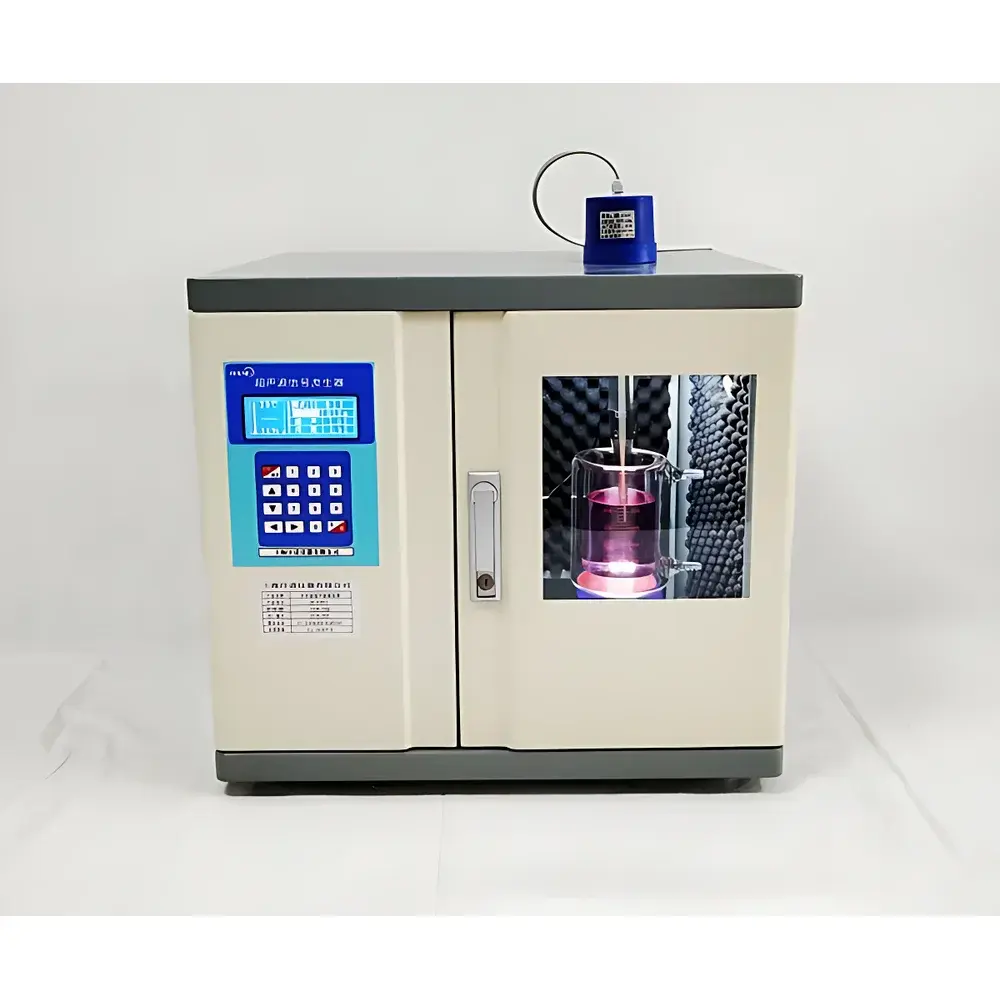
Hanuo HNWH-500W High-Power Ultrasonic Nebulizer
| Brand | Hanuo |
|---|---|
| Origin | Shanghai, China |
| Model | HNWH-500W |
| Ultrasonic Power | 500 W (continuously adjustable, 100–500 W) |
| Ultrasonic Frequency | 30 kHz (auto-tracking) |
| Nebulization Capacity | 5–10 L/h |
| Tank Volume | 1000 mL |
| Nebulizer Tip Material | Titanium Alloy |
| Operation Mode | Pulse or Continuous |
| Control Interface | 4.3-inch TFT Touchscreen |
| PC Connectivity | Optional |
| Vacuum Filtration Pump | Optional |
Overview
The Hanuo HNWH-500W High-Power Ultrasonic Nebulizer is an industrial-grade ultrasonic atomization system engineered for precision liquid dispersion in research and production environments. Unlike conventional pressure-driven spray nozzles, this device utilizes high-intensity longitudinal ultrasonic vibration—generated by a piezoelectric transducer coupled to a titanium alloy sonotrode—to mechanically destabilize the liquid surface at the air–liquid interface. This capillary-wave-induced breakup mechanism produces a narrow droplet size distribution (typically 5–100 µm), with high spatial uniformity and minimal shear stress on sensitive solutes. The system operates at a fixed fundamental frequency of 30 kHz with real-time auto-frequency tracking to maintain resonance under variable load conditions, ensuring stable energy transfer and reproducible雾化 performance across diverse liquid media—including aqueous solutions, organic solvents, viscous suspensions, and even non-aqueous conductive fluids such as molten metal precursors. Its absence of pressurized gas lines, mechanical nozzles, or moving parts eliminates clogging, wear, and acoustic noise—making it particularly suitable for cleanroom-compatible coating, aerosol generation for inhalation studies, and continuous-flow powder synthesis.
Key Features
- 500 W nominal ultrasonic output power, continuously adjustable from 100–500 W via digital feedback control
- 30 kHz resonant frequency with integrated auto-tracking circuitry to sustain optimal coupling efficiency during extended operation
- Titanium alloy nebulizer tip—corrosion-resistant, thermally stable, and acoustically efficient for long-term durability in aggressive chemical environments
- 4.3-inch full-color TFT touchscreen interface with intuitive parameter configuration, real-time power monitoring, and operational history logging
- Pulse or continuous ultrasonic mode selection—enabling precise duty-cycle control for thermal management and droplet size modulation
- Modular architecture supporting optional PC-based remote control (RS-485/USB) and integration with vacuum-assisted filtration systems for closed-loop solvent recovery
- No external compressed air required; low electrical consumption per unit mass of generated aerosol (≤0.8 kWh/kg)
Sample Compatibility & Compliance
The HNWH-500W demonstrates broad compatibility with liquids ranging from deionized water and ethanol to high-viscosity polymer solutions (up to 500 cP) and molten salt precursors. It imposes no intrinsic chemical restrictions—unlike thermal or electrostatic atomizers—and maintains consistent performance across pH 1–14 and conductivity up to 20 mS/cm. While not certified to specific regulatory standards out-of-the-box, its design aligns with core principles of GLP-compliant instrumentation: traceable parameter setting, non-volatile operational logs, and hardware-level interlocks (e.g., temperature cutoff at 85°C ambient). When configured with optional data export and audit trail modules, the system supports documentation requirements under ISO/IEC 17025 and FDA 21 CFR Part 11 for regulated R&D workflows involving inhalable particle characterization or pharmaceutical spray-drying development.
Software & Data Management
The embedded firmware enables local storage of up to 1,000 operational records—including timestamp, setpoint values, actual power delivery, and runtime duration. Through optional USB or RS-485 connectivity, users may export CSV-formatted logs for post-processing in MATLAB, Python, or LIMS platforms. No proprietary software installation is required; basic telemetry is accessible via terminal emulation. For advanced integration, SDK documentation (C/C++ and Python APIs) is available upon request, facilitating synchronization with programmable logic controllers (PLCs), environmental chambers, or in-line particle sizers (e.g., SMPS or APS). All parameter changes are timestamped and non-volatile—even after power cycling—ensuring full procedural traceability.
Applications
- Lab-scale synthesis of spherical metal powders (e.g., Cu, Al, Ni alloys) via ultrasonic spray pyrolysis in tubular furnaces
- Uniform thin-film deposition for perovskite solar cell R&D, where droplet monodispersity directly impacts film morphology and charge transport
- Aerosol generation for inhalation toxicology studies, meeting USP and ISO 27427 guidelines for respirable fraction calibration
- Continuous microencapsulation of biologics using coaxial ultrasonic nozzles (requires custom tip adaptation)
- Humidification of controlled-atmosphere gloveboxes without condensation risk or mineral carryover
- Pre-concentration of trace analytes in environmental water samples prior to ICP-MS analysis
FAQ
What is the maximum permissible viscosity for stable雾化 with the HNWH-500W?
Viscous liquids up to 500 cP can be reliably雾化; beyond this, reduced flow rate and increased tip heating may occur—consult application engineering for customized amplitude compensation protocols.
Can the system operate unattended for extended durations (e.g., >8 hours)?
Yes—provided ambient temperature remains below 35°C and coolant flow (if externally jacketed) is maintained; built-in thermal protection automatically reduces power if internal transducer temperature exceeds 75°C.
Is the titanium nebulizer tip replaceable in the field?
Yes—the tip is threaded and tool-free; replacement requires only standard hex keys and takes less than 90 seconds with no recalibration needed.
Does the device support analog 0–10 V or 4–20 mA process control inputs?
Not natively; however, optional PLC interface modules are available to convert industrial analog signals into serial commands compatible with the onboard controller.
How is droplet size distribution verified and validated?
Hanuo provides reference calibration reports using Phase Doppler Anemometry (PDA); end users may validate in situ with laser diffraction (e.g., Malvern Spraytec) or cascade impactor analysis per ISO 27427 Annex B.



