
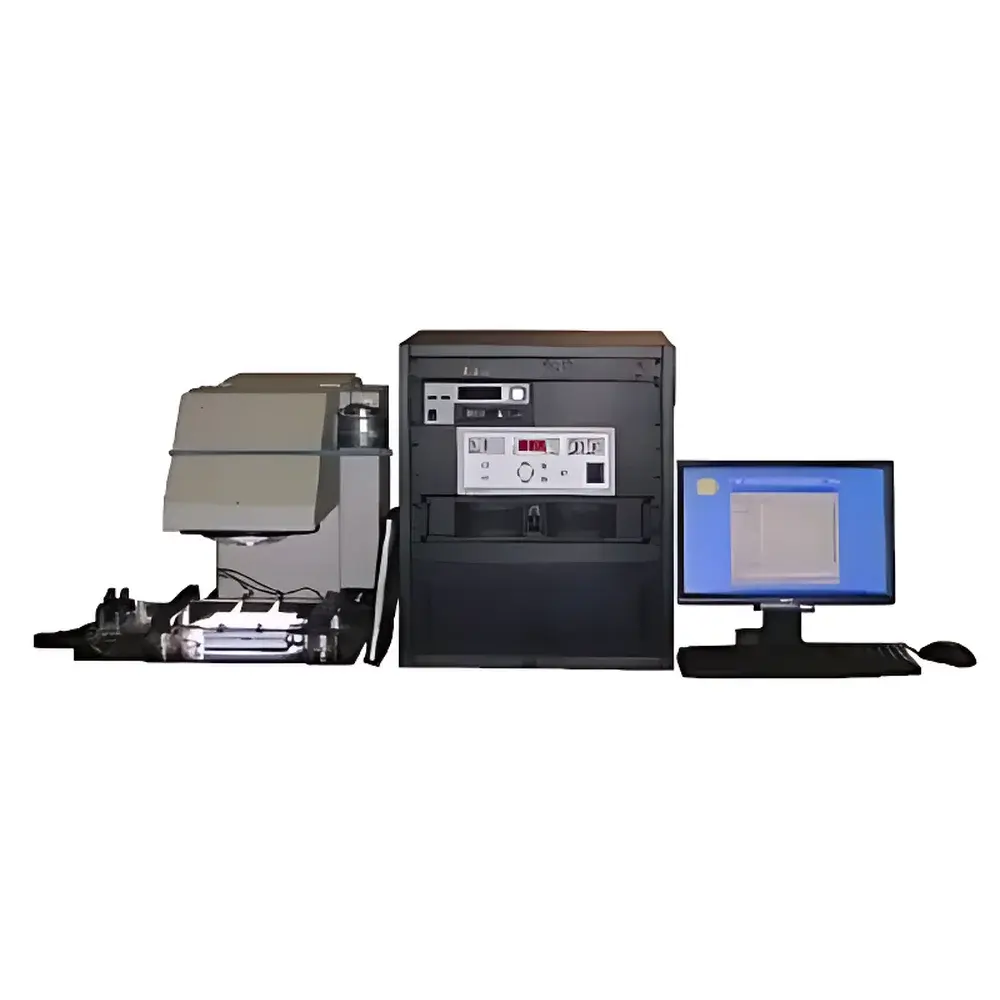
Solar Cell I-V Measurement System IV16 by PV Measurements
| Brand | PV Measurements |
|---|---|
| Model | IV16 |
| Light Source Class | ABA-Class Solar Simulator (Standard) |
| Illuminated Area | 16 cm × 16 cm |
| Voltage Range | ±2.0 V |
| Current Range | 0–10 A |
| Spectral Match Compliance | ASTM E927-23, IEC 60904-9 Ed. 3 |
| Temporal Stability | < ±1% (A-class), < ±3% (B-class), < ±10% (C-class) |
| Irradiance Uniformity | < ±2% (A-class), < ±3% (B-class), < ±10% (C-class) |
| Standard Test Conditions (STC) | 1000 W/m², AM1.5G spectrum, 25 °C ± 2 °C |
| Software | IV Analysis Suite with GLP-compliant data logging, report generation (PDF/text), and audit-trail-enabled parameter calculation (Voc, Isc, Jsc, Pmax, Vmax, Imax, FF, η) |
| Sample Interface | 4-wire Kelvin connection |
| Optional Upgrades | AAA-class simulator, temperature-controlled vacuum chuck, Rs extraction via attenuated-light sweep, automated database export, reverse-bias leakage testing, conveyor integration |
Overview
The PV Measurements IV16 Solar Cell I-V Measurement System is a turnkey, laboratory-grade photovoltaic characterization platform engineered for precision current–voltage (I-V) curve acquisition under standardized illumination conditions. It operates on the fundamental principle of controlled electronic load sweeping across the voltage domain of a photovoltaic device while simultaneously measuring its corresponding current response under calibrated solar-spectrum irradiance. The system integrates an ABA-class continuous-output solar simulator—compliant with ASTM E927-23 and IEC 60904-9 Ed. 3—capable of delivering spatially uniform, spectrally matched (AM1.5G) irradiance over a 16 cm × 16 cm active area. This enables reliable evaluation of large-area cells, mini-modules, and thin-film substrates without edge-effect bias. All measurements are referenced to Standard Test Conditions (STC): 1000 W/m² total irradiance, AM1.5G spectral distribution, and 25 °C ± 2 °C cell temperature—ensuring inter-laboratory comparability and traceability to NIST-traceable reference cells.
Key Features
- ABA-class solar simulator with real-time irradiance monitoring and active drift compensation via integrated radiometer
- Four-wire (Kelvin) measurement architecture eliminating lead resistance error in low-impedance devices
- Programmable voltage sweep: bidirectional, variable ramp rate (1 mV/s to 10 V/s), user-defined start/stop points and step resolution
- Dual-mode operation: light I-V (under illumination) and dark I-V (for diode ideality factor and series/shunt resistance analysis)
- Automated STC normalization using real-time temperature feedback from optional thermocouple interface
- Integrated electronic load with ±2.0 V voltage range and 0–10 A current range, supporting both crystalline silicon, CIGS, perovskite, and dye-sensitized solar cells
- Hardware-triggered synchronization between light source shutter control and data acquisition to eliminate transient artifacts
Sample Compatibility & Compliance
The IV16 accommodates rigid and flexible photovoltaic samples up to 16 cm × 16 cm, including wafer-based c-Si, multi-junction tandem cells, organic PV (OPV), quantum dot solar cells, and emerging perovskite architectures. Its mechanical design supports standard busbar configurations and custom electrode layouts via interchangeable sample holders. Regulatory compliance is embedded at the system level: all I-V calculations adhere to ASTM E1036, IEC 60904-1, and JIS C8912 methodologies; spectral match and spatial uniformity meet ABA-tier tolerances per IEC 60904-9; temporal stability is continuously logged and archived. For regulated environments—including ISO/IEC 17025-accredited laboratories—the software supports 21 CFR Part 11-compliant electronic signatures, audit trails, and user-access controls when configured with optional validation packages.
Software & Data Management
The IV Analysis Suite is a Windows-based application built on a deterministic real-time acquisition engine. It performs on-the-fly calculation of primary photovoltaic parameters: open-circuit voltage (Voc), short-circuit current (Isc), short-circuit current density (Jsc), maximum power point (Pmax), fill factor (FF), and conversion efficiency (η). Advanced features include series resistance (Rs) extraction via light-intensity variation (optional attenuator module), shunt resistance (Rsh) fitting using dark I-V exponential regression, and temperature-corrected extrapolation to STC. Data exports are available in CSV, TXT, and PDF formats—with customizable report templates compliant with internal QA protocols or third-party certification submissions. All raw waveform data, metadata (timestamp, ambient T/RH, irradiance value), and operator ID are stored in a relational SQLite database with immutable log entries, satisfying GLP/GMP documentation requirements.
Applications
The IV16 serves as a core instrument in R&D labs evaluating new absorber materials, interfacial layers, and passivation schemes; in manufacturing process development for inline yield assessment and root-cause analysis of efficiency loss mechanisms; and in independent testing laboratories performing type approval, certification (e.g., UL 1703, IEC 61215), and degradation studies (e.g., ISOS protocols). Its flexibility supports accelerated aging correlation studies (light-soaking, thermal cycling), spectral response mapping (when coupled with monochromator options), and low-light performance characterization down to 100 W/m². Universities utilize the platform for teaching semiconductor device physics, PV metrology standards, and hands-on calibration practices aligned with NREL and Fraunhofer ISE reference methodologies.
FAQ
What standards does the IV16 comply with for solar simulator classification?
The standard ABA-class configuration meets IEC 60904-9 Ed. 3 and ASTM E927-23 requirements for spectral match (75–125% in A-band, 60–140% in B-band), temporal stability (< ±3%), and spatial non-uniformity (< ±3%). AAA-class upgrade achieves < ±2% uniformity and < ±1% stability.
Can the system measure series resistance (Rs) and shunt resistance (Rsh)?
Yes—Rs is derived from light-intensity-dependent I-V sweeps (optional attenuator kit); Rsh is calculated from dark I-V curve fitting using single-diode model regression.
Is temperature control integrated into the base system?
No—temperature regulation requires the optional heated/cooled vacuum chuck, which maintains ±0.5 °C stability across the sample surface during measurement.
Does the software support automated database upload?
Yes—via configurable ODBC or REST API interfaces, enabling direct insertion of Voc, η, FF, and metadata into LIMS or MES platforms.
What is the minimum measurable current resolution?
The electronic load provides 10 µA current resolution at full scale, scalable via external shunts for sub-mA applications.
Related Products





