
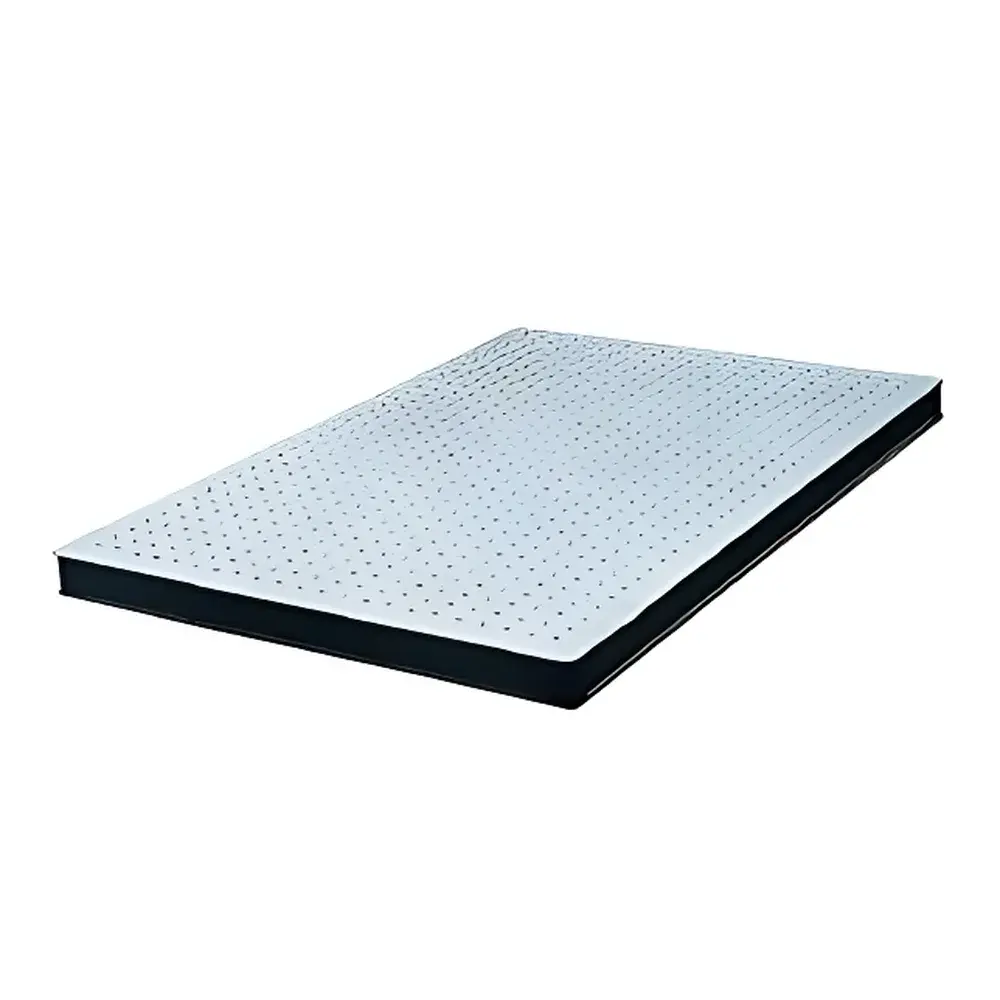
GDFB Series Honeycomb Optical Breadboard Platform
| Origin | South Korea |
|---|---|
| Manufacturer Type | Distributor |
| Origin Category | Imported |
| Model | GDFB Series Honeycomb Breadboard |
| Pricing | Upon Request |
Overview
The GDFB Series Honeycomb Optical Breadboard Platform is an engineered passive vibration isolation and mechanical mounting solution designed for high-stability optical experiments and precision photonic system integration. Constructed using a rigid aluminum honeycomb core bonded between two precision-ground stainless steel faceplates, this platform leverages cellular structural mechanics to achieve an optimal stiffness-to-mass ratio—minimizing dynamic deflection under static and transient loads while maintaining dimensional stability across ambient temperature fluctuations. Unlike solid metal plates or perforated steel breadboards, the honeycomb architecture provides superior bending rigidity per unit mass, making it especially suitable for applications requiring long-term alignment retention in interferometry, laser cavity construction, quantum optics setups, and metrology-grade optical benches. The non-reflective, matte-finished stainless steel top surface eliminates stray light scattering, supporting low-noise imaging and beam path integrity in sensitive detection environments.
Key Features
- High-rigidity aluminum honeycomb core with fully bonded 304 stainless steel faceplates for exceptional flatness (typical deviation ≤ ±5 µm over 1 m²) and thermal stability
- Non-glare, passivated stainless steel top surface optimized for optical cleanliness and minimal specular reflection
- Standardized M6 threaded hole pattern (25 mm pitch, fully tapped through both faceplates) enabling rapid, repeatable component mounting with industry-standard kinematic and adjustable mounts
- Permanent structural integrity: epoxy-acrylic adhesive bonding ensures zero delamination, no warping, and negligible coefficient of thermal expansion mismatch (CTE < 12 ppm/°C average across operating range)
- Lightweight design (approx. 35–45 kg/m² depending on thickness) reduces inertial loading on underlying active or passive isolation systems
- Edge-machined mounting flanges and optional grounding studs support ESD-safe integration in laser laboratories and cleanroom-compatible installations
Sample Compatibility & Compliance
The GDFB platform accommodates standard optical components including lens holders (e.g., Thorlabs KM100, Newport UH1), translation stages, mirror mounts, fiber launchers, and optomechanical posts up to 1″ diameter. Its uniform surface flatness and consistent thread depth ensure compatibility with ISO 9001-certified assembly workflows and GLP-compliant lab documentation protocols. While not an active isolation device, the platform meets mechanical interface requirements referenced in ISO 10360-7 (coordinate measuring machine foundations) and ASTM E177 (standard practice for use of tolerance limits in calibration). It is routinely deployed in facilities adhering to ISO/IEC 17025 accreditation for optical testing laboratories.
Software & Data Management
As a purely mechanical subsystem, the GDFB Series requires no embedded firmware, drivers, or proprietary software. Its performance metrics—including flatness maps, modal resonance frequencies (typically >350 Hz for 1000 × 750 × 100 mm variant), and load-deflection curves—are provided in NIST-traceable calibration reports upon request. These reports comply with data integrity principles outlined in FDA 21 CFR Part 11 when archived within validated laboratory information management systems (LIMS). Users may integrate dimensional verification data into MATLAB, Python (SciPy), or Zemax OpticStudio via ASCII-formatted coordinate datasets for alignment error budgeting and system-level tolerance analysis.
Applications
- Laser interferometer baseplates for gravitational wave detector prototypes and industrial displacement metrology
- Stable platforms for ultrafast optical parametric amplifiers (OPAs) and chirped-pulse amplification (CPA) beamlines
- Mounting substrate for spatial light modulators (SLMs), digital micromirror devices (DMDs), and high-resolution wavefront sensors
- Foundational structure in educational optics labs where repeatability, safety, and long-term durability are prioritized over cost
- Backplane for vacuum-compatible optical assemblies (with optional helium-leak-tested variants)
- Substrate for multi-spectral imaging systems integrating visible, SWIR, and MWIR channels on a single mechanical reference frame
FAQ
Is the GDFB platform compatible with active vibration isolation tables?
Yes—the low mass and high modal stiffness enable efficient coupling with electrodynamic or pneumatic active isolators without inducing resonant amplification below 10 Hz.
Can custom hole patterns or cutouts be machined post-purchase?
Custom machining is supported only at time of order; post-delivery drilling compromises structural integrity and voids warranty due to core exposure and bond-line stress concentration.
What is the maximum recommended static load per square meter?
For long-term flatness retention (< ±8 µm drift over 5 years), static loading should remain below 1.2 MPa (equivalent to ~120 kg distributed over 100 × 100 mm area).
Does the platform require periodic recalibration?
No—dimensional stability is inherent to the bonded honeycomb architecture; however, annual flatness verification using a laser tracker or electronic level is recommended for ISO 17025 audit readiness.
Are metric and imperial mounting accessories equally supported?
All threaded holes conform to ISO metric standards (M6 × 1.0); imperial-threaded hardware requires helicoil inserts or adapter bushings for secure engagement.



