
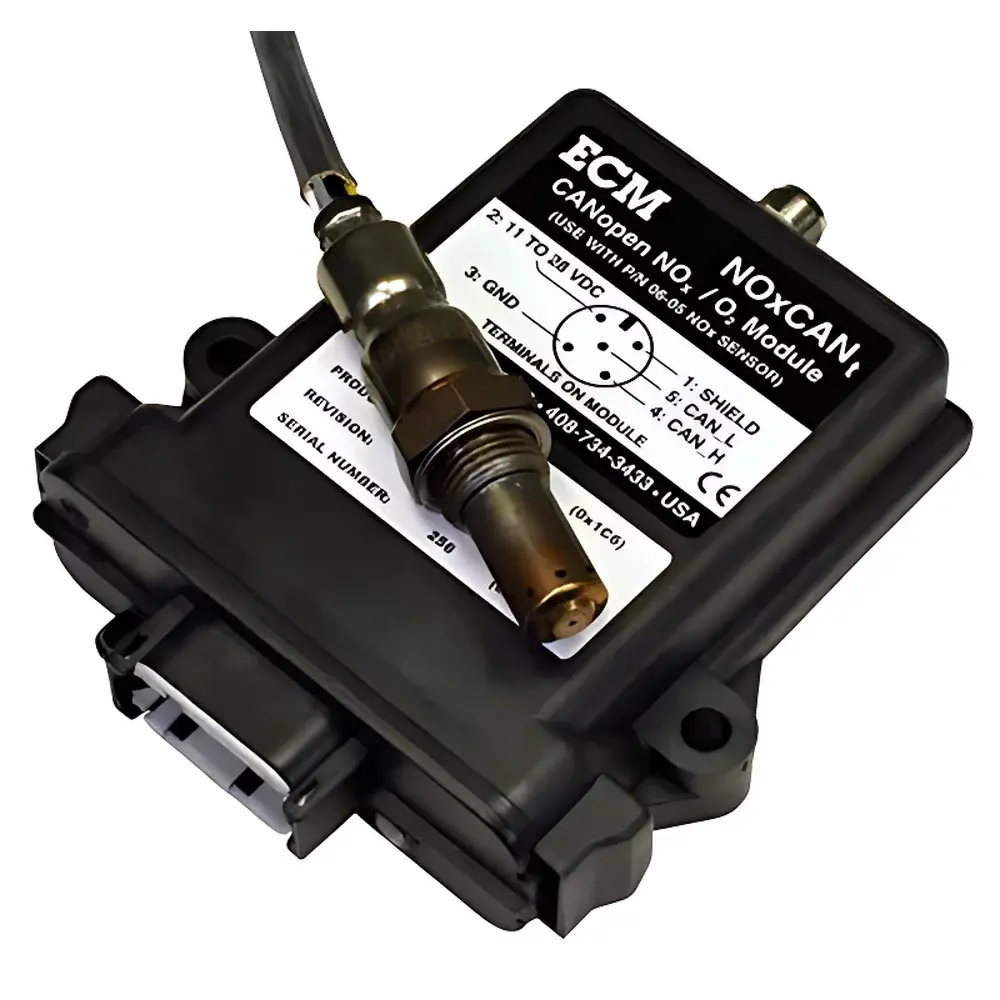
ECM NOxCANt Advanced NOx/Lambda/O2 Measurement Module
| Brand | ECM |
|---|---|
| Origin | USA |
| Model | NOxCANt |
| Communication | High-Speed CAN (ISO 11898) |
| Input | 1× NTK T-type ceramic NOx sensor (18 mm × 1.5 mm thread) + optional pressure sensor (1/4" NPT) |
| Measurement Range | NOx: 0–5000 ppm (λ ≥ 1 and λ < 1) |
| Lambda | 0.40–25 |
| AFR | 6.0–364 |
| O₂ | 0–25% vol |
| Pressure | 0–517 kPa (0–75 psia) |
| Accuracy | NOx: ±20 ppm (0–1000 ppm), ±2% FS (remaining range) |
| Lambda | ±0.008 @ λ=1, ±0.016 @ λ=0.8–1.2, ±0.018 (elsewhere) |
| AFR | ±0.15 @ 14.6, ±0.4 @ 12–18, ±1.0 (elsewhere) |
| O₂ | ±0.4% (0–2% O₂), ±0.8% (elsewhere) |
| Pressure | ±5.2 kPa (±0.75 psia) |
| Response Time | <1 s (NOx), <150 ms (Lambda/AFR/O₂) |
| Fuel Composition Configurability | H:C, O:C, N:C, H₂ ratios user-definable |
| Operating Temperature | −55 °C to +125 °C |
| Dimensions | 145 mm × 120 mm × 40 mm |
| Power Supply | 11–28 VDC |
| Sensor Cable | Standard 1 m (2 m optional) |
Overview
The ECM NOxCANt is a high-integrity, embedded-grade NOx/Lambda/O2 measurement module engineered for real-time combustion diagnostics and aftertreatment control in internal combustion engine systems. It operates on the principle of electrochemical sensing using an NTK T-type ceramic zirconia-based NOx sensor, coupled with dual-potentiometric O2 detection and stoichiometric lambda calculation derived from exhaust gas composition. Unlike conventional benchtop analyzers, the NOxCANt is designed as a field-deployable, CAN-integrated subsystem—capable of direct insertion into exhaust manifolds or downstream of catalytic converters, enabling closed-loop feedback for ECU-level air-fuel ratio optimization, SCR dosing control, and DPF regeneration logic. Its architecture complies with SAE J1939-71 and ISO 11898-2 physical layer specifications, ensuring deterministic timing, bus arbitration resilience, and interoperability within multi-node powertrain networks.
Key Features
- Direct-mount NTK T-type ceramic NOx sensor with integrated thermal management and self-heating capability for stable operation across transient exhaust conditions.
- On-sensor EEPROM calibration memory: stores factory-traceable zero/span coefficients, enabling plug-and-play replacement without manual recalibration.
- User-configurable fuel composition parameters (H:C, O:C, N:C, H2 content) to maintain stoichiometric accuracy across gasoline, diesel, biodiesel, natural gas, and hydrogen-blended fuels.
- Dual-range lambda calculation: supports both lean-burn (λ > 1) and rich-burn (λ < 1) operation with sub-0.01 unit resolution at stoichiometry (λ = 1).
- Simultaneous analog-compatible digital output via high-speed CAN 2.0B (1 Mbit/s), supporting up to 32 uniquely addressable nodes on a single bus segment.
- Extended operational envelope: rated for continuous exposure to exhaust gas temperatures up to 900 °C at the sensor tip, with electronics housing qualified from −55 °C to +125 °C ambient.
- Modular expansion support: optional display head with analog outputs (0–5 V / 4–20 mA) enables local visualization and integration with legacy DAQ or PLC systems.
Sample Compatibility & Compliance
The NOxCANt is validated for use with raw, uncooled, and unfiltered engine exhaust streams—including particulate-laden diesel exhaust and high-humidity biogas applications. Sensor materials meet ASTM B117 salt-spray resistance requirements, and the module housing conforms to IP67 ingress protection when mated with OEM-spec connectors. All measurement algorithms adhere to ISO 16183 (determination of nitrogen oxides in exhaust gas) and support traceability per ISO/IEC 17025 calibration practices. The CAN firmware implements message filtering, CRC-15 error detection, and configurable timeout recovery—ensuring data integrity under electromagnetic interference typical of heavy-duty vehicle environments. While not FDA-regulated, its architecture satisfies functional safety prerequisites aligned with ISO 26262 ASIL-B for non-safety-critical monitoring functions.
Software & Data Management
Configuration, real-time monitoring, and sensor calibration are performed via ECM’s proprietary CAN-based PC application (Windows 10/11 compatible), requiring an external ISO 11898-compliant USB-to-CAN adapter (sold separately). The software provides full access to all CAN identifiers (PGNs), allows Node ID assignment, enables dynamic scaling of analog outputs, and logs timestamped parameter sets with metadata (fuel type, calibration date, operator ID). Audit trails are exportable in CSV or HDF5 format for GLP-compliant reporting. Firmware updates are delivered via signed CAN frames with secure boot verification, preventing unauthorized modification. No cloud connectivity or remote telemetry is implemented—ensuring data sovereignty and compatibility with air-gapped test cell networks.
Applications
- Real-time NOx and lambda mapping during engine dynamometer development and OBD-II compliance testing (EPA Tier 4, Euro VI, China VI).
- SCR system validation: correlating urea injection rate with downstream NOx conversion efficiency under transient load cycles.
- Aftertreatment diagnostic logging for OEM warranty analysis and root-cause failure investigation.
- Marine diesel engine emissions monitoring in IMO Tier III-certified vessels.
- R&D of low-carbon fuels: quantifying NOx formation sensitivity to H:C ratio shifts in e-fuels and ammonia co-firing trials.
- Mobile source remote sensing programs where compact size and CAN-native output reduce integration overhead.
FAQ
Is the NOxCANt module certified for regulatory emissions testing?
The NOxCANt is not a Type-Approved instrument per EPA 40 CFR Part 1065 or EU Regulation (EU) 2017/1151. It is intended for engineering development, control system integration, and supplemental monitoring—not for official certification testing.
Can multiple NOxCANt modules share one CAN bus without conflict?
Yes. Each module supports programmable Node ID (0x00–0xFF) and configurable PGN assignment, enabling deterministic arbitration and collision-free multiplexing on a single high-speed CAN segment.
Does the module support automatic zero calibration during engine shutdown?
No. Zero calibration requires intentional user-initiated procedure using certified span gas and ambient air reference—performed via PC software. No auto-zero functionality is implemented to preserve long-term baseline stability.
What is the recommended maintenance interval for the NTK T-type sensor?
Sensor lifetime is application-dependent but typically exceeds 12,000 hours in steady-state diesel applications. ECM recommends quarterly functional verification using traceable NO/NO2 standards and annual full recalibration if exposed to sulfur-rich fuels or oil-contaminated exhaust.
Is pressure compensation applied automatically to NOx readings?
Yes. When the optional pressure sensor is installed and enabled, the module applies real-time barometric correction to NOx partial pressure calculations—critical for altitude-varying applications such as aviation piston engines and off-road equipment.







