
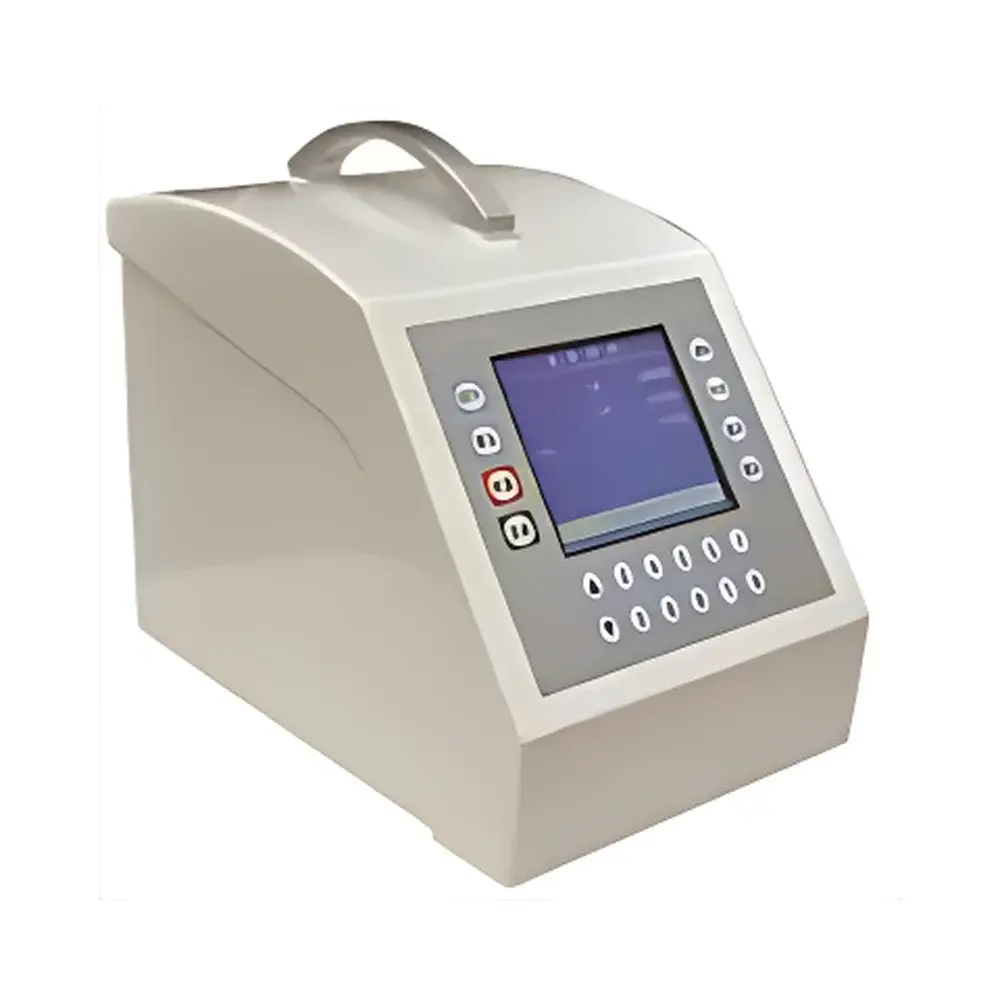
NeuronBC V4.0 Portable Automated Filter Integrity Tester
| Brand | NeuronBC |
|---|---|
| Model | V4.0 |
| Display | 5.7″ backlit digital LCD |
| Interface | Chinese-language GUI |
| Data Visualization | Real-time test curve and numerical display |
| Processing | Dual-core embedded controller |
| Software | PC-based upper-computer software with audit trail capability |
| User Management | Multi-level password-protected access control |
| Safety Protection | Automatic pressure-limiting and overpressure cutoff for filter safeguard |
| Test Methods | Forward flow (diffusion), bubble point, and water intrusion (for hydrophobic membranes) |
| Compliance Support | Configurable report generation aligned with FDA 21 CFR Part 11 and EU Annex 11 requirements |
| Reporting | Optional integrated thermal printer interface |
| Membrane Compatibility | Flat-sheet membranes, cartridge filters, and disc filters |
| Origin | Beijing, China |
| Price | USD 5,600 (FOB) |
Overview
The NeuronBC V4.0 Portable Automated Filter Integrity Tester is an engineered solution for rapid, field-deployable verification of membrane filter integrity in pharmaceutical, biotechnology, and sterile manufacturing environments. It operates on established physical principles—namely, gas diffusion through wetted pores (forward flow), capillary air displacement (bubble point), and liquid intrusion under pressure (water intrusion method)—to quantitatively assess pore size distribution, defect presence, and structural continuity of sterilizing-grade filters. Unlike benchtop counterparts, the V4.0 integrates portable form factor with laboratory-grade repeatability, enabling on-site validation during filter installation, pre-use qualification, and post-use integrity verification without requiring dedicated lab infrastructure. Its dual-core architecture ensures deterministic response timing and synchronized sensor sampling—critical for regulatory compliance where test duration, pressure ramp rate, and data timestamping must be traceable and reproducible.
Key Features
- 5.7-inch backlit digital LCD with high-contrast alphanumeric and graphical rendering for real-time pressure decay curves, flow rate trends, and pass/fail status indicators
- Chinese-language graphical user interface optimized for GMP operator workflows, minimizing training time and input error risk
- Embedded dual-core processor enabling concurrent execution of pressure control, sensor acquisition, and algorithmic calculation without latency
- Automated pressure ramping and dwell sequencing per ASTM F838-22 and ISO 13408-2 protocols, with configurable ramp rates and stabilization thresholds
- Integrated safety logic that dynamically terminates pressurization upon detecting abnormal pressure rise or flow deviation—preventing irreversible damage to hydrophilic or hydrophobic membranes
- Water intrusion method (WIM) implementation compliant with PDA Technical Report No. 40, eliminating reliance on flammable alcohols (e.g., IPA) for hydrophobic filter preconditioning
- Multi-tiered user authentication (administrator, technician, auditor) with individually assignable permissions and encrypted password storage
Sample Compatibility & Compliance
The V4.0 supports integrity testing across a broad range of filtration formats including pleated cartridge filters (0.1 µm to 0.45 µm), flat-sheet membranes (e.g., PVDF, PTFE, nylon), and disc filters up to 47 mm diameter. It accommodates both hydrophilic (e.g., cellulose acetate, polyethersulfone) and hydrophobic membranes (e.g., polytetrafluoroethylene, polypropylene) via method-selective fluid management. All test modes adhere to internationally recognized standards: forward flow tests align with USP , bubble point with ASTM F316-20, and water intrusion with ISO 15717:2016. The system’s firmware and software architecture support ALCOA+ data integrity principles—including attributable, legible, contemporaneous, original, and accurate records—and are configurable for 21 CFR Part 11 electronic signature and audit trail requirements.
Software & Data Management
The included Windows-based upper-computer software provides comprehensive test method configuration, historical data review, trend analysis, and PDF/CSV report export. Each test record contains embedded metadata: operator ID, timestamp (with NTP synchronization option), environmental temperature/humidity (via optional external probe), instrument serial number, and calibration status flags. Audit trails log all critical events—including parameter edits, user logins, report generation, and firmware updates—with immutable timestamps and user attribution. Exported reports include graphical overlays of expected vs. measured diffusion curves and automated pass/fail determinations based on user-defined acceptance criteria (e.g., maximum allowable diffusion rate per cm²).
Applications
This instrument is routinely deployed in cleanroom environments for pre-sterilization filter qualification, post-filtration integrity confirmation prior to aseptic filling, and periodic in-process verification during continuous bioprocessing. It supports validation activities for single-use systems, tangential flow filtration assemblies, and final fill/finish operations governed by EU GMP Annex 1 and WHO TRS 986. In R&D settings, its diffusion flow sensitivity enables comparative evaluation of membrane aging, cleaning cycle impact, and compatibility with novel process fluids. The water intrusion functionality is particularly valuable for validating vent filters in upstream bioreactor applications where alcohol-based wetting is prohibited due to explosion hazard or extractables concerns.
FAQ
Does the V4.0 meet FDA 21 CFR Part 11 requirements for electronic records?
Yes—the system supports role-based electronic signatures, audit trail activation, and secure user authentication when configured with validated software settings.
Can it test 0.1 µm PTFE vent filters using water intrusion?
Yes; the WIM protocol includes adjustable pressure ramp profiles and hold times optimized for low-surface-tension hydrophobic membranes.
Is calibration traceable to national standards?
Calibration certificates reference NIST-traceable pressure transducers and mass flow sensors, with documented uncertainty budgets available upon request.
What maintenance is required for long-term reliability?
Annual verification of pressure and flow sensor accuracy is recommended; no consumable parts require replacement under normal operating conditions.
Can test data be exported to LIMS or MES platforms?
Yes—CSV and XML outputs are structured for direct ingestion into common laboratory information management systems via configurable field mapping.




