
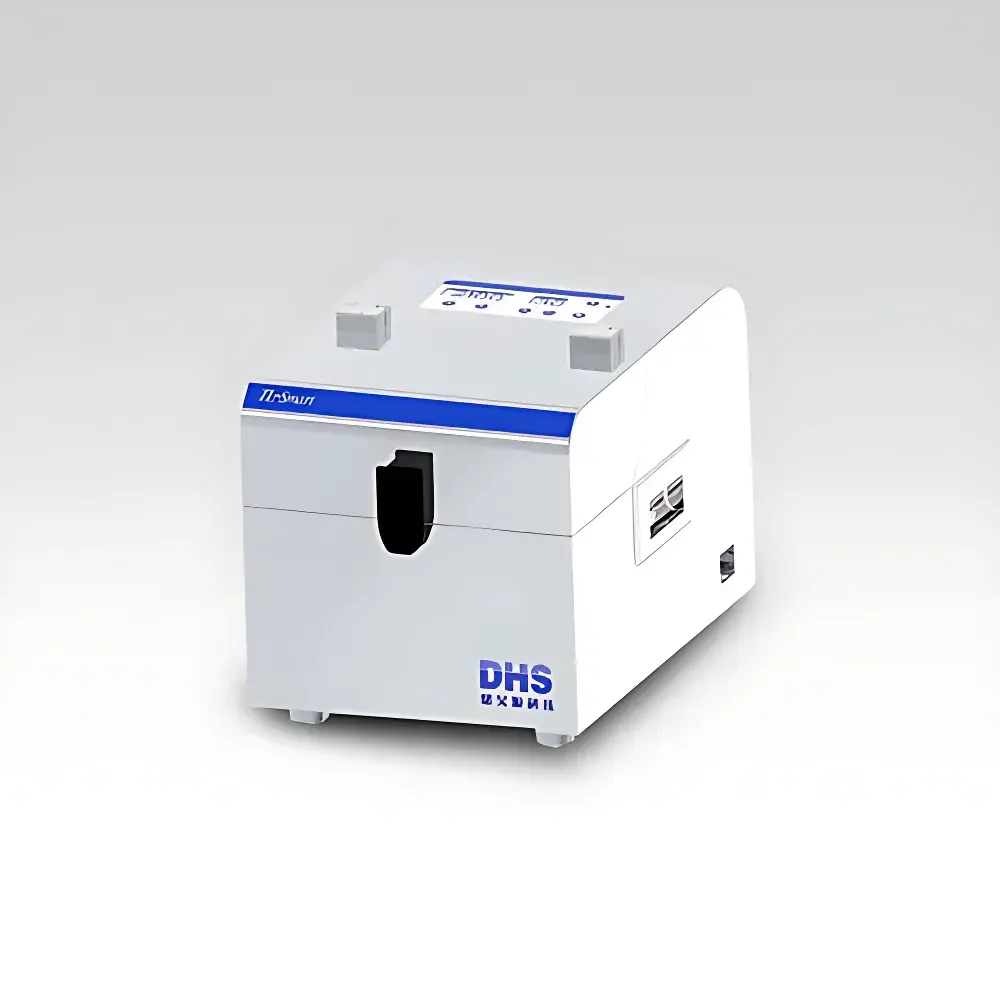
DHS TL-Smart Portable Field Tissue Grinder
| Brand | DHS |
|---|---|
| Origin | Tianjin, China |
| Model | TL-Smart |
| Power Supply | AC 220 V / DC 48 V |
| Motor Output | 250 W (AC), 480 W (DC) |
| Operating Frequency | 1500–2100 rpm (adjustable in 100 rpm increments) |
| Sample Capacity | 6 × 5 mL tubes or 8 × 2 mL tubes |
| Grinding Modes | Dry & Wet Milling |
| Run Time | 1–99 min (1 min increment) |
| Safety Interlock | Lid-open automatic stop |
| Noise Level | ≤60 dB(A) |
| Display | High-brightness LED digital display |
| Dimensions (L×W×H) | 350 × 250 × 200 mm |
| Net Weight | 18 kg |
| Battery Runtime | >5 h (Li-ion, integrated) |
| Patent Sample Holder | CN201922209779.9 (quick-lock mechanism) |
Overview
The DHS TL-Smart Portable Field Tissue Grinder is an engineered solution for rapid, reproducible mechanical homogenization of biological tissues and soft biomaterials under non-laboratory conditions. Based on high-frequency 4D orbital ball milling—where grinding beads undergo simultaneous vertical, horizontal, rotational, and oscillatory motion—the instrument achieves efficient cell lysis and matrix disruption without thermal degradation. Its compact footprint (350 × 250 × 200 mm) and dual-power architecture (AC 220 V / DC 48 V) enable seamless deployment in mobile laboratories, field inspection vehicles, biosafety level-2 (BSL-2) mobile units, and remote clinical collection sites. Unlike handheld homogenizers, the TL-Smart fully encloses sample tubes during operation, eliminating aerosol generation and cross-contamination risk—a critical requirement for molecular diagnostics, pathogen surveillance, and GLP-compliant sample preprocessing.
Key Features
- Portable dual-power operation: Integrated lithium-ion battery supports >5 hours of continuous grinding at 2100 rpm, eliminating dependency on grid power during field deployments.
- Patented quick-lock sample holder (CN201922209779.9): Tool-free tube loading/unloading with positive mechanical engagement ensures consistent clamping force and vibration damping across all cycles.
- Configurable tube compatibility: Interchangeable adapters accommodate either six 5 mL centrifuge tubes or eight 2 mL microtubes—optimized for downstream applications including RNA extraction, protein solubilization, and microbiome sampling.
- Programmable precision control: Digital interface allows precise setting of run time (1–99 min, 1-min steps) and frequency (1500–2100 rpm, 100-rpm increments), enabling method standardization across operators and sites.
- Acoustic containment design: Sound-dampened housing and balanced rotor assembly limit operational noise to ≤60 dB(A), meeting ISO 7779 requirements for ambient noise in shared mobile lab environments.
- Fail-safe interlock system: Motor halts immediately upon lid opening—complying with IEC 61000-6-2 electromagnetic immunity and EN 61000-6-4 emission standards for portable medical devices.
Sample Compatibility & Compliance
The TL-Smart is validated for use with mammalian tissues (liver, spleen, muscle), plant material (leaf, root), frozen samples (−80 °C pre-chilled), and microbial pellets. It supports both dry grinding (e.g., lyophilized tissue) and wet grinding (with lysis buffers, RNAlater®, or cryoprotectants). All contact surfaces are constructed from medical-grade stainless steel (AISI 304) and autoclavable polymer components compliant with USP Class VI biocompatibility testing. The device meets CE marking requirements under Directive 2014/30/EU (EMC) and 2014/35/EU (LVD), and its operational parameters align with ASTM D7263-06 for mechanical homogenization repeatability in forensic and clinical specimen preparation.
Software & Data Management
While the TL-Smart operates via embedded firmware without external software dependency, its parameter settings—including frequency, duration, and start/stop timestamps—are retained in non-volatile memory for audit trail reconstruction. The LED display logs the last five executed protocols, supporting traceability per ISO/IEC 17025:2017 Clause 7.7 (result reporting) and FDA 21 CFR Part 11 Annex A (electronic record integrity). For centralized fleet management, optional RS-232 serial output enables integration with LIMS platforms for automated protocol synchronization and usage logging—facilitating GMP-aligned equipment qualification (IQ/OQ).
Applications
- Rapid pathogen nucleic acid extraction in outbreak response vehicles (e.g., SARS-CoV-2, influenza A/B, mpox virus)
- Field-based metabolomics sampling where flash-freezing is impractical
- Point-of-collection homogenization for veterinary diagnostic labs operating under OIE standards
- Pre-analytical processing in decentralized clinical trials requiring chain-of-custody documentation
- Environmental microbiology—grinding soil or water filter membranes prior to DNA isolation
- Quality control of herbal medicine raw materials per Chinese Pharmacopoeia Vol. IV Section 9101
FAQ
Is the TL-Smart suitable for cryogenic grinding?
Yes—when used with pre-chilled adapters and stainless-steel grinding beads, it maintains sample integrity below −20 °C; however, liquid nitrogen immersion is not supported due to sealed chamber design.
Can the instrument be calibrated or verified for regulatory submissions?
Yes—frequency accuracy is factory-verified using NIST-traceable tachometry; users may perform periodic verification using external optical tachometers per ISO 17025 Clause 6.5.2.
What maintenance is required for long-term field deployment?
No scheduled lubrication is needed; routine cleaning of the sample chamber and adapter surfaces with 70% ethanol is recommended after each use—consistent with CLSI GP26-A4 guidelines for reusable lab equipment.
Does the device support GLP-compliant electronic records?
While it lacks built-in electronic signature capability, its parameter retention and timestamped execution history satisfy ALCOA+ principles when paired with a validated LIMS interface via RS-232.
Are replacement adapters available for non-standard tube formats?
Custom adapter plates can be fabricated upon request using CAD files provided under NDA; standard configurations remain limited to 2 mL and 5 mL centrifuge tube footprints.



