
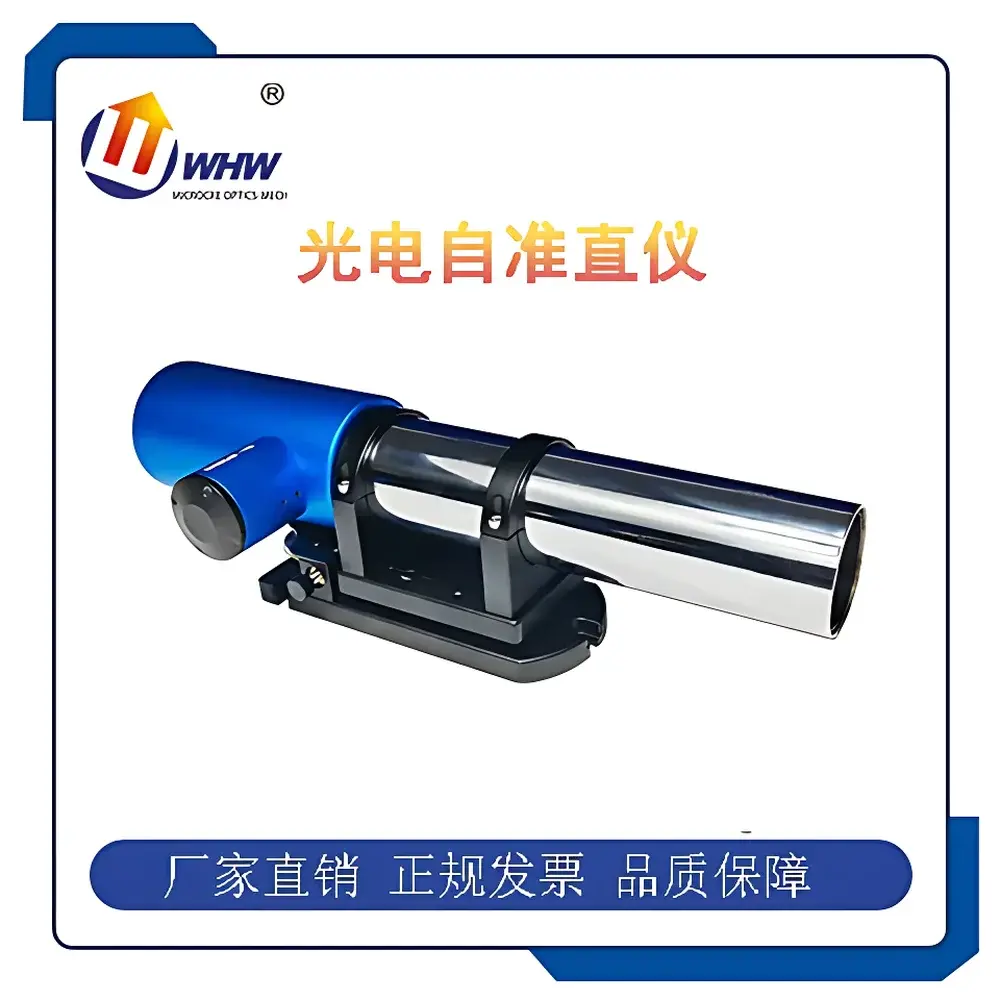
YANRUN MC030-YRMUT3000/0.2 Dual-Axis Photoelectric Autocollimator
| Brand | YANRUN |
|---|---|
| Origin | Shanghai, China |
| Manufacturer Type | Manufacturer |
| Product Origin | Domestic (China) |
| Model | MC030-YRMUT3000/0.2 |
| Quotation | Upon Request |
| Focal Length | 300 mm |
| Aperture | 48 mm |
| Light Source | Imported Semiconductor LED |
| Measurement Range | 0–30 m |
| Detector | High-Precision Photodetector |
| Display Resolution | Adjustable from 1″ to 0.0001″ (arc sec) |
| Field of View (X/Y) | 1900″ × 1400″ (arc sec) |
| Accuracy (Center) | ±0.2″ (0–±100″), ±0.5″ (0–±600″) |
| Frequency Response | ≤30 Hz |
| Interface | USB 2.0 |
| OS Requirement | Windows 7 or later (64-bit) |
| Dimensions | 388 × 135 × 125 mm (L×W×H) |
| Weight | 5.0 kg |
Overview
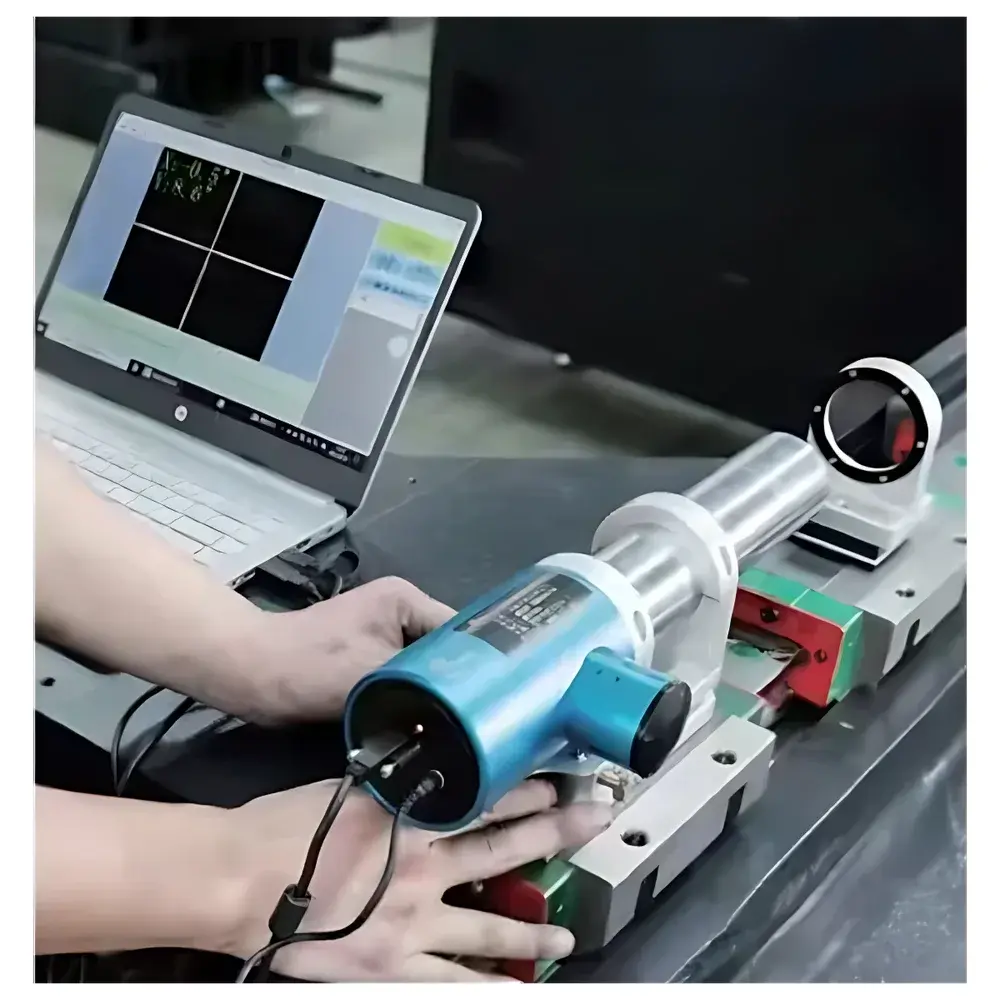
The YANRUN MC030-YRMUT3000/0.2 Dual-Axis Photoelectric Autocollimator is an advanced angular metrology instrument engineered for high-precision, non-contact measurement of angular deviations in two orthogonal axes (X and Y) simultaneously. It operates on the fundamental principle of optical autocollimation: a collimated beam—generated by projecting a reticle located at the focal plane of a high-quality objective lens—is reflected off a planar mirror and re-imaged onto a calibrated photodetector array positioned at the same focal plane. When the mirror rotates by angle α, the returned image shifts by ΔS ≈ 2f·α (where f = 300 mm is the effective focal length), enabling sub-arcsecond angular resolution through precise centroid displacement analysis. This system replaces traditional visual autocollimators with real-time digital imaging, eliminating observer-dependent parallax and human aiming errors. Designed for traceable metrology in controlled environments, it meets core requirements for ISO 10110-7 (optical component testing), ISO 230-1 (machine tool geometric accuracy), and ASTM E2919 (angular measurement standardization). Its compact form factor (388 × 135 × 125 mm), low mass (5.0 kg), and USB 2.0 interface support rapid deployment in production floors, calibration labs, and field service applications.
Key Features
- Dual-axis simultaneous measurement with independent X/Y readouts—enabling real-time cross-coupling analysis and vectorial angular error decomposition.
- High-resolution CMOS photodetector array with adjustable display resolution down to 0.0001 arc seconds (0.05 µrad), supporting both coarse alignment and nanoradian-level verification.
- Stable, long-life imported semiconductor LED illumination (rated >20,000 hours), providing consistent intensity and spectral stability without thermal drift or filament fatigue.
- Real-time electronic eyepiece visualization: live video feed of reflected reticle image with dynamic centroid tracking, contrast enhancement, and auto-thresholding for low-SNR conditions.
- Integrated error curve generation and statistical evaluation—automated calculation of straightness, flatness, perpendicularity, and parallelism per ISO 1101 and ASME Y14.5 geometrical tolerancing standards.
- Modular software architecture supporting optional add-on modules: rotary stage synchronization, multi-point grid scanning, thermal drift compensation, and GLP-compliant audit trail logging.
- Multi-language UI (English, Chinese, Russian, Korean) with configurable report templates compliant with ISO/IEC 17025 documentation requirements.
- Robust mechanical design: aluminum alloy housing with vibration-damped base mount; compatible with standard optical breadboards and kinematic platforms.
Sample Compatibility & Compliance
The MC030-YRMUT3000/0.2 is optimized for use with flat, specular reflective surfaces—including polished steel, fused silica, silicon wafers, and coated optical mirrors—with reflectivity ≥60% in the visible spectrum (450–650 nm). It supports measurement distances from 0 to 30 meters, accommodating both short-range benchtop alignment (e.g., laser cavity setup) and large-scale infrastructure verification (e.g., linear guideway straightness over 20 m). The instrument complies with electromagnetic compatibility (EMC) directive 2014/30/EU and carries a Chinese utility model patent (ZL2021XXXXXXX.X). While not FDA-regulated, its data export capabilities (CSV, XLSX) and timestamped measurement logs align with GLP/GMP documentation practices. For regulatory-grade applications, optional 21 CFR Part 11-compliant software validation packages are available upon request.
Software & Data Management
The bundled Windows-based control software (v5.2+, 64-bit only) runs on systems equipped with Intel Core i3-4th Gen or higher (≥2.3 GHz, ≥8 GB RAM). It provides full USB 2.0 device enumeration, real-time image acquisition at up to 30 Hz frame rate, and pixel-level centroid fitting using Gaussian-weighted moment algorithms. Raw coordinate data (X₀, Y₀, timestamp, temperature sensor reading) is stored in binary .dat files with metadata headers; processed results—including deviation plots, histogram statistics, Cpk indices, and GD&T conformance flags—are exportable to Excel (.xlsx) with customizable branding and unit formatting (arc sec, µrad, or mrad). Audit trails record operator ID, parameter changes, calibration events, and software updates—retained for ≥12 months unless manually purged. Remote operation via LAN-enabled PC is supported using TCP/IP socket protocol for integration into factory MES or LabVantage environments.
Applications
- Precision machine tool geometric verification: straightness and squareness of CNC gantry rails, spindle axis alignment, and rotary table wobble assessment.
- Optical assembly metrology: collimation of laser resonators, alignment of interferometer arms, and tilt adjustment of adaptive optics deformable mirrors.
- Aerospace component inspection: wing spar angular tolerance verification, gimbal bearing runout, and inertial sensor platform leveling.
- Calibration laboratory services: transfer standard verification for angle blocks, polygon calibrators, and electronic levels per ISO 7083.
- Physics education and research: demonstration of small-angle approximation, angular momentum conservation experiments, and Fabry–Pérot cavity stabilization feedback loops.
- Industrial metrology: flatness mapping of granite surface plates (via multi-position reversal method), verticality checks of lithography steppers, and parallelism validation of wafer chucks.
FAQ
What is the minimum required warm-up time before high-accuracy measurements?
For measurements within ±0.2″ specification, pre-heating for ≥15 minutes is mandatory to stabilize internal thermal gradients. For metrological calibration per JJG 1068–2021, the instrument must be thermally equilibrated in a Class 2 (±0.5°C) environment for ≥24 hours prior to verification.
Can this autocollimator measure dynamic angular motion?
Yes—its ≤30 Hz frequency response supports quasi-static motion tracking, such as slow rotational drift of precision stages or thermal-induced tilting in optical mounts. It is not intended for high-frequency vibration analysis (>50 Hz).
Is third-party calibration certification included with purchase?
A factory calibration certificate (traceable to NIM, China) is provided. Full ISO/IEC 17025-accredited calibration with uncertainty budget requires separate scheduling through authorized regional metrology institutes.
How is angular accuracy verified across the full field of view?
The instrument employs a two-point reversal method using a high-stability pentaprism to map nonlinearity across the 1900″ × 1400″ FOV; residual systematic error is corrected via embedded polynomial compensation coefficients stored in firmware.
Does the system support external triggering or synchronization with motion controllers?
Yes—TTL-compatible trigger input is available via optional DB9 accessory port, enabling synchronized capture with linear encoders, rotary tables, or laser trackers in automated measurement sequences.





