
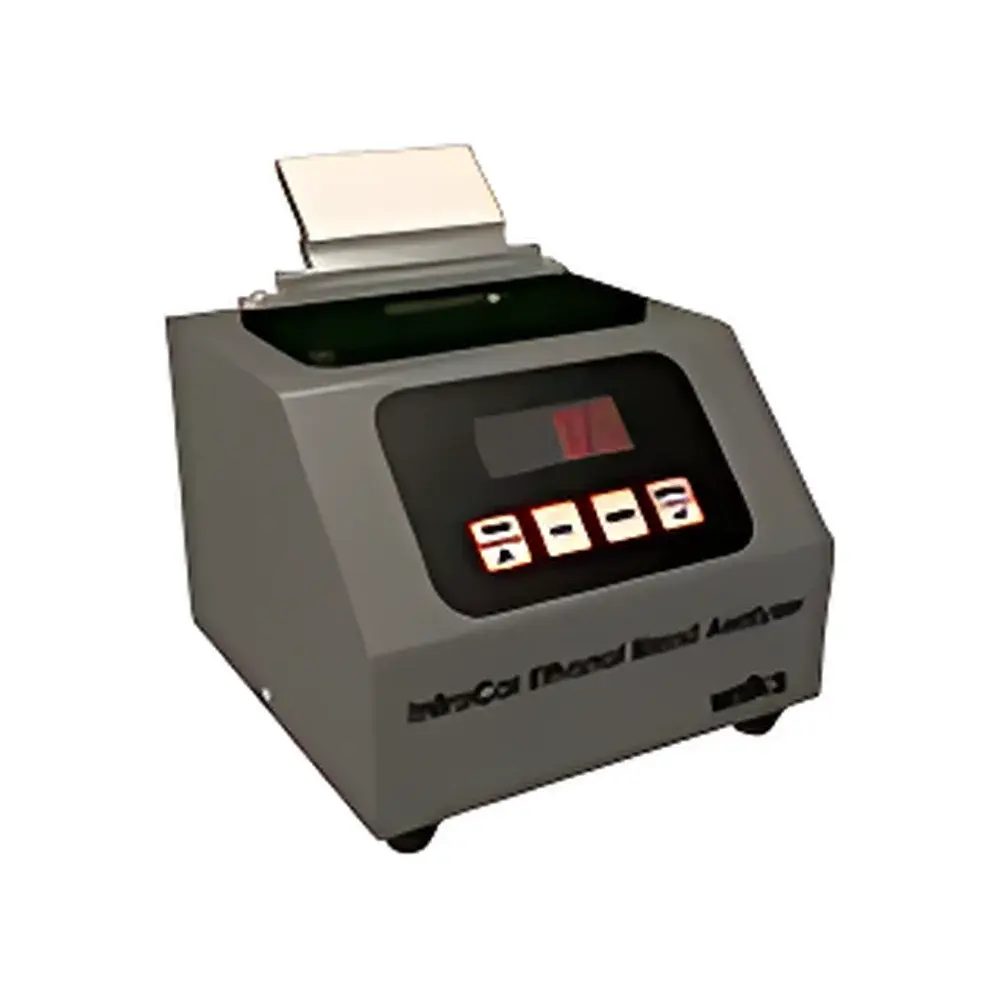
Wilks InfraSpec VFA-IR Spectrometer and InfraCal Biodiesel/Ethanol Blend Analyzers
| Brand | Wilks |
|---|---|
| Origin | USA |
| Model Series | InfraSpec VFA-IR (E, ES, EB), InfraCal Biodiesel Blend Analyzer, InfraCal Ethanol Blend Analyzer |
| Measurement Principle | Fourier-transform infrared (FTIR) spectroscopy with fixed-filter mid-IR detection |
| Sample Type | Liquid fuels and feedstocks (non-volatile and volatile) |
| Detection Capabilities | Biodiesel (FAME) in diesel, ethanol in gasoline, water in ethanol/methanol, free fatty acids (FFA) in feedstock, total glycerides, low-level biodiesel (ppm range) |
| Output Format | Direct % v/v readout for blends |
| Compliance | Designed to support ASTM D7371 (biodiesel in diesel), ASTM D4806 (ethanol in gasoline), EN 14078, and ISO 12937 methodologies |
| Portability | Handheld or benchtop configurations with ruggedized industrial housing |
| Power | Rechargeable Li-ion battery (field operation) or AC adapter |
| Data Interface | USB, optional Bluetooth |
| Software | Wilks WinISI III or InfraSoft Pro for calibration management, spectral review, audit trail, and CFR Part 11–compliant user access control |
Overview
The Wilks InfraSpec VFA-IR Spectrometer and InfraCal series of fuel analyzers constitute a purpose-built platform for rapid, field-deployable quantification of biofuel components in petroleum-based hydrocarbon matrices. These instruments operate on the principle of mid-infrared absorption spectroscopy, utilizing fixed-wavelength optical filters tuned to characteristic vibrational bands—specifically the C=O stretch at ~1745 cm⁻¹ for fatty acid methyl esters (FAME), the O–H stretch at ~3300–3500 cm⁻¹ for water, and the C–O stretch near 1050 cm⁻¹ for ethanol. Unlike dispersive or full-spectrum FTIR systems, the VFA-IR architecture employs robust, temperature-stabilized filter wheels and solid-state detectors engineered for high signal-to-noise ratio under variable ambient conditions. This design enables direct, interference-resistant measurement without solvent extraction, derivatization, or chromatographic separation—reducing analysis time from hours to under 60 seconds per sample. The platform supports both regulatory-compliant quality assurance (QA) and process control applications across refining, blending, distribution, and feedstock procurement.
Key Features
- Ruggedized industrial enclosure rated IP54 for dust and splash resistance, validated for operation in ambient temperatures from –10 °C to +50 °C
- Pre-calibrated, factory-verified chemometric models traceable to NIST SRMs for FAME, ethanol, water, FFA, and glycerides
- Integrated sample plate with removable cover to minimize evaporation during analysis of volatile samples (e.g., gasoline–ethanol mixtures)
- On-device display with intuitive menu navigation and real-time spectral preview; no external PC required for routine measurements
- Rechargeable lithium-ion battery supporting >8 hours of continuous operation or >200 analyses per charge
- USB 2.0 and optional Bluetooth 4.2 connectivity for secure data export, firmware updates, and remote diagnostics
- Self-diagnostic routines including detector linearity verification, filter position validation, and baseline drift monitoring
Sample Compatibility & Compliance
The system accommodates neat liquid fuels (diesel, gasoline, biodiesel, ethanol, methanol), crude vegetable oils, used cooking oil (UCO), animal fats, and transesterification reaction mixtures. It is validated for ASTM D7371 (infrared determination of biodiesel in diesel), ASTM D4806 (specification for denatured fuel ethanol), EN 14078 (determination of FAME content in middle distillates), and ISO 12937 (water content in petroleum products). Instrument design and software architecture facilitate compliance with GLP and GMP environments: user authentication, electronic signatures, audit trails, and calibration lockout are enforced via Wilks InfraSoft Pro software—fully aligned with FDA 21 CFR Part 11 requirements for electronic records and signatures.
Software & Data Management
Wilks InfraSoft Pro provides comprehensive instrument control, method development, calibration model building (PLS regression), and report generation. Each analysis session logs operator ID, timestamp, instrument serial number, calibration version, raw spectrum, and result uncertainty estimate. Data exports comply with CSV, PDF, and XML formats compatible with LIMS integration. The software supports multi-user role-based access (Administrator, Analyst, Reviewer), password-protected method editing, and automatic backup to network drives or cloud storage. Calibration models may be transferred between instruments within the same model family using encrypted .cal files—ensuring inter-laboratory reproducibility without revalidation.
Applications
- Quantitative determination of biodiesel (FAME) concentration in diesel fuel at levels from 0.5% to 30% v/v, with detection down to 0.1% (1000 ppm) using the InfraSpec EB configuration
- Verification of ethanol content in gasoline (E5 to E85) per ASTM D4806, including detection of phase separation indicators
- Water contamination screening in anhydrous ethanol (≤0.5% v/v) and methanol feedstocks—critical for catalyst protection in esterification reactors
- Free fatty acid (FFA) titration surrogate in virgin or waste feedstocks, supporting pretreatment decisions prior to base-catalyzed transesterification
- Total glyceride (TG) and monoglyceride (MG) monitoring during biodiesel production to assess reaction completeness and optimize washing cycles
- In-line QC at terminal rack loading arms or mobile fuel testing units for real-time blend verification prior to delivery
FAQ
What regulatory standards does this analyzer support?
ASTM D7371, ASTM D4806, EN 14078, ISO 12937, and ISO 9001-aligned calibration protocols.
Can it measure biodiesel in ultra-low-sulfur diesel (ULSD) with additives?
Yes—the chemometric models are validated against ULSD formulations containing common detergents, antioxidants, and cold-flow improvers.
Is method transfer possible between different InfraSpec units?
Yes, via encrypted .cal file import/export; cross-unit correlation studies show R² ≥ 0.998 for identical sample sets.
Does the system require annual recalibration by the manufacturer?
No—users perform daily verification with certified reference standards; factory recalibration is recommended every 24 months or after physical impact.
How is data integrity ensured for audit purposes?
All measurements include embedded digital signatures, immutable timestamps, and full audit trail logging compliant with 21 CFR Part 11 Annex 11.





