
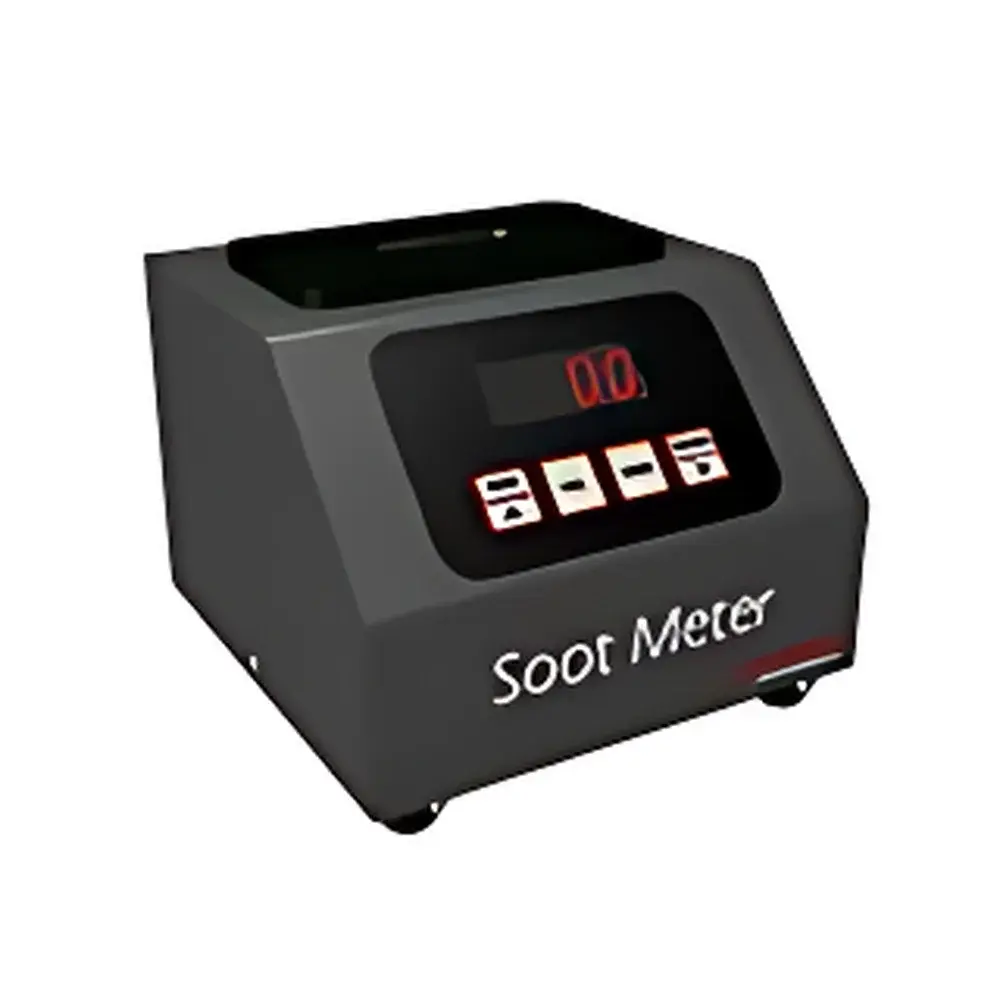
Wilks InfraCal Soot Meter HATR-CP Portable Diesel Oil Soot Analyzer
| Brand | Wilks |
|---|---|
| Origin | USA |
| Model | HATR-CP |
| Instrument Type | Portable Soot Analyzer |
| Analytical Wavelength | 3.9 µm (2553 cm⁻¹) |
| Sample Interface | Cubic Zirconia ATR Crystal |
| Display | 4-digit, 7-segment red LED (5/8″ character height) |
| Power Supply | 12 V DC, 2.0 A (universal AC/DC adapter included) |
| Weight | 2.0 kg |
| Dimensions | 165 × 165 × 225 mm |
| Operating Temperature Range | 4 °C – 45 °C |
| Typical Soot Measurement Range | 0–15 % w/w |
| Output Resolution | 0.0001 |
| Analysis Time | < 30 s |
| Repeatability | 0–3 % soot ±0.1 % |
| Calibration Memory | Factory 0–10 % soot curve + user-defined up to 20-point calibration |
| Communication | RS-232 (9-pin D-sub female, PC-compatible) |
| Compliance | ASTM D7686-11 |
Overview
The Wilks InfraCal Soot Meter HATR-CP is a portable, field-deployable Fourier-transform infrared (FT-IR) based analyzer engineered for rapid, quantitative determination of suspended carbonaceous particulates—commonly referred to as soot—in diesel engine lubricating oils. It operates on the principle of attenuated total reflectance (ATR) spectroscopy at a fixed analytical wavelength of 3.9 µm (2553 cm⁻¹), a region highly sensitive to C–H stretching vibrations characteristic of carbon-rich soot agglomerates dispersed in hydrocarbon matrices. Unlike gravimetric or thermal methods requiring solvent extraction or high-temperature decomposition, the HATR-CP enables direct, non-destructive measurement of undiluted oil samples—eliminating sample preparation, reagent use, and operator-induced variability. Its design conforms to ASTM D7686-11, the standard test method for determining soot content in diesel engine oils using mid-infrared spectroscopy with ATR sampling. This regulatory alignment ensures data integrity for condition-based maintenance programs, engine durability studies, and OEM lubricant qualification protocols.
Key Features
- Direct ATR Sampling: Integrated cubic zirconia (CZ) ATR crystal provides exceptional chemical inertness, scratch resistance, and acid stability—enabling repeated contact with aggressive used-oil matrices without degradation or calibration drift.
- Field-Ready Portability: Compact footprint (165 × 165 × 225 mm), lightweight chassis (2.0 kg), and dual power options—including integrated 12 V DC operation via universal switching supply or optional external 12 V battery pack (16 h runtime)—support deployment across mobile labs, engine test cells, marine vessels, mining sites, and roadside service bays.
- High-Resolution Quantification: 4-digit, 7-segment red LED display delivers real-time output resolution of 0.0001 % soot mass fraction, supporting precise trend analysis across low-concentration regimes (<0.5 %) critical for early-stage wear diagnostics.
- Robust Calibration Architecture: Factory-loaded 0–10 % soot calibration curve supplemented by user-configurable 20-point polynomial fitting—facilitating traceable adaptation to proprietary oil formulations, additive packages, or fleet-specific baselines.
- Validated Inter-Method Correlation: Performance benchmarked against thermal gravimetric analysis (TGA) and benchtop FT-IR per Mobil Oil Company’s Paulsboro Technical Center validation study—demonstrating mean absolute deviation <0.2 % soot across 0–15 % range and inter-unit repeatability within ±0.1 % (0–3 %) and ±0.3 % (3–15 %).
Sample Compatibility & Compliance
The HATR-CP is validated for use with conventional and synthetic diesel engine oils, including API CK-4, FA-4, and earlier CJ-4 formulations. It accommodates viscosity ranges typical of SAE 10W-30 through 15W-40 grades without dilution or heating. The instrument meets ASTM D7686-11 requirements for spectral bandwidth, signal-to-noise ratio, and calibration verification procedures. While not inherently GLP/GMP-certified, its RS-232 interface supports integration into validated data acquisition systems compliant with 21 CFR Part 11 when paired with audit-trail-enabled software. Optional accessories—including NIST-traceable reference oil sets (0–12 % soot, TGA-correlated) and serial printers with timestamped output—enable formalized calibration verification and record retention per ISO/IEC 17025 laboratory accreditation criteria.
Software & Data Management
Although the HATR-CP operates as a standalone unit with embedded firmware, its RS-232 port enables bidirectional communication with Windows-based PCs running terminal emulation or custom data logging applications. Measurement records—including sequence number, date/time stamp, soot value, and calibration ID—are exportable in ASCII format for integration into LIMS or CMMS platforms. The optional InfraLog Serial Printer (Part #403-0018) produces hard-copy reports compliant with internal QA documentation standards. All calibration parameters—including zero offset, gain coefficients, and polynomial fit coefficients—are stored in non-volatile memory, preserving traceability during power cycling or field transport. Firmware updates are performed via serial interface using manufacturer-supplied utilities, with version control and checksum validation ensuring configuration integrity.
Applications
- Real-time soot trending in diesel engine oil drain intervals for predictive maintenance scheduling
- Rapid screening of lubricant degradation in heavy-duty truck fleets, locomotive depots, and marine propulsion systems
- Validation of oil filtration efficiency and soot removal kinetics in centrifugal or electrostatic filter testing
- Supporting OEM engine development programs requiring high-frequency soot monitoring under controlled dynamometer conditions
- On-site verification of oil health at remote infrastructure sites—e.g., backup generators in telecom shelters, mining equipment in arid environments, or construction machinery operating under severe dust loading
FAQ
Does the HATR-CP require solvent extraction or sample dilution?
No. The ATR sampling interface enables direct measurement of neat, undiluted diesel engine oil—eliminating solvent handling, evaporation artifacts, and procedural variability.
Can it measure soot in bio-diesel or renewable diesel blends?
Yes—provided the base oil formulation remains conventional or synthetic mineral/hydroprocessed ester. Validation data for FAME or HVO-blended oils should be established empirically using reference materials traceable to TGA.
What is the recommended frequency for calibration verification?
ASTM D7686-11 recommends daily zero checks and weekly multi-point verification using certified reference oils—particularly after extended field deployment or exposure to temperature extremes.
Is the cubic zirconia ATR crystal susceptible to fouling from varnish or oxidation products?
The CZ crystal surface is chemically impervious to organic acids and oxidation byproducts common in degraded diesel oils. Routine cleaning with lint-free wipes and isopropyl alcohol restores optical performance without abrasion.
How does the HATR-CP handle interference from fuel dilution or nitration?
While optimized for soot detection at 3.9 µm, significant fuel dilution (>5 % v/v) or advanced nitration may introduce spectral overlap. Users should interpret results in context with complementary tests (e.g., FT-IR carbonyl index, GC-FID fuel quantification) when anomalies exceed ±0.5 % soot deviation from historical trends.
Related Products







