
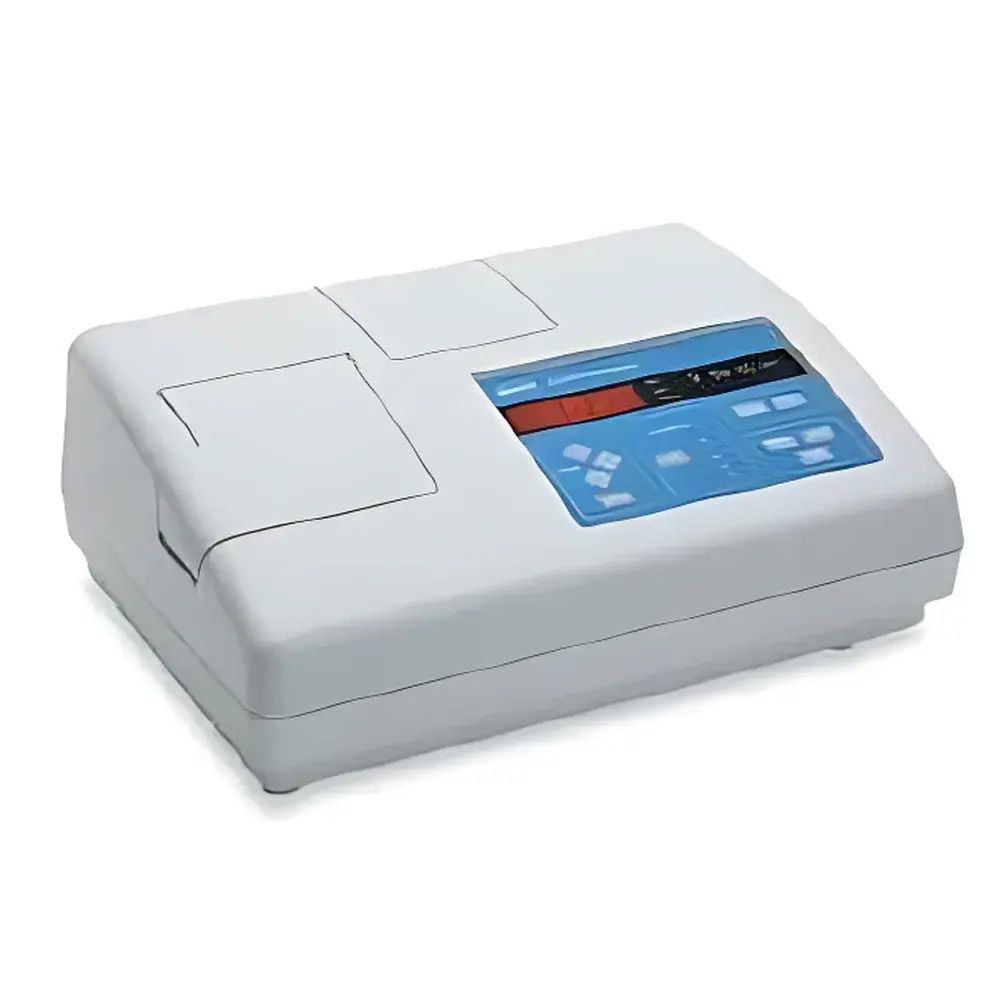
Hach 2100N Laboratory Turbidimeter
| Brand | Hach |
|---|---|
| Origin | USA |
| Manufacturer Type | Authorized Distributor |
| Product Origin | Imported |
| Model | 2100N |
| Price | Upon Request |
| Range | 0–4000 NTU |
| Accuracy | ±2% of reading (0–1000 NTU), ±5% of reading (1000–4000 NTU) |
| Resolution | 0.001 NTU |
| Minimum Sample Volume | 20 mL |
| Measurement Modes | NTU, NEP, EBC |
| Ratio Measurement | Yes |
| Signal Averaging | Programmable |
| Sample Chamber Purge | Compressed air compatible |
| Operating Environment | 10–40 °C, ≤90% RH (non-condensing at 25 °C) |
| Power Supply | 230 V, 50/60 Hz |
Overview
The Hach 2100N Laboratory Turbidimeter is a precision optical instrument engineered for reliable, traceable turbidity measurement in regulated and research-intensive environments. Based on nephelometric detection—measuring the intensity of light scattered at 90° from a collimated incident beam—the 2100N employs Hach’s proprietary dual-detector ratio measurement technology. This design actively compensates for color interference, suspended particle settling effects, and lamp aging, ensuring metrological stability across extended operational cycles. Unlike single-beam systems, the ratio method compares forward-scattered and side-scattered signals in real time, minimizing drift and enhancing accuracy—particularly critical for low-turbidity samples (e.g., drinking water compliance testing per EPA Method 180.1 or ISO 7027-1:2016). The instrument conforms to standard definitions of turbidity units (NTU), while also supporting NEP (Nephelometric Equivalence Parameter) and EBC (European Brewery Convention) scales for cross-sector compatibility in food & beverage and pharmaceutical process validation.
Key Features
- Ratio-based nephelometry: Dual-detector optical architecture eliminates colorimetric bias and improves long-term repeatability under variable sample conditions.
- Programmable signal averaging: Adjustable averaging time (1–100 seconds) optimizes signal-to-noise ratio for both rapid screening and high-precision analysis.
- Compressed-air purge system: Integrated air inlet enables active purging of the sample cell chamber to prevent condensation-induced scattering artifacts—essential for accurate measurement of cold or thermally unstable samples.
- Self-diagnostic firmware: Real-time monitoring of LED output, detector response, and optical path integrity; alerts users via on-screen codes and audible prompts for immediate troubleshooting.
- High-resolution display and intuitive interface: Backlit LCD with contextual soft keys supports multilingual operation (English, Spanish, French, German) and guided calibration workflows.
- Robust mechanical design: Anodized aluminum housing, sealed optical compartment, and vibration-dampened sample stage ensure stability during routine lab use and transport between locations.
Sample Compatibility & Compliance
The 2100N accepts standard 20 mL glass vials (10 mm path length) and accommodates a wide range of aqueous matrices—including clarified potable water, coagulated wastewater effluents, filtered groundwater, fermentation broths, and pharmaceutical rinse solutions. Its 0.001 NTU resolution and validated accuracy down to sub-1 NTU support compliance with U.S. EPA drinking water standards (40 CFR Part 141), WHO Guidelines for Drinking-water Quality, and ISO 7027-1:2016 for instrumental turbidimetry. When operated with StablCal® primary standards (traceable to NIST SRM 2100B), the system meets GLP data integrity requirements and supports audit-ready documentation for FDA 21 CFR Part 11–compliant environments when paired with HachLink™ software and appropriate user access controls.
Software & Data Management
HachLink™ Software provides secure, bidirectional communication between the 2100N and Windows-based workstations. It enables full method configuration, calibration history logging, electronic signature capture, and automated report generation (PDF/CSV). All measurements are timestamped and stored with metadata—including operator ID, calibration status, sample ID, and environmental conditions—facilitating traceability in quality control laboratories subject to ISO/IEC 17025 accreditation. Audit trails record every parameter change, calibration event, and data export action, satisfying regulatory expectations for data integrity and ALCOA+ principles (Attributable, Legible, Contemporaneous, Original, Accurate).
Applications
- Drinking water treatment: Finished water verification, filter performance monitoring, and disinfection by-product precursor assessment.
- Wastewater management: Clarifier optimization, membrane integrity testing, and tertiary effluent compliance reporting.
- Environmental monitoring: Surface water clarity profiling, sediment transport studies, and stormwater runoff characterization.
- Pharmaceutical manufacturing: Sterile filtration validation, container closure integrity testing (CCIT) support, and bioburden reduction verification.
- Academic research: Colloidal stability studies, flocculation kinetics modeling, and nanoparticle dispersion analysis.
- Food & beverage QA: Beer clarity (EBC scale), juice stabilization efficacy, and dairy processing consistency checks.
FAQ
Does the 2100N comply with EPA Method 180.1?
Yes—the 2100N meets all optical, calibration, and procedural specifications outlined in EPA Method 180.1 for laboratory turbidity measurement.
Can the instrument be used for continuous flow applications?
Not natively—but optional manual (47449-00) and automatic (47450-02) flow-through cells enable integration into process streams with external peristaltic or pressure-driven sampling.
Is calibration traceable to national standards?
Yes—StablCal® standards (26621-05) are certified reference materials traceable to NIST SRM 2100B and issued with individual uncertainty statements.
What maintenance is required beyond routine cleaning?
Annual verification of photometric linearity and detector response using Hach-certified verification kits is recommended for labs operating under ISO/IEC 17025 or GMP frameworks.
How does the air purge function improve measurement reliability?
By removing condensate films that form on optics during cold-sample analysis, the purge prevents spurious scattering events and maintains consistent beam geometry—critical for reproducibility across temperature gradients.



