
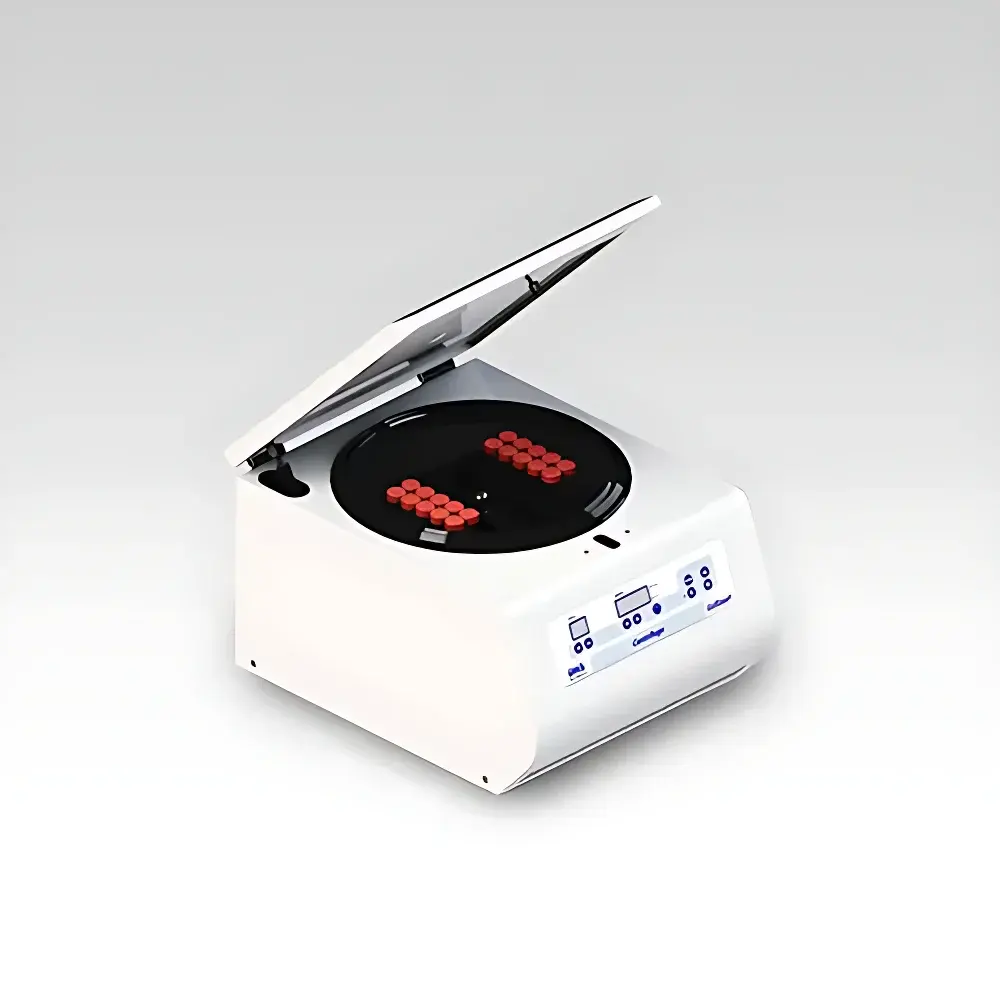
DHS CellSmart Benchtop Centrifuge
| Brand | DHS |
|---|---|
| Origin | Tianjin, China |
| Model | CellSmart |
| Instrument Type | Benchtop Centrifuge |
| Speed Range | 0–4000 rpm |
| Max RCF | 2770 × g |
| Max Capacity | 6 × 50 mL |
| Rotor Configuration | Horizontal (swing-out) rotor system |
| Sample Compatibility | Cells, bacteria, blood tubes, microcentrifuge tubes, cryovials |
| Dimensions (W×D×H) | 288 × 384 × 480 mm |
| Construction | All-metal housing, stainless-steel chamber |
| Drive System | Brushless DC motor |
| Display | High-brightness LED, rpm/rcf toggle function |
| Control | Microprocessor-based, instant spin button |
| Noise Level | ≤55 dB(A) |
| Thermal Management | Optimized airflow ducting for minimal temperature rise |
Overview
The DHS CellSmart Benchtop Centrifuge is an engineered solution for routine low-speed separation of biological suspensions—specifically optimized for cell culture workflows, bacterial pellet recovery, whole blood processing, and primary sample preparation. Operating on the principle of sedimentation under centrifugal force, the CellSmart generates a maximum relative centrifugal force (RCF) of 2770 × g at 4000 rpm, sufficient to efficiently pellet mammalian cells, yeast, and bacteria without inducing shear-induced damage or excessive heating. Its compact footprint (288 × 384 × 480 mm) enables seamless integration into biosafety cabinets, laminar flow hoods, and crowded benchtop environments—making it suitable for core labs, clinical pathology units, and academic teaching facilities where spatial efficiency and operational reliability are critical.
Key Features
- Brushless DC motor drive ensures maintenance-free operation, eliminates carbon dust contamination, and delivers consistent torque across the full speed range (0–4000 rpm).
- Horizontal swing-out rotor architecture supports high-capacity configurations—including up to 6 × 50 mL conical tubes, 20 × 15 mL tubes (both conical and round-bottom), 42 × 2 mL microtubes or cryovials, 24 × 5 mL vacutainers, or 30 × 10 mL tubes—enabling flexible throughput without compromising balance stability.
- Intelligent thermal management via engineered airflow ducting minimizes internal temperature rise during extended runs; typical ΔT remains below +3°C after 15 minutes at maximum speed, preserving thermolabile samples.
- Microprocessor-controlled interface with dual-mode LED display allows real-time switching between rotational speed (rpm) and relative centrifugal force (rcf), supporting method reproducibility and protocol alignment across ISO/IEC 17025-compliant laboratories.
- Instant-spin function permits rapid, hands-free pelleting for quick supernatant removal or brief sedimentation steps—ideal for wash cycles in cell isolation protocols.
- Stainless-steel chamber and all-metal enclosure provide corrosion resistance, ease of decontamination (including ethanol and 10% bleach compatibility), and structural integrity for daily use in GLP-aligned environments.
Sample Compatibility & Compliance
The CellSmart accommodates standard laboratory consumables compliant with IEC 61010-1 safety standards for laboratory equipment. Its rotor system accepts commercially available polypropylene and polycarbonate tubes meeting ASTM D4979 and ISO 8536 specifications. The centrifuge is designed for Class II biosafety applications and supports workflows requiring adherence to CLSI GP45-A4 guidelines for centrifugation of clinical specimens. While not certified for sterile processing per ISO 13485, its smooth interior surfaces and absence of lubricants or particulate-generating components make it suitable for cleanroom-adjacent use when paired with appropriate PPE and procedural controls.
Software & Data Management
The CellSmart operates as a standalone instrument with no embedded software or network connectivity. All parameters—including time, speed, and rcf—are set manually and retained only for the duration of the active run. No audit trail, electronic record, or data export capability is provided, aligning with its classification as a Class A general-purpose centrifuge under FDA 21 CFR Part 11 interpretation for non-GMP/non-clinical-trial settings. For laboratories requiring traceability, manual logbook entry or external time-stamped video documentation is recommended per internal SOPs.
Applications
- Cell culture: Harvesting adherent and suspension cells (e.g., HEK293, CHO, Jurkat) prior to lysis or passaging.
- Microbiology: Pelleting bacterial cultures (E. coli, S. aureus) for plasmid prep, genomic DNA extraction, or antibiotic susceptibility testing.
- Hematology: Separating whole blood into plasma, buffy coat, and erythrocyte fractions using standard 5–10 mL vacutainers.
- Biobanking: Preparing aliquots of peripheral blood mononuclear cells (PBMCs) or serum for long-term cryostorage.
- Teaching labs: Demonstrating sedimentation kinetics, density-based separation principles, and safe centrifugation practices under undergraduate life science curricula.
FAQ
What is the maximum tube size supported by the standard horizontal rotor?
The CellSmart’s primary configuration supports 6 × 50 mL conical tubes (up to 50 mL volume, max outer diameter 30 mm). Optional吊篮 (baskets) accommodate 15 mL, 10 mL, 5 mL, and 2 mL formats—each validated for balanced loading per IEC 61010-2-020 Annex B.
Is the centrifuge suitable for use with infectious samples?
Yes—when operated inside a certified biosafety cabinet and fitted with sealed rotors and O-ring–equipped buckets, the CellSmart meets containment requirements for BSL-2 agents per CDC/NIH Biosafety in Microbiological and Biomedical Laboratories (BMBL) 6th edition recommendations.
Does the unit include rotor imbalance detection or automatic shutdown?
No—the CellSmart does not feature active imbalance sensing. Users must ensure symmetrical loading and verify tube mass equivalence before initiating runs, in accordance with manufacturer-specified tolerance limits (±0.1 g per opposing position).
Can the centrifuge be used for continuous operation over multiple cycles?
Yes—its brushless motor and passive cooling design support repeated sequential runs with ≤2-minute cooldown intervals between cycles at maximum speed, provided ambient room temperature remains ≤25°C and ventilation clearance ≥10 cm is maintained on all sides.



