
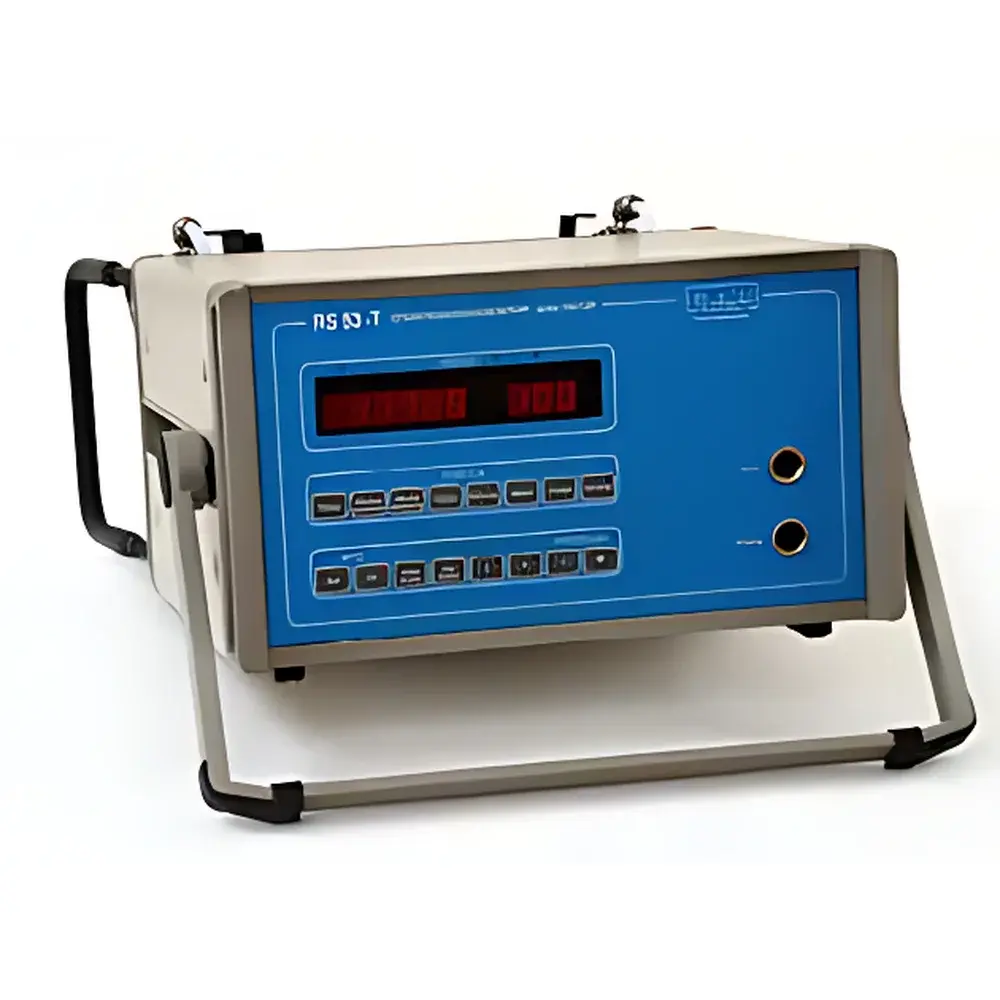
Ratfisch RS53-T Portable Total Hydrocarbon Analyzer (FID-Based)
| Brand | Ratfisch |
|---|---|
| Origin | Germany |
| Model | RS53-T |
| Instrument Type | Portable Flue Gas Analyzer |
| Measurement Principle | Flame Ionization Detection (FID) |
| Range | 0–10 / 100 / 1,000 / 10,000 / 100,000 ppm (as propane) |
| Accuracy | ≤ ±1% of reading |
| Repeatability | < ±2% of full scale |
| Response Time | ≤ 2 s (without sampling line) |
| Stability | < ±2% of full scale (zero & span drift over 7 days: < ±2% and < ±4%, respectively) |
| Linearity | ±2% of full scale up to 10,000 ppm |
| Cross-Sensitivity to O₂ | < ±2% of full scale |
| Detection Limit | < 2% of full scale |
| Zero Drift | < ±2% FS/week |
| Span Drift | < ±4% FS/week |
| Sample Flow Rate | ~90 L/h |
| Output Signals | 0–10 V or 0/4–20 mA |
| Operating Temperature | +5 °C to +35 °C |
| Power Supply | 230 V / 50 Hz |
| Dimensions | 360 mm × 200 mm × 500 mm |
| Weight | ~20 kg |
| Certification | TÜV-certified |
| Optional Features | ppb-range capability, heated sampling line, front-mounted particulate filter, integrated zero-air & combustion air supply, H₂ or He/H₂ fuel selector, onboard calibration gas cylinder, onboard fuel cylinder, PC communication software |
Overview
The Ratfisch RS53-T is a field-deployable, flame ionization detection (FID)-based total hydrocarbon (THC) analyzer engineered for regulatory-grade quantification of volatile organic compounds (VOCs) and total gaseous hydrocarbons in flue gas, stack emissions, and process streams. Designed and manufactured in Germany, the RS53-T adheres to the physical and electrochemical principles of FID—where hydrocarbon molecules are pyrolyzed in a hydrogen-fueled flame, generating ions proportional to carbon mass flow. This enables linear, compound-independent response across C₁–C₁₂+ aliphatic, aromatic, and olefinic species (with methane equivalence), making it suitable for compliance monitoring under EU Industrial Emissions Directive (IED), U.S. EPA Method 25A, and ISO 8573-5 for hydrocarbon contamination in compressed air systems. Its heated analysis chamber (adjustable up to 200 °C) prevents condensation of high-boiling-point organics, ensuring representative measurement in hot, humid, or variable-composition exhaust streams.
Key Features
- FID detection with dual-fuel flexibility: selectable H₂-only or He/H₂ combustion gas mixture for optimized sensitivity and flame stability
- Integrated zero-air generator and combustion air supply—eliminates external gas dependencies during field operation
- Onboard fuel cylinder (H₂ or He/H₂ blend) and certified calibration gas cylinder—enabling self-contained calibration and zero/span verification without auxiliary infrastructure
- Heated sample chamber (up to 200 °C) and optional heated sampling line—minimizing adsorption losses and water condensation artifacts
- Automatic flame monitoring and fuel cutoff logic—ensures safety compliance and extends sensor lifetime during flame-out events
- Multi-range auto-scaling (0–10 ppm to 0–100,000 ppm as propane) with manual override—supporting both trace-level TLV assessment and high-concentration combustion efficiency evaluation
- Real-time status indicators for flame integrity, sample flow rate, concentration alarm, range selection, and fault diagnostics
Sample Compatibility & Compliance
The RS53-T accepts hot, wet, and particulate-laden flue gases directly from stacks or ducts. Optional front-mounted sintered metal filters (5 µm nominal) and heated sampling lines (up to 180 °C) enable robust operation in cement kilns, incinerators, and chemical reactor off-gases. All internal wetted surfaces are passivated stainless steel; no catalytic or polymer components contact the sample stream. The instrument carries TÜV certification per EN 15267-3 for continuous emission monitoring systems (CEMS), and its measurement performance aligns with EN 12619 (automated THC analyzers) and ASTM D6348 (standard test method for gaseous hydrocarbons). Data integrity meets GLP/GMP expectations via time-stamped audit trails and configurable alarm logging—compatible with FDA 21 CFR Part 11 when paired with validated PC software.
Software & Data Management
The RS53-T supports analog output (0–10 V or 4–20 mA) for integration into PLC-based control systems and SCADA networks. An optional Windows-compatible communication software package provides real-time data visualization, automated calibration reporting, trend analysis (7-day rolling storage), and CSV export for third-party LIMS or environmental databases. All configuration changes, zero/span events, and alarm triggers are timestamped and stored internally with user-accessible event logs. Firmware updates are performed via USB interface with cryptographic signature validation to ensure system integrity.
Applications
- Regulatory stack testing for VOC and THC emissions per EPA, EU IED, and national air quality ordinances
- Combustion optimization in boilers, furnaces, and thermal oxidizers via real-time hydrocarbon slip monitoring
- Threshold limit value (TLV) assessment in workplace ambient air and fenceline monitoring zones
- Leak detection and repair (LDAR) programs requiring rapid, quantitative field screening
- Process troubleshooting in petrochemical, pharmaceutical, and coating manufacturing where solvent recovery efficiency must be verified
- Calibration verification of fixed CEMS installations using portable reference-grade instrumentation
FAQ
What hydrocarbon species does the RS53-T detect?
It responds to all organic compounds containing C–H bonds—including methane, ethane, benzene, toluene, xylene, and heavier aliphatics—with near-uniform sensitivity normalized to propane equivalents.
Is the RS53-T suitable for measuring methane alone?
Yes, though it reports total hydrocarbons; for speciated methane analysis, GC-FID or NDIR instrumentation is recommended.
Can it operate continuously for unattended monitoring?
It is designed for periodic field use (typically 4–8 h per charge); continuous operation requires external AC power and periodic maintenance (e.g., flame jet cleaning every 200 h).
How often does calibration verification require traceable standards?
Per EN 15267-3, daily zero/span checks are recommended for compliance applications; full multi-point calibration every 7 days ensures traceability to NIST-traceable propane standards.
Does the analyzer support data export for regulatory reporting?
Yes—via analog output or optional PC software with configurable report templates compliant with EU MRV and EPA electronic reporting requirements.







