
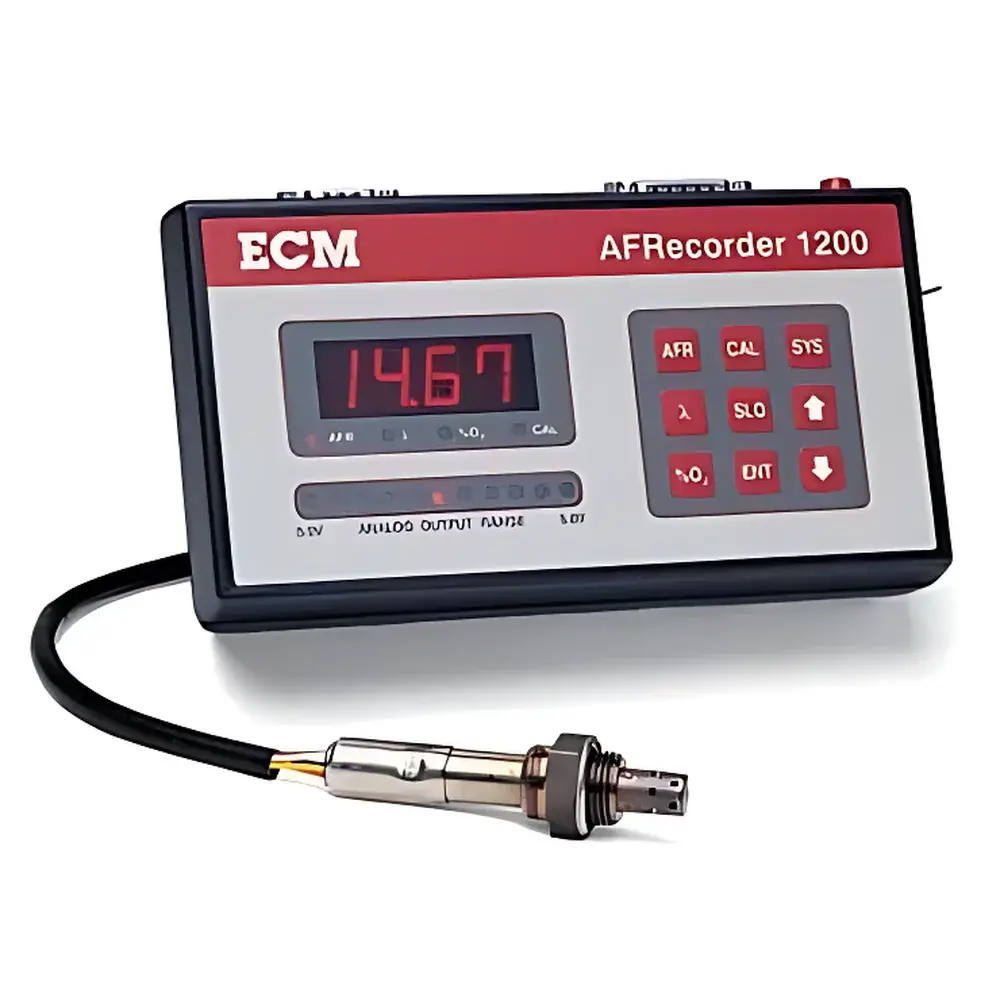
ECM AFRecorder1200 Air-Fuel Ratio Analyzer
| Brand | ECM |
|---|---|
| Origin | USA |
| Model | AFRecorder1200 |
| Instrument Type | Portable |
| Detection Principle | Electrochemical Sensing |
| Measurement Range | AFR 6–150 |
| Accuracy | ±0.6% (stoichiometric), ±0.9% (full range) |
| Response Time | <150 ms |
| Calculation Interval | 1 ms |
| Fuel Flexibility | Configurable H:C, O:C, N:C ratios and H₂ content |
| Analog Output | Linearized 0–5 V (BNC female) |
| Digital Interface | RS232 (bidirectional) |
| SEGO Sensor Output | User-configurable |
| Data Logging | Integrated |
| Statistical Functions | Mean, Min, Max, Standard Deviation |
| Power Supply | 11–28 VDC (with 100–250 VAC/DC adapter) |
| Dimensions | 190.5 × 101.6 × 30.5 mm (W × H × D) |
| Weight | 290 g |
Overview
The ECM AFRecorder1200 Air-Fuel Ratio Analyzer is a discontinued but historically significant portable instrumentation platform engineered for real-time, high-fidelity combustion stoichiometry monitoring in dynamic engine and exhaust environments. Built upon electrochemical sensing technology using the NTK wideband oxygen sensor architecture, the AFRecorder1200 delivers rapid, linearized air-fuel ratio (AFR), lambda (λ), equivalence ratio (φ), and oxygen concentration (O₂) measurements across a broad operational envelope. Its core measurement principle relies on dual-cell zirconia-based electrochemical pumping cells operating under controlled bias voltage—enabling precise oxygen partial pressure quantification and subsequent stoichiometric calculation via embedded fuel-specific combustion equations. Designed for laboratory validation, powertrain development, and field-based emissions diagnostics, the unit was widely deployed in R&D facilities complying with SAE J1930, ISO 8714, and EPA 40 CFR Part 1065 test protocols.
Key Features
- Real-time electrochemical sensing with sub-150 ms response time and 1 ms internal calculation cycle—optimized for transient engine operation and closed-loop control feedback.
- Fuel-agnostic configuration: supports gasoline, diesel, ethanol (E85), methanol, natural gas (CNG), propane (LPG), hydrogen, and blended fuels via user-definable atomic ratios (H:C, O:C, N:C) and optional H₂ compensation.
- Linearized 0–5 V analog output (BNC female) with factory-calibrated scaling—compatible with oscilloscopes, data acquisition systems (e.g., National Instruments DAQ, Dewetron, ETAS INCA), and PLC interfaces.
- Bidirectional RS232 serial interface supporting ASCII command protocol for remote configuration, live data streaming, and firmware-level parameter adjustment.
- Onboard non-volatile memory for autonomous data logging at user-selectable intervals—retaining timestamped AFR, λ, φ, O₂, and derived statistics without external host dependency.
- Compact, ruggedized enclosure (190.5 × 101.6 × 30.5 mm; 290 g) with integrated thermal management—rated for continuous operation within −20 °C to +70 °C ambient conditions.
- Universal power architecture: operates from 11–28 VDC input or via included 100–250 VAC/DC switching adapter—suitable for benchtop, vehicle-mounted, or mobile test cell deployment.
Sample Compatibility & Compliance
The AFRecorder1200 was validated for use with exhaust gas streams containing up to 10% CO₂, ≤5% H₂O (v/v), and trace hydrocarbons typical of spark-ignition and compression-ignition engines. It complies with electromagnetic compatibility requirements per FCC Part 15 Class B and CE Directive 2014/30/EU. While not certified for safety-critical automotive ECUs, its measurement traceability aligns with NIST-traceable calibration practices and supports GLP-compliant documentation when used with validated sensor assemblies. The device meets functional safety expectations for non-intrusive diagnostic instrumentation per ISO 26262 ASIL-A guidance when integrated into test benches adhering to IEC 61000-4 series immunity standards.
Software & Data Management
Data acquisition and post-processing were facilitated through ECM’s legacy Windows-based AFRecorder Utility (v3.x), which enabled real-time visualization, CSV export, statistical summary generation (mean, min, max, standard deviation), and alarm threshold configuration (though hardware-level alarms were not implemented). All logged datasets included embedded UTC timestamps, sensor health flags, and raw pump current diagnostics. Audit trails and electronic signatures were not natively supported; however, integration with third-party platforms such as MATLAB, LabVIEW, or CANape permitted 21 CFR Part 11-compliant data handling when paired with appropriate validation packages and procedural controls.
Applications
- Engine calibration and ECU development—particularly for wide-open throttle (WOT), deceleration fuel cut, and cold-start enrichment mapping.
- Aftertreatment system evaluation—including three-way catalyst (TWC) light-off characterization and lean NOₓ trap (LNT) regeneration monitoring.
- Fuel formulation testing—quantifying stoichiometric shifts during biofuel blend transitions or synthetic fuel qualification.
- Emissions compliance verification—supporting steady-state and transient cycle testing per ISO 8178, UN GTR No. 15, and CARB LEV III certification procedures.
- Academic research in combustion kinetics—providing high-temporal-resolution AFR data for reaction pathway modeling and flame speed correlation studies.
FAQ
Is the AFRecorder1200 still supported by ECM?
No—ECM discontinued manufacturing and technical support for the AFRecorder1200 in 2018. Firmware updates, repair services, and spare sensor assemblies are no longer available directly from the manufacturer.
Can the AFRecorder1200 be calibrated in-house?
Yes—using certified span gases (e.g., 20.9% O₂ in N₂ for zero/span, and known AFR reference mixtures), users could perform two-point calibration via RS232 commands. However, full sensor cell reconditioning requires proprietary equipment and is not field-serviceable.
What alternatives does ECM currently offer?
ECM now recommends the AF-X Series (e.g., AF-X3 and AF-X5), which feature upgraded sensor electronics, CAN bus output, enhanced temperature compensation algorithms, and extended diagnostic telemetry—including real-time sensor degradation metrics and predictive maintenance alerts.
Does the device meet modern cybersecurity requirements for connected lab instruments?
No—the AFRecorder1200 lacks network connectivity, encryption, or secure boot functionality. It is classified as an isolated, standalone measurement node and should be operated in air-gapped test environments where IT security policies prohibit unauthenticated external communication.
Are calibration certificates provided with used units?
No—unless explicitly retained and archived by prior owners, NIST-traceable calibration documentation is not transferable. Re-certification must be performed by an ISO/IEC 17025-accredited laboratory prior to regulated use.
Related Products







