
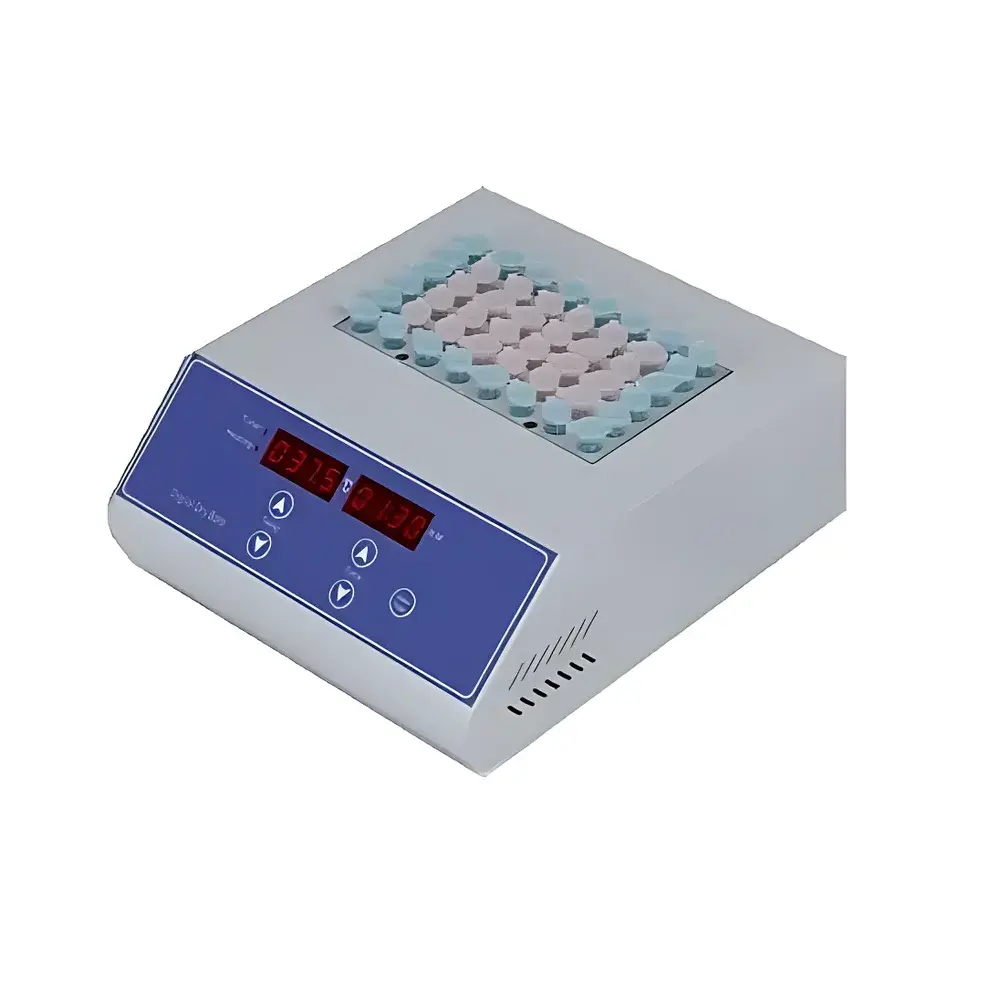
MENTS JY200-2 Advanced Dry Block Heater
| Brand | MENTS |
|---|---|
| Origin | Beijing, China |
| Manufacturer Type | OEM Manufacturer |
| Country of Origin | China |
| Model | JY200-2 |
| Price | USD 630 (FOB) |
| Temperature Range | Ambient +5°C to 160°C |
| Temperature Accuracy | ±0.5°C (@40°C), ±1.0°C (@120°C) |
| Temperature Uniformity | ±0.5°C |
| Heating Time | ≤15 min (25°C → 160°C) |
| Display Resolution | 0.1°C |
| Timer Range | 1–99 h 59 min |
| Power | 500 W |
| Input Voltage | AC 220 V |
| Dimensions (W×D×H) | 260 × 220 × 100 mm |
| Net Weight | 7 kg |
| Aluminum Block Material | High-Purity Anodized Aluminum |
| Over-Temperature Protection | Integrated Thermal Cut-Off |
| Calibration Offset Adjustment | User-Accessible via Keypad |
Overview
The MENTS JY200-2 Advanced Dry Block Heater is a microprocessor-controlled, dual-zone dry bath instrument engineered for precise, stable, and repeatable thermal incubation across life science, clinical diagnostics, and quality control laboratories. Unlike water baths, it employs high-purity anodized aluminum blocks as the primary heat transfer medium—offering rapid thermal response, zero evaporation risk, minimal maintenance, and enhanced contamination control. Its operational range spans from ambient +5°C to 160°C, making it suitable for applications requiring elevated temperatures such as enzyme inactivation, protein denaturation, serum coagulation, DNA pre-denaturation prior to PCR setup, and solvent evaporation protocols. The device complies with fundamental safety and electromagnetic compatibility requirements per IEC 61010-1:2010 for laboratory electrical equipment and is constructed with flame-retardant housing materials meeting UL94 V-0 standards.
Key Features
- Dual independent heating blocks allow simultaneous operation at two distinct setpoints—enabling parallel processing of different sample types or temperature-dependent reaction steps.
- High-resolution LED display shows real-time block temperature, setpoint, countdown timer, and system status—including fault codes for immediate diagnostics.
- User-accessible temperature offset calibration ensures long-term traceability and alignment with reference thermometers, supporting GLP-compliant documentation workflows.
- Integrated over-temperature cut-off circuitry (thermal fuse + electronic limiter) provides redundant protection against runaway heating—critical for unattended overnight runs.
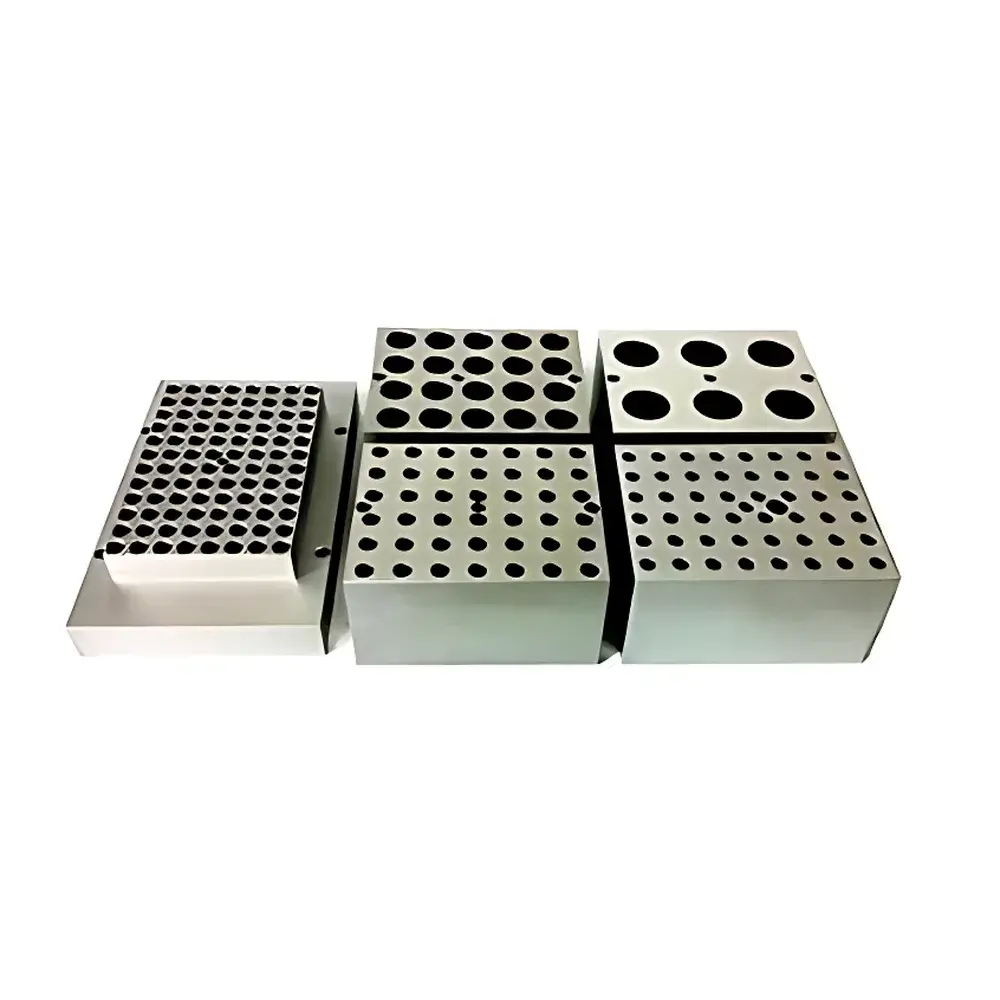
- Quick-release, tool-free block interchange system supports rapid decontamination and cross-application flexibility; all standard modules are autoclavable (121°C, 20 min).
- Intelligent PID control algorithm minimizes overshoot and stabilizes temperature within ±0.5°C uniformity across the active zone—verified per ISO/IEC 17025 calibration practices.
Sample Compatibility & Compliance
The JY200-2 accommodates a broad spectrum of tube formats via 13 standardized interchangeable aluminum blocks—including 0.2 mL, 0.5 mL, 1.5 mL, and 2.0 mL microcentrifuge tubes; 6–40 mm diameter test tubes; and 96-well PCR plate configurations. Optional custom blocks are available upon request to meet proprietary vessel geometries. All blocks feature precision-machined wells with tight dimensional tolerances (±0.05 mm) to ensure optimal thermal contact and minimize axial temperature gradients. The instrument is routinely deployed in environments adhering to CLIA, CAP, and ISO 15189 requirements; its programmable timer and stable thermal performance support documented incubation protocols required under USP Analytical Instrument Qualification guidelines.
Software & Data Management
While the JY200-2 operates as a standalone unit without PC connectivity, its embedded firmware supports full audit-trail functionality through non-volatile memory logging: up to 100 recent cycle records—including start time, duration, setpoint, final block temperature, and any triggered alarms—are retained after power cycling. All user-modifiable parameters (e.g., calibration offset, buzzer enable/disable, default timer) are password-protected to prevent accidental changes during shared-lab use. For integration into networked lab environments, optional RS-232 or USB-to-serial adapters (sold separately) enable remote parameter readout and basic command control using ASCII protocol—compatible with LabVantage, STARLIMS, and custom Python-based monitoring scripts.
Applications
- Pre-analytical sample conditioning: serum clotting (37°C), plasma separation stabilization (4°C block variant required), and whole-blood incubation prior to hematology analysis.
- Molecular biology workflows: hot-start PCR setup, restriction enzyme digestion termination, cDNA synthesis pre-incubation, and agarose gel loading buffer warming.
- Pharmaceutical QC: dissolution media pre-heating, excipient melting point verification, and stability study sample equilibration per ICH Q5C guidelines.
- Industrial microbiology: microbial enumeration media activation, endotoxin assay LAL reagent warming, and sterility test membrane filtration rinse solution tempering.
- Forensic toxicology: derivatization reaction incubation (e.g., silylation at 70–90°C) and solid-phase extraction eluent evaporation at controlled low-boiling-point temperatures.
FAQ
What is the maximum recommended continuous operating temperature for the JY200-2?
The unit is rated for continuous operation up to 160°C; however, sustained use above 120°C may reduce long-term thermal sensor drift stability—calibration verification every 6 months is advised under such conditions.
Can the JY200-2 be used for cooling applications?
No. This is a heating-only dry block system; it does not incorporate Peltier or refrigeration elements. For cooling + heating capability, consider the MENTS TC-2000 series thermoelectric incubators.
Are the aluminum blocks resistant to common laboratory solvents?
Yes—blocks are hard-anodized per MIL-A-8625 Type III, providing excellent resistance to ethanol, isopropanol, acetone, and diluted acids/bases; prolonged exposure to concentrated HCl or NaOH is not recommended.
Does the JY200-2 meet FDA 21 CFR Part 11 requirements?
As a Class I stand-alone instrument without electronic signature or multi-user role management, it does not fully comply with Part 11—but its audit-trail-capable firmware and calibration log retention support ALCOA+ data integrity principles when used within validated SOPs.
How often should the temperature accuracy be verified?
Per ISO/IEC 17025 Clause 5.9.1, users should perform independent verification using a NIST-traceable thermometer at least quarterly—or before each critical assay run where temperature deviation could impact result validity.
Related Products



