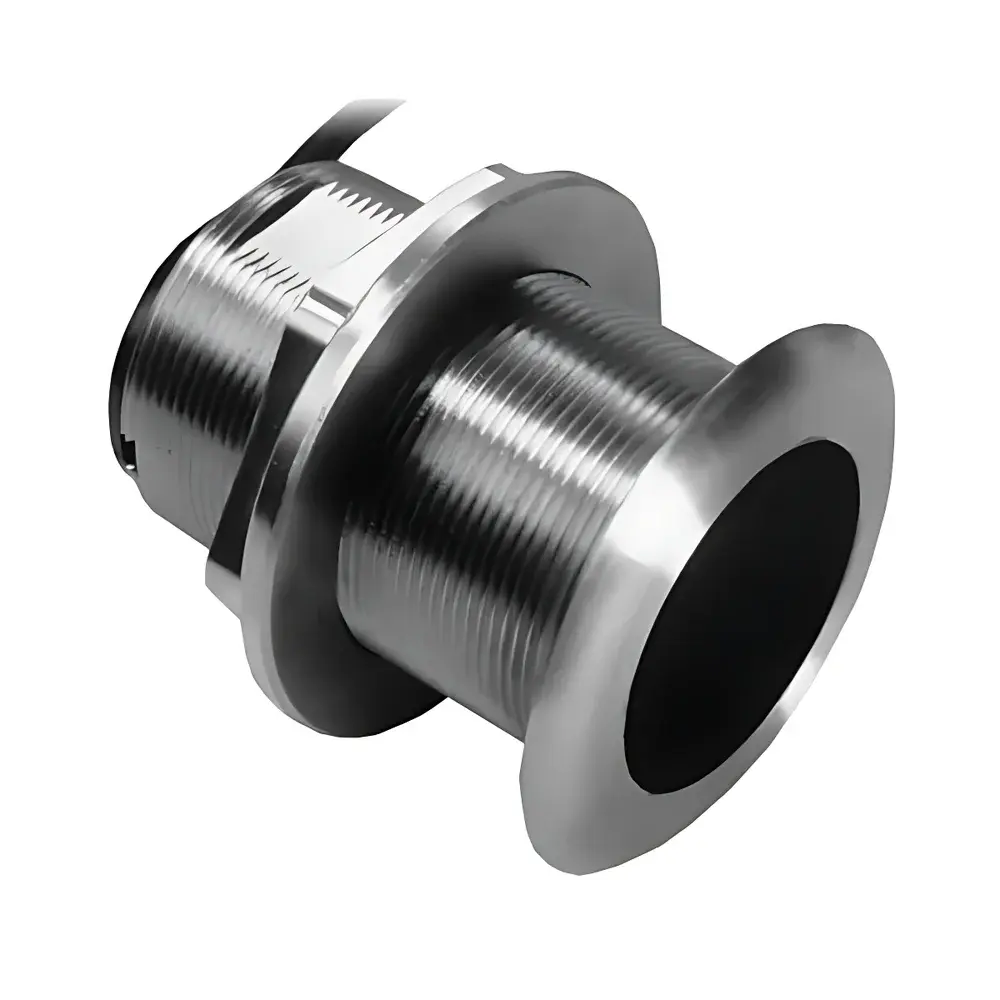
AirMar SS60 Dual-Frequency Through-Hull Depth Sounder
| Brand | AIRMAR |
|---|---|
| Origin | USA |
| Model | SS60 |
| Frequency Bands | 50 kHz / 200 kHz |
| Beam Width | 45° @ 50 kHz, 12° @ 200 kHz |
| Transmit Power | 600 W |
| Housing Material | Stainless Steel |
| Mounting Type | Low-Profile Through-Hull |
| Cutout Diameter | 60 mm |
| Stub Length | 68.5 mm |
| Cable Length | 10 m |
| Integrated Tilt Sensor | Yes |
| Integrated Temperature Sensor | Yes |
| Maximum Hull Tilt Compensation | 24° |
| Acoustic Window Material | Polyurethane |
| Weight | 1.4 kg |
| Recommended Hull Length | Up to 8 m (25 ft) |
| Compatible Hull Inclinations | 0°, 12°, 20° |
Overview
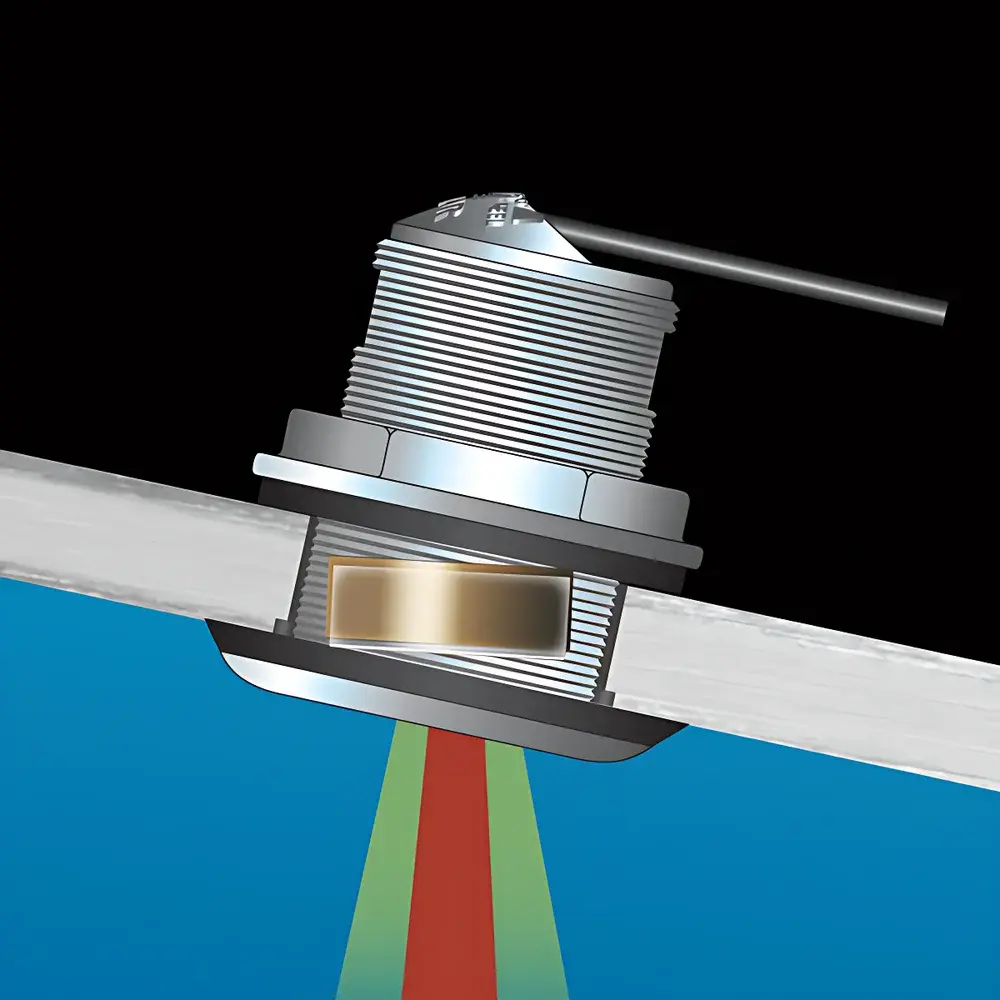
The AirMar SS60 is a dual-frequency, through-hull depth sounder engineered for precision hydrographic performance in shallow-to-moderate offshore and inland water environments. Utilizing piezoceramic transducer elements operating simultaneously at 50 kHz and 200 kHz, the SS60 leverages fundamental principles of pulse-echo sonar: acoustic energy is transmitted into the water column, reflected from the seabed or suspended targets, and returned to the transducer for time-of-flight calculation and depth derivation. Its unique low-profile, near-flush mounting geometry—protruding only 5 mm beyond the hull surface—minimizes hydrodynamic drag while maintaining consistent beam alignment under dynamic vessel motion. Critically, the integrated tilt sensor enables real-time correction of beam pointing angle relative to true vertical, ensuring accurate depth measurement even on hulls with up to 24° deadrise. This architecture eliminates the need for external fairings or complex mechanical leveling systems, delivering performance comparable to professionally faired installations without compromising hull integrity or speed efficiency.
Key Features
- Dual-frequency operation (50 kHz for long-range bottom tracking in deeper coastal waters; 200 kHz for high-resolution imaging and fish detection in lakes and bays)
- Low-profile through-hull design with 5 mm external protrusion—optimized for planing hulls, center consoles, and sportfishing vessels up to 8 m (25 ft)
- Integrated solid-state tilt sensor enabling automatic beam compensation across 0°, 12°, and 20° hull deadrise configurations
- Stainless steel housing rated for corrosion resistance in saltwater and brackish environments; compatible alternative B60 bronze variant available for aluminum or wood hulls
- Polyurethane acoustic window providing broadband impedance matching, cavitation resistance, and mechanical damping
- Onboard temperature sensor supporting water-column sound velocity correction per ASTM D1073 and ISO 18925 standards
- 600 W peak transmit power with narrow-beam focusing at 200 kHz (12°) and wide-beam coverage at 50 kHz (45°) for versatile target discrimination
Sample Compatibility & Compliance
The SS60 is designed for installation on fiberglass, aluminum, and composite hulls with deadrise angles up to 24°. It complies with marine electromagnetic compatibility requirements per EN 50081-2 and EN 50082-2. The stainless steel housing meets ASTM A276 Type 316 specifications for marine-grade austenitic stainless steel. The polyurethane acoustic window conforms to UL 94 HB flammability rating and exhibits stable acoustic impedance (Z ≈ 2.5 MRayl) across temperatures from –10 °C to +50 °C. Installation requires adherence to ABYC E-11 and ISO 8846 marine electrical safety standards. No hazardous substances are used in construction; RoHS 2011/65/EU and REACH SVHC compliance is certified by AIRMAR.
Software & Data Management
The SS60 outputs NMEA 2000 (PGN 128259, 128267) and NMEA 0183 (DPT, MTW, VHW) sentences for seamless integration with multifunction displays (MFDs), chartplotters, and vessel management systems. Raw echo data is not stored onboard; however, third-party logging software (e.g., Actisense NGT-1, Maretron DSM250) can capture and timestamp depth, temperature, and tilt metadata for post-mission analysis. When deployed in GLP-compliant survey workflows, the device supports audit-trail–capable data acquisition when paired with NMEA 2000-certified gateways that log PGN transmission timestamps and source IDs—meeting foundational traceability requirements per ISO/IEC 17025:2017 Clause 7.5.2.
Applications
- Commercial and recreational inshore fishing operations requiring reliable bottom contour mapping and thermocline identification
- Scientific limnological surveys in lakes and reservoirs where low-drag mounting preserves vessel maneuverability during transect sampling
- Coastal navigation support for vessels operating in tidal estuaries with rapidly shifting bathymetry
- Deployment on research platforms conducting multi-parameter water column profiling (when integrated with CTD or ADCP systems via NMEA 2000 backbone)
- Regulatory monitoring applications involving depth-referenced gear deployment (e.g., gillnet setting, trap placement) under NMFS or regional fisheries management frameworks
FAQ
What hull materials are compatible with the SS60 stainless steel version?
The SS60 stainless steel housing is recommended for fiberglass, carbon fiber, and GRP hulls. For aluminum or wooden hulls, the B60 bronze-housed variant is advised to prevent galvanic corrosion.
Does the SS60 require a separate heading sensor for tilt compensation?
No—the SS60 incorporates a factory-calibrated MEMS tilt sensor; no external gyro or compass input is required for deadrise compensation.
Can the SS60 be used in freshwater lakes with depths exceeding 100 m?
At 50 kHz, the SS60 achieves reliable bottom detection to approximately 90 m in typical freshwater conditions (sound velocity ~1470 m/s); performance beyond this depends on sediment composition and noise floor.
Is the polyurethane acoustic window replaceable in the field?
The acoustic window is permanently bonded during manufacturing and is not user-replaceable; damage requires transducer unit replacement per AIRMAR service guidelines.
How does the SS60 handle signal interference from multiple echosounders on the same vessel?
The SS60 employs frequency-agile pulse scheduling and built-in blanking intervals aligned with NMEA 2000 timing protocols to minimize cross-talk; simultaneous operation with other 50/200 kHz devices is supported when installed with ≥1.5 m separation.