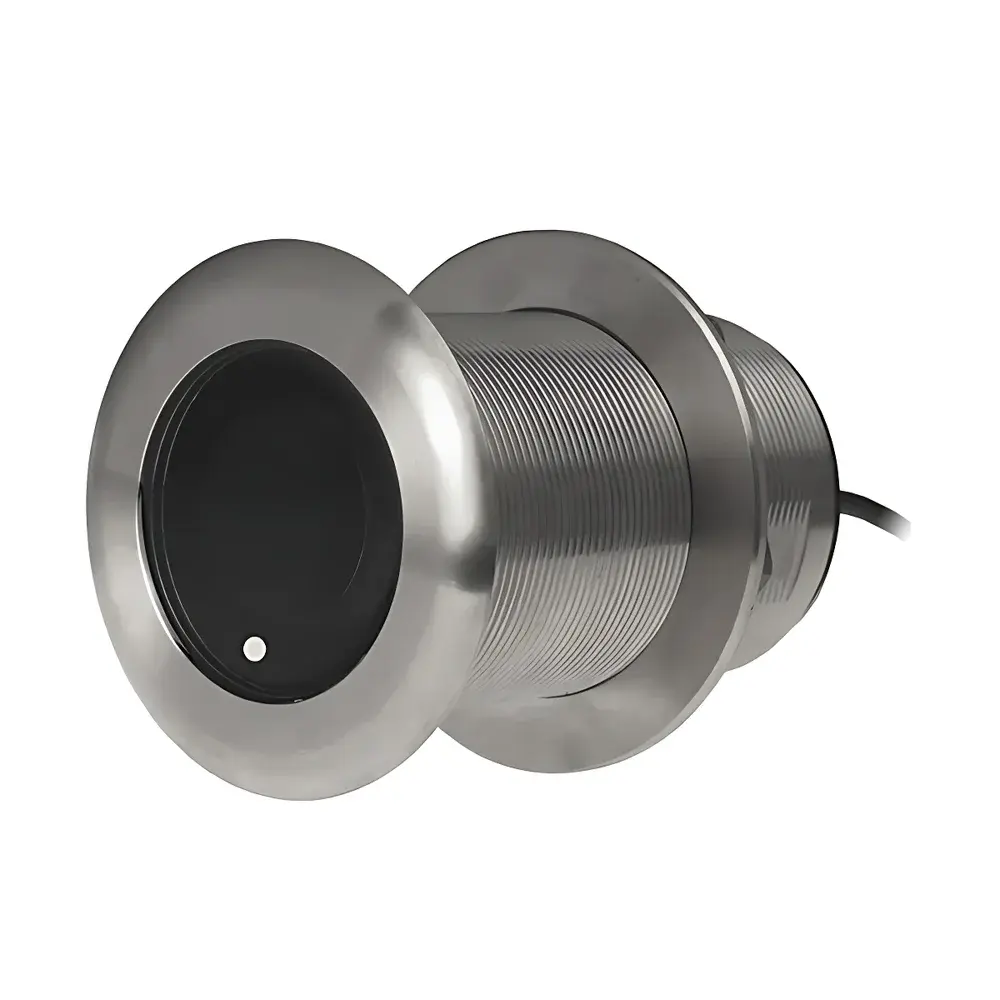
AIRMAR SS75M Chirp Depth Sounder
| Brand | AIRMAR |
|---|---|
| Origin | USA |
| Model | SS75M |
| Operating Frequency Range | 80–130 kHz |
| Output Power | 600 W |
| Beamwidth | 24°–16° (depending on tilt) |
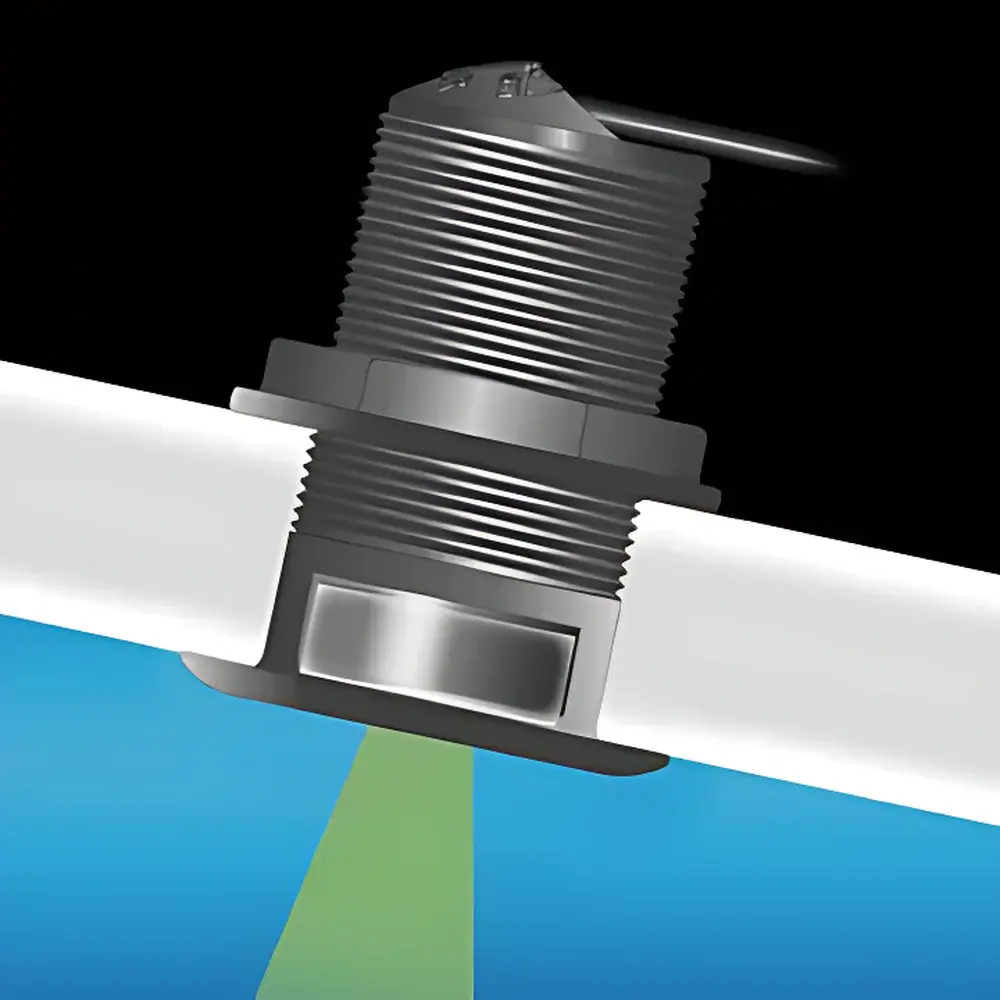
| Transducer Mounting | Through-hull |
| Housing Material | Stainless Steel |
| Cutout Diameter | 70 mm |
| Shaft Length | 95 mm |
| Cable Length | 10 m |
| Integrated Temperature Sensor | Yes |
| Weight | 1.4 kg |
| Maximum Hull Deadrise Angle | 28° |
| Acoustic Window Material | Polyurethane |
| Compatible Hull Materials | Fiberglass, Wood |
| Chirp Bandwidth | 50 kHz |
| Target Detection Depth | Up to 3,000 m |
| Tilt Options | 0°, 12°, 20° |
Overview
The AIRMAR SS75M Chirp Depth Sounder is a high-performance, through-hull mounted single-beam echosounder engineered for precision bathymetric measurement and real-time water temperature profiling in marine environments. Utilizing broadband frequency-modulated (FM) chirp sonar technology, the SS75M transmits continuous swept-frequency pulses across an optimized 50 kHz bandwidth (80–130 kHz), enabling superior signal-to-noise ratio, enhanced bottom discrimination, and significantly improved target resolution compared to conventional pulsed echo sounders. This principle—based on pulse compression and matched filtering—allows the system to resolve closely spaced acoustic returns with high fidelity, supporting accurate differentiation of fish schools (including baitfish and game species), submerged structures, and sediment layers at depths up to 3,000 meters. Designed for integration into navigation, fisheries research, and hydrographic survey platforms, the SS75M delivers repeatable depth data under variable sea states and water column conditions, with minimal installation footprint and robust mechanical integrity.
Key Features
- Chirp sonar architecture operating across 80–130 kHz, delivering 5×–10× greater resolution and detail over legacy fixed-frequency systems
- Integrated high-accuracy thermistor-based water temperature sensor with fast thermal response time (≤2 s)
- Three fixed-deadrise mounting configurations: 0° (flat hull), 12°, and 20°—optimized for precise beam alignment on fiberglass or wood hulls with deadrise angles up to 28°
- Low-profile stainless steel housing with polyurethane acoustic window, corrosion-resistant and pressure-rated for continuous submersion
- Xducer ID® patent-pending transducer identification protocol enabling automatic configuration recognition by compatible chartplotters and multifunction displays
- Optimized for popular fishing frequencies at 88 kHz and 107 kHz, ensuring compatibility with widely deployed marine electronics ecosystems
- Through-hull installation design with standardized 70 mm cutout and 95 mm shaft length, minimizing hull modification requirements
Sample Compatibility & Compliance
The SS75M is validated for use on vessels up to 8 meters LOA with fiberglass or wooden hull construction. Its polyurethane acoustic window ensures optimal acoustic coupling and minimal signal attenuation across a wide range of water temperatures (−5°C to +40°C) and salinities (0–40 ppt). The transducer complies with IEC 62237-1:2015 for underwater acoustic transducers and meets EMC requirements per EN 301 489-1 V2.2.2 (2019) and EN 301 489-17 V3.2.2 (2020). While not certified for safety-critical navigation under IMO Resolution A.694(17), it is routinely deployed in GLP-aligned hydrographic data collection workflows and supports traceable calibration via NIST-traceable reference standards when integrated with compliant data loggers.
Software & Data Management
The SS75M outputs raw depth and temperature data via NMEA 2000 (PGN 128267, 128259) and NMEA 0183 (DPT, MTW) protocols, enabling seamless integration with industry-standard marine software including MaxSea TimeZero, FURUNO NavNet TZtouch, Garmin Panoptix LiveScope, and third-party hydrographic processing tools such as QPS Qimera and CARIS HIPS & SIPS. When paired with AIRMAR’s proprietary configuration utility or compatible MFDs, users can access real-time gain control, noise rejection thresholds, and bottom lock sensitivity settings. All operational parameters—including tilt angle, frequency sweep profile, and temperature offset—are stored in non-volatile memory and support audit-ready logging when used with NMEA 2000-certified recorders compliant with ISO 8217:2017 Annex G data tagging conventions.
Applications
- Commercial and recreational fisheries: Discrimination of pelagic biomass layers, identification of thermocline boundaries, and mapping of benthic habitat complexity
- Coastal bathymetric surveys: High-resolution depth profiling for nautical chart updates, dredging planning, and shoreline change analysis
- Scientific oceanography: Water column characterization in estuarine and continental shelf environments, supporting studies of mixing dynamics and plankton distribution
- Vessel performance monitoring: Real-time draft correction and under-keel clearance assessment in shallow-draft operations
- Aquaculture site evaluation: Substrate classification and mooring infrastructure inspection in nearshore lease areas
FAQ
What is the maximum operational depth for the SS75M?
The SS75M is rated for reliable bottom detection up to 3,000 meters in standard seawater conditions (15°C, 35 ppt salinity), assuming adequate signal processing and low ambient noise.
Can the SS75M be installed on aluminum or composite hulls?
No—the SS75M is specifically validated for fiberglass and wood hulls only; aluminum or carbon fiber hulls require alternative transducer models due to acoustic impedance mismatch and potential signal distortion.
Is the temperature sensor calibrated to a recognized standard?
Yes—the integrated thermistor is factory-calibrated against NIST-traceable references and maintains ±0.2°C accuracy across its full operating range.
Does the SS75M support dual-frequency operation?
No—it operates exclusively in the medium-band chirp mode (80–130 kHz); multi-frequency capability requires separate B75L/B75H or SS75L/SS75H units.
How does Xducer ID® simplify system setup?
Xducer ID® embeds transducer-specific metadata (model, tilt, frequency band) into the NMEA 2000 stream, allowing compatible displays to auto-configure display scaling, color palettes, and gain profiles without manual input.