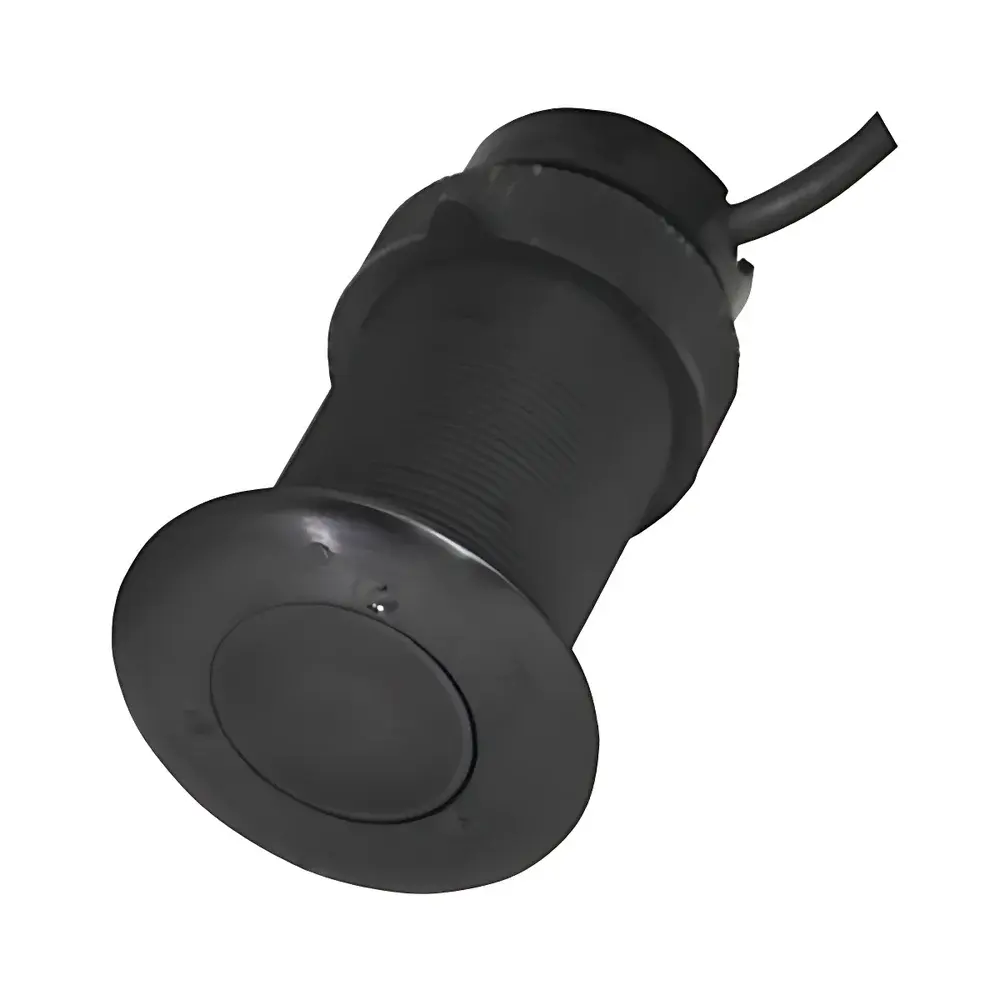
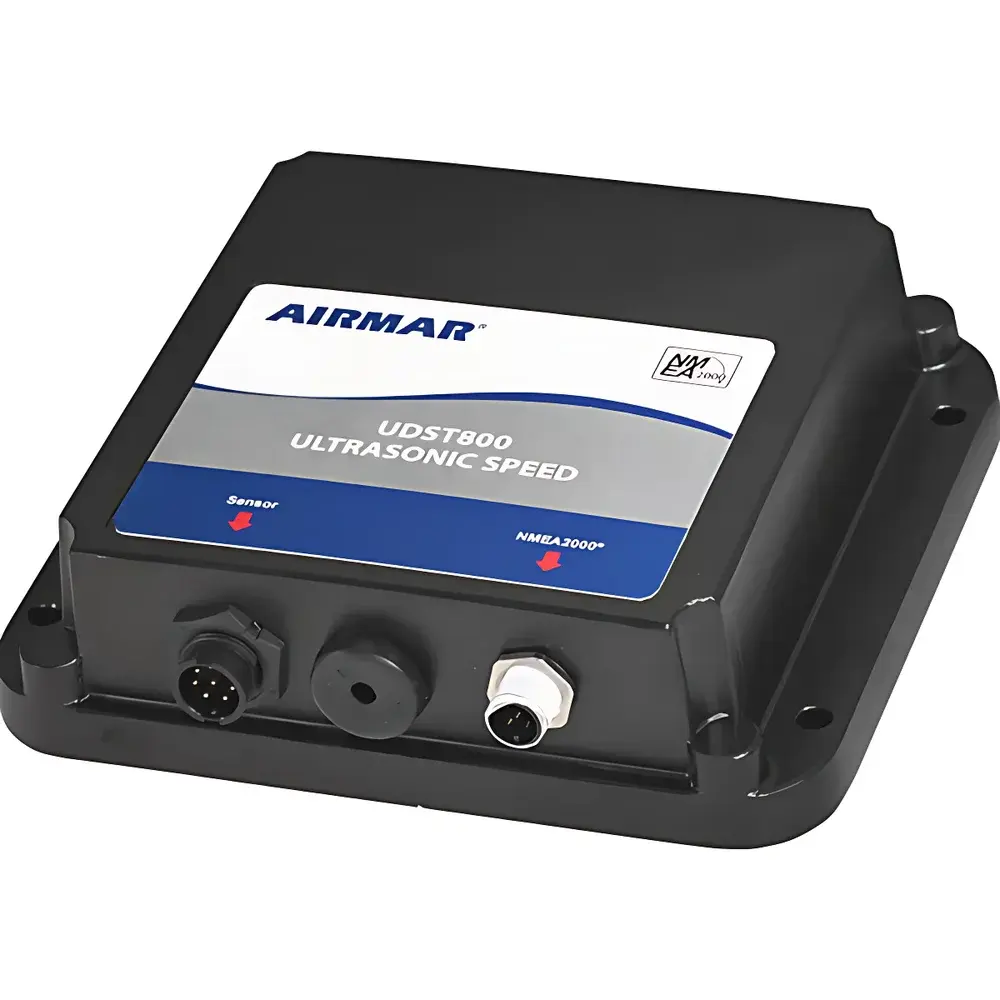
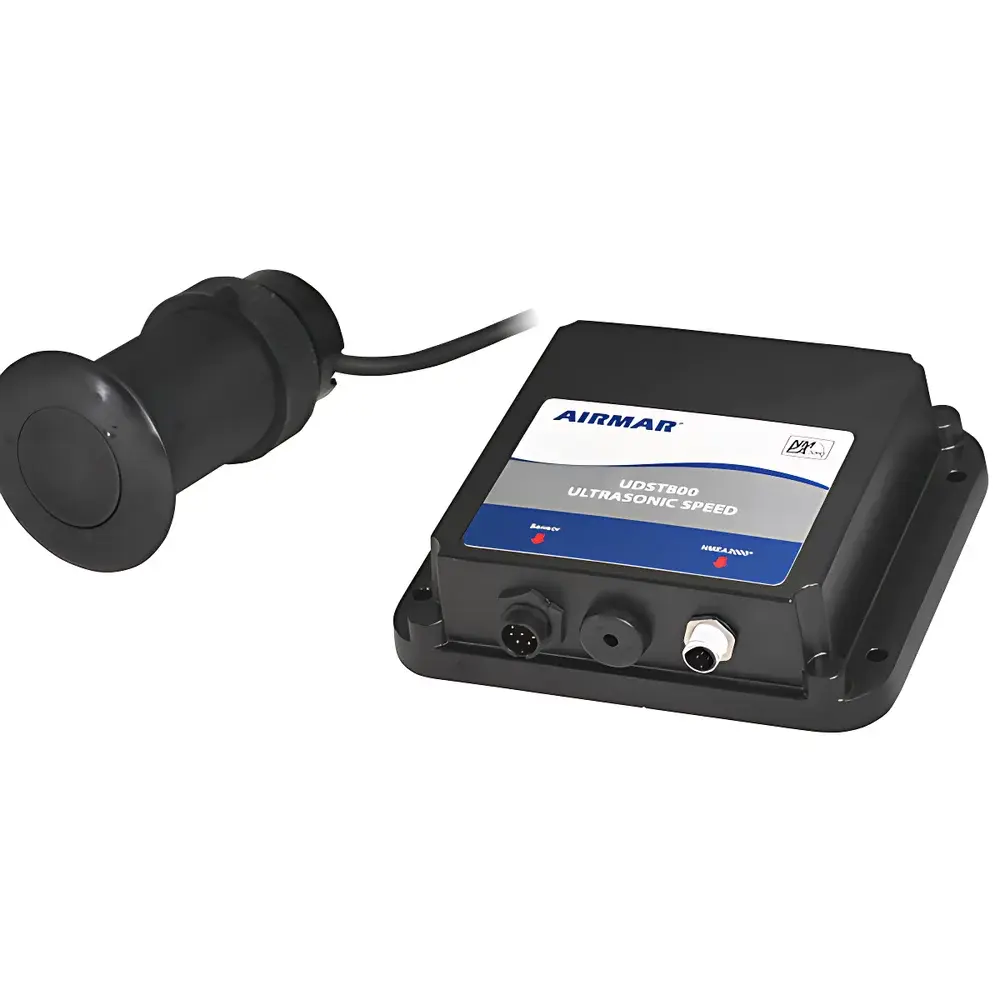
Airmar UDST800 Ultrasonic Dual-Function Speed and Temperature Transducer
| Brand | Airmar |
|---|---|
| Origin | USA |
| Model | UDST800 |
| Output | NMEA 0183 |
| Transducer Frequency | 4.5 MHz |
| Pulse Repetition Frequency | 0.5–12 kHz (adaptive) |
| Speed Range | 0.1–50 knots |
| Operating Temperature | −4 to 40 °C |
| Supply Voltage | 9–16 VDC |
| Average Current Draw | 125 mA @ 12 VDC |
| Housing Material | Plastic / Bronze / Stainless Steel |
| Housing Diameter | 51 mm |
| Weight | 1.4 kg (plastic) / 1.8 kg (bronze) |
| Compliance | EN 60945, IEC 61162-1/-2 |
Overview
The Airmar UDST800 is an ultrasonic dual-function transducer engineered for high-fidelity vessel speed-through-water (STW) and hull-integrated water temperature measurement. Unlike mechanical paddlewheel or electromagnetic sensors, the UDST800 employs time-of-flight ultrasonic correlation technology—based on the proven principle of acoustic cross-correlation between two spatially separated transducer elements—to determine water velocity with no moving parts. This solid-state architecture eliminates mechanical wear, bearing degradation, and fouling sensitivity, delivering long-term stability and repeatability across diverse marine environments. Designed specifically for integration into modern NMEA-enabled bridge systems, the UDST800 operates via a single through-hull mounting point and supports adaptive pulse repetition frequency (PRF) modulation—from 0.5 kHz at low speeds to 12 kHz at high speeds—to maintain optimal signal-to-noise ratio and sampling resolution across its full 0.1–50 knot operational envelope. Its 4.5 MHz transducer frequency ensures excellent near-field resolution and immunity to bubble interference, while its embedded digital signal processor continuously adjusts gain, filtering, and correlation windowing in real time based on vessel dynamics, water salinity, and depth conditions.
Key Features
- Integrated speed-through-water and water temperature sensing in a single transducer housing
- Zero-maintenance solid-state design with no rotating or sliding components
- Adaptive PRF control enabling consistent accuracy from drift speed (0.1 kn) to planing regimes (50 kn)
- NMEA 0183 output compliant with version 3.01, supporting both RS-232 and RS-422 electrical interfaces
- Embedded microcontroller performing real-time echo correlation, thermal compensation, and data validation
- Multi-material through-hull options (plastic, bronze, stainless steel) certified for seawater immersion per ISO 8502-9
- CE-marked and compliant with EN 60945 (Maritime Navigation and Radiocommunication Equipment) and IEC 61162-1/-2 (NMEA interface standards)
Sample Compatibility & Compliance
The UDST800 is validated for operation in both freshwater and seawater environments, with automatic salinity compensation applied during velocity calculation. Its acoustic performance remains stable across temperature gradients from −4 °C to +40 °C, meeting ASTM D5237-22 requirements for marine sensor thermal operating range. The transducer’s pressure rating exceeds 10 bar static head, ensuring integrity at typical keel-mounting depths. All housing variants comply with IMO Resolution A.694(17) for electromagnetic compatibility (EMC) and are tested per IEC 60529 IP68 for submersion protection. For regulatory traceability, each unit carries a unique serial number logged in Airmar’s ISO 9001:2015-certified manufacturing database, supporting GLP-aligned calibration record retention.
Software & Data Management
Raw speed and temperature data are output as standardized NMEA 0183 sentences: VHW (Water Speed and Heading), MWV (Wind Speed and Angle relative to Water), and MTW (Water Temperature). These sentences include built-in checksum validation and support configurable update rates up to 10 Hz. When integrated into NMEA 2000 networks via compatible gateway devices, the UDST800 data populate PGNs 127250 (Speed Log) and 130311 (Environmental Parameters), enabling seamless interoperability with chartplotters, autopilots, and performance monitoring systems. Firmware updates—delivered via USB-to-serial adapter—are digitally signed and validated prior to installation, satisfying FDA 21 CFR Part 11 requirements for electronic record integrity where applicable.
Applications
The UDST800 serves as a primary STW reference in commercial fishing vessels, research survey craft, high-performance sail yachts, and naval auxiliary platforms requiring accurate hydrodynamic feedback for fuel optimization, trim control, and dynamic positioning. Its low latency (<100 ms end-to-end delay) and high update rate make it suitable for real-time maneuvering assistance systems and autonomous surface vehicle (ASV) navigation stacks. OEM integrators leverage its compact footprint and standardized interface for inclusion in integrated bridge systems (IBS) compliant with IEC 61162-450. In scientific applications, the device supports underway CTD profiling when paired with conductivity and depth modules, fulfilling data quality criteria outlined in UNESCO/IOC Technical Series No. 113 for oceanographic sensor networks.
FAQ
Does the UDST800 require calibration after installation?
No—factory calibration is retained for the life of the transducer under normal operating conditions. Airmar provides a Certificate of Conformance with traceable NIST-traceable verification data.
Can the UDST800 be installed on aluminum or carbon fiber hulls?
Yes, provided a compatible non-conductive mounting sleeve is used to prevent galvanic corrosion; installation guidelines are detailed in Airmar Technical Bulletin TB-UDST-02.
Is firmware update capability available for field revision?
Yes—firmware version 2.1 and later support over-the-wire updates via RS-232 using Airmar’s proprietary configuration utility (Windows/macOS/Linux).
What is the maximum cable length supported for NMEA 0183 output?
Up to 50 meters using shielded twisted-pair cable meeting EIA/TIA-422-B specifications, with termination resistors applied at the receiving end.
How does the UDST800 handle air entrainment or turbulent flow near the hull?
Its adaptive correlation algorithm dynamically widens the interrogation window and applies median filtering to suppress spurious echoes, maintaining ±0.1 knot accuracy even in breaking-wave conditions per ISO 14505-2 Annex D test protocols.