
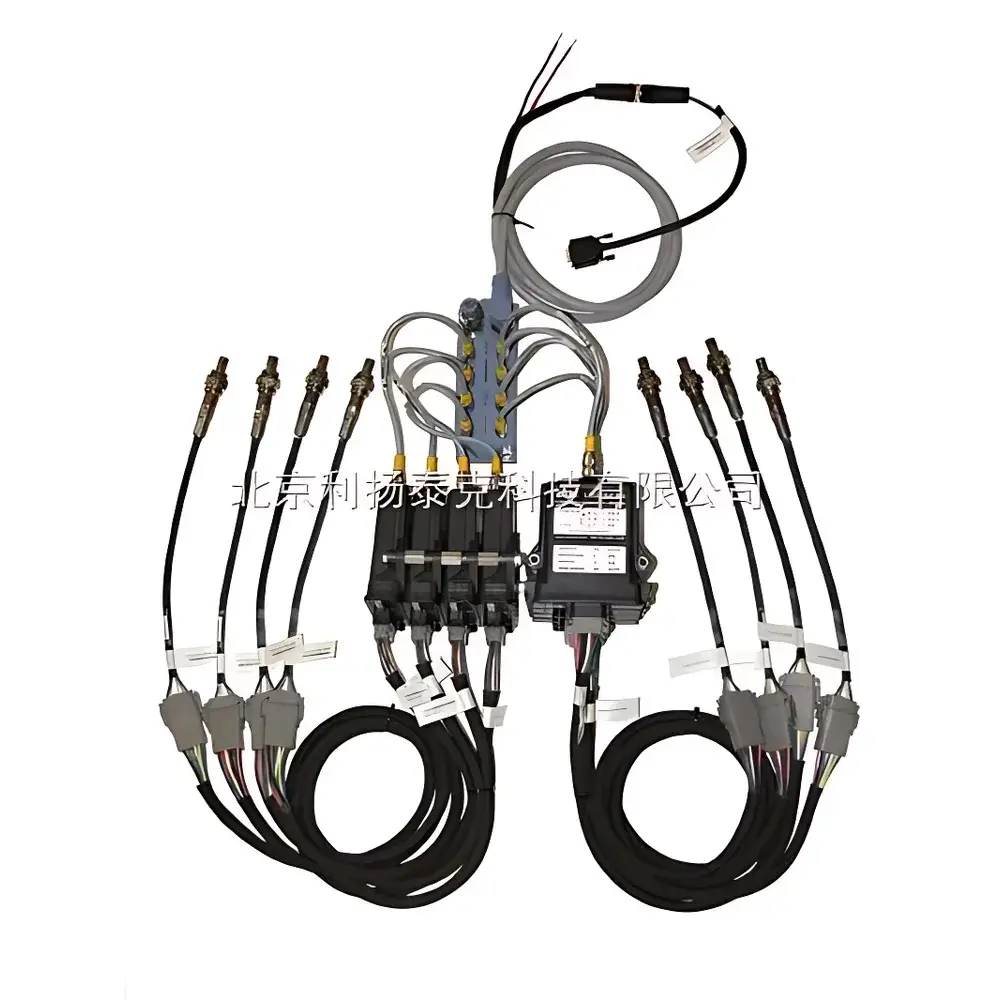
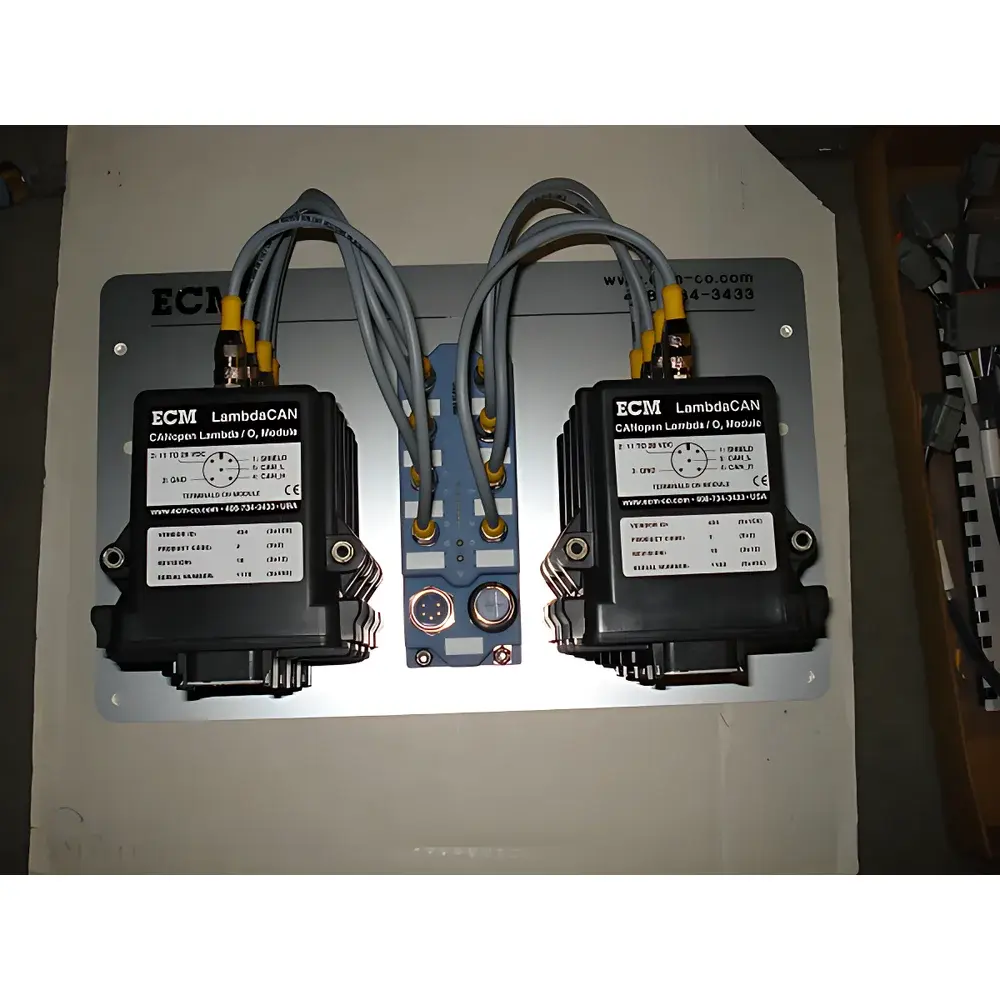
ECM LambdaCAN Multi-Channel Air-Fuel Ratio Analysis System
| Brand | ECM |
|---|---|
| Origin | USA |
| Model | LambdaCAN |
| Input Channels | Up to 8 lambda sensors + up to 8 optional pressure sensors |
| Lambda Range | 0.40–25 |
| AFR Range | 6.0–364 |
| O₂ Range | 0–25% |
| Pressure Range (optional) | 0–517 kPa |
| Lambda Accuracy | ±0.005 at λ=1, ±0.008 at λ=0.8–1.2, ±0.009 elsewhere |
| AFR Accuracy | ±0.1 at 14.6, ±0.2 at 12–18, ±0.5 elsewhere |
| O₂ Accuracy | ±0.2 (0–2% O₂), ±0.4 (other) |
| Pressure Accuracy | ±5.2 kPa |
| Response Time | <150 ms |
| Fuel Composition Parameters | Configurable H:C, O:C, N:C, and H₂ ratios |
| CAN Interface | High-speed CAN per ISO 11898 |
| Operating Temperature | −40 °C to +105 °C |
| Power Supply | 11–28 VDC |
| Sensor Thread | 18 mm × 1.5 mm (lambda), 1/4" NPT (pressure) |
| Module Dimensions | 145 mm × 120 mm × 40 mm |
Overview
The ECM LambdaCAN Multi-Channel Air-Fuel Ratio Analysis System is a precision-engineered, high-speed measurement platform designed for real-time stoichiometric and non-stoichiometric combustion analysis in engine development, emissions certification, and aftertreatment system validation. Based on wideband zirconia electrochemical sensor technology, the system measures lambda (λ), air-fuel ratio (AFR), and oxygen concentration (%O₂) across up to eight independent channels simultaneously—each with factory-traceable calibration stored directly in the sensor connector’s onboard EEPROM. This architecture eliminates manual calibration drift and ensures metrological continuity from installation through field operation. The system operates on the principle of limiting-current amperometry, where pump current is precisely controlled to maintain a reference Nernst voltage across the sensing element; this current is then mathematically converted into λ or AFR using fuel-specific stoichiometric coefficients. Its integrated pressure compensation module—calibrated to ISO 9001-certified standards—corrects for barometric and intake manifold pressure variations, enabling accurate measurements under transient, boosted, or altitude-varying conditions without external correction tables.
Key Features
- Simultaneous acquisition from up to eight wideband lambda sensors, fully synchronized via hardware timestamping on the CAN bus
- Factory-calibrated sensors with embedded calibration coefficients stored in non-volatile memory (EEPROM) within each sensor connector
- On-the-fly ambient-air re-calibration capability—completed in under 3 seconds—with updated coefficients automatically written back to EEPROM
- Optional integrated pressure channel (0–517 kPa absolute) with ±5.2 kPa accuracy, compliant with SAE J2340 and ISO 2534 requirements for intake/exhaust pressure reporting
- Real-time pressure compensation algorithm applied per-channel to correct λ and AFR values for deviations from standard atmospheric pressure (101.325 kPa)
- Full compatibility with industry-standard wideband sensors from Bosch, NTK, and Delphi—including support for legacy and next-generation planar and cup-type elements
- Configurable fuel composition parameters: hydrogen-to-carbon (H:C), oxygen-to-carbon (O:C), nitrogen-to-carbon (N:C), and molecular hydrogen (H₂) fraction—enabling accurate conversion for gasoline, diesel, ethanol blends (E10–E85), natural gas (CNG/LNG), hydrogen, and synthetic fuels
- High-speed CAN 2.0B interface compliant with ISO 11898-2, supporting data transmission rates up to 1 Mbps with deterministic latency & CRC-15 error detection
Sample Compatibility & Compliance
The LambdaCAN system is validated for continuous monitoring of exhaust and intake gas streams in internal combustion engine test cells, dynamometer laboratories, and onboard vehicle validation platforms. It supports both stoichiometric (λ = 1) and highly lean (λ > 5) or rich (λ < 0.7) combustion regimes—critical for GDI, HCCI, and dual-fuel engine characterization. All firmware and calibration procedures adhere to GLP (Good Laboratory Practice) documentation requirements, and raw sensor data—including pump current, Nernst voltage, heater resistance, and aging factor—is logged with millisecond resolution for audit-ready traceability. The system meets EMC immunity per ISO 11452-2 and environmental robustness per ISO 16750-4 (vibration, thermal shock, humidity). While not a certified emissions analyzer per EPA 40 CFR Part 1065 or EU Regulation (EU) 2017/1151, it serves as a primary control and diagnostic instrument within Type Approval test cycles and R&D environments governed by ISO 2534, SAE J1930, and VDA 231-103.
Software & Data Management
Data acquisition and configuration are performed via ECM’s Windows-based LambdaCAN Configuration Tool, which communicates over CAN using standardized UDS (Unified Diagnostic Services) protocols. The tool enables channel mapping, fuel parameter assignment, pressure compensation enablement, and real-time waveform visualization with configurable triggers and math channels (e.g., Δλ between cylinders, AFR deviation from target). All configuration files are saved in XML format with SHA-256 checksums for version control. Raw CAN frames are exportable in ASAM MDF4 (.mf4) format—fully compatible with INCA, ETAS ASCET, AVL DiTEST, and MATLAB/Simulink workflows. Audit logs record every calibration event, parameter change, and firmware update with user ID, timestamp, and IP address (when connected via Ethernet-CAN gateway), satisfying FDA 21 CFR Part 11 electronic record requirements when deployed in regulated development environments.
Applications
- Engine control unit (ECU) development and closed-loop lambda control validation
- Aftertreatment system efficiency testing (TWC, DOC, DPF, SCR) under dynamic load profiles
- Fuel formulation studies—including biofuel blends, ammonia co-fueling, and hydrogen-diesel dual injection
- Onboard diagnostics (OBD-II) strategy verification and MIL trigger logic testing
- Transient emissions mapping for WLTC, RDE, and FTP-75 cycle compliance assessment
- Intake oxygen measurement for EGR rate calculation and combustion phasing optimization
- Research into low-temperature combustion modes (PCCI, RCCI) requiring sub-100-ms temporal resolution
FAQ
Does the LambdaCAN system require periodic recalibration in the field?
No—factory calibration is permanently stored in each sensor’s EEPROM. Ambient-air re-calibration is optional and recommended only after extended storage or exposure to extreme contamination; it takes <3 seconds and updates the EEPROM with new zero-point coefficients.
Can I use third-party lambda sensors with different thread types?
The system accepts all wideband sensors with 18 mm × 1.5 mm mounting threads and analog output compatible with the Bosch LSU 4.9 / LSU ADV protocol. Adapters for M18×1.5 to 1/8″ NPT or 1/4″ NPT are available but must preserve electrical shielding and thermal mass integrity.
Is pressure compensation mandatory for accurate AFR readings?
It is strongly recommended for any application involving boosted engines, altitude changes, or intake manifold sampling—where absolute pressure deviates significantly from 101.325 kPa. Uncorrected pressure errors scale nonlinearly with λ; e.g., +34 kPa yields ~0.58 λ error at λ = 3.
What software interfaces does LambdaCAN support besides ECM’s native tool?
Raw CAN messages conform to SAE J1939-71 and custom ECM-defined PGNs. Users may integrate directly via Vector CANoe, dSPACE ControlDesk, or NI VeriStand using provided DBC files and API libraries (C/C++, Python, .NET).
How is sensor aging monitored and compensated?
Each sensor reports real-time heater resistance and pump current stability metrics. The system calculates an aging factor based on deviation from nominal resistance curves and applies adaptive gain correction to maintain long-term accuracy—logged for predictive maintenance scheduling.
Related Products







