
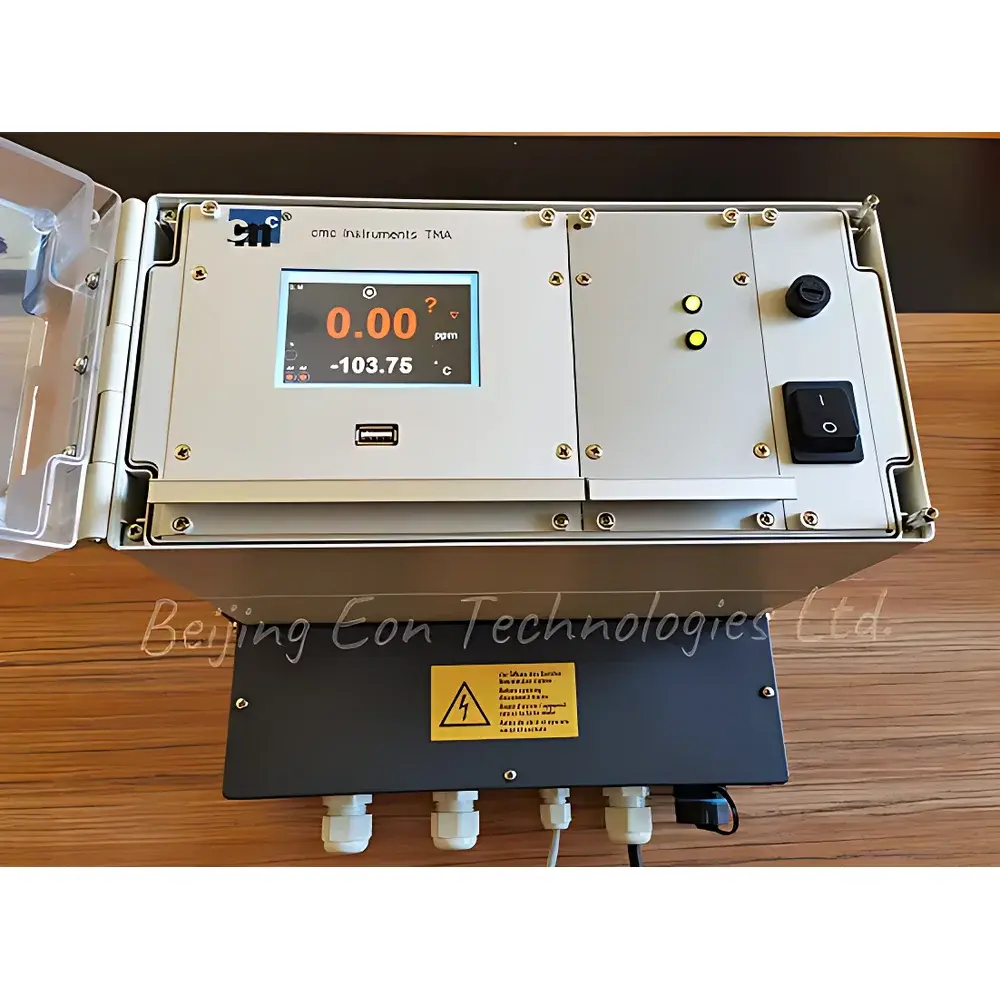
CMC TMA-202-W P₂O₅ Electrolytic Trace Moisture Analyzer
| Brand | CMC (HimSi) |
|---|---|
| Origin | Germany |
| Model | TMA-202-W |
| Product Type | Online Dew Point Analyzer |
| Measurement Principle | Phosphorus Pentoxide (P₂O₅) Electrolytic Method |
| Operating Temperature | -10 °C to +50 °C |
| Accuracy | ±1% of full scale |
| Repeatability | ±0.1% of full scale |
| Range Options | 0–10 ppm / 0–100 ppm / 0–1,000 ppm / 0–2,500 ppm (auto/manual switching) |
| Sensitivity | 0.1% of full scale |
| Analog Output | 4–20 mA (configurable) |
| Alarm Outputs | 2 relay outputs |
| Display | Touchscreen with multilingual UI (including Chinese) |
| Sample Flow Rate | 20 NL/h |
| Recommended Sample Pressure | 0.1–0.5 barg |
| Sample Temperature | 5–50 °C |
| T₅₀ Response Time | <8 s |
| Ambient Temperature Range | 5–65 °C |
| Cable Length | Standard 3 m (up to 300 m optional) |
| Dimensions | 300 mm (W) × 260 mm (H) × 280 mm (D) |
Overview
The CMC TMA-202-W is a high-stability, online trace moisture analyzer engineered for continuous, absolute measurement of water vapor in aggressive and combustible process gases. It employs the well-established phosphorus pentoxide (P₂O₅) electrolytic principle — a primary standard method recognized for its metrological traceability and lack of calibration drift over time. Unlike optical or capacitive techniques, the TMA-202-W performs direct electrochemical decomposition of water molecules (H₂O → H₂ + ½O₂) within a sealed glass cell containing parallel electrodes coated with a hygroscopic phosphoric acid (H₃PO₄) film. The resulting P₂O₅ layer continuously absorbs moisture from the sample stream; the equilibrium between absorption and electrolysis yields a current strictly proportional to the partial pressure of water. This fundamental physical relationship ensures long-term stability without periodic recalibration — a critical requirement for GMP-compliant gas purity monitoring in semiconductor fabrication, specialty chemical synthesis, and high-purity industrial gas production.
Key Features
- True absolute measurement principle — no zero/span drift; eliminates need for routine calibration gases
- Robust P₂O₅ sensor architecture optimized for corrosive and reactive gases including Cl₂, HCl, SO₂, H₂S, F₂, and HF (excluding gases that chemically attack P₂O₅ or H₃PO₄)
- Microprocessor-controlled auto-ranging across four selectable spans: 0–10 ppm, 0–100 ppm, 0–1,000 ppm, and 0–2,500 ppm
- Ultra-fast response: T₅₀ ≤ 8 seconds; full stabilization typically achieved within 30 seconds under nominal flow conditions
- Integrated self-diagnostic routines at power-on and during operation — verifies sensor integrity, electronics functionality, and signal path continuity
- NAMUR-compliant interface design (NE 43/NE 44) for seamless integration into DCS and PLC-based control systems
- Wide operating ambient range (5–65 °C) with internal thermal management to stabilize sensor temperature
Sample Compatibility & Compliance
The TMA-202-W is validated for use with inert gases (He, Ne, Ar, Kr, Xe), diatomic gases (H₂, N₂, O₂, D₂), oxidizing species (O₃, F₂), hydrocarbons (CH₄, C₂H₂), halocarbons (Freon series, SF₆), and highly corrosive acid gases (Cl₂, HCl, SO₂, H₂S, HBr). Its sensor construction — featuring fused-silica cell body and platinum or rhodium electrodes — resists chemical degradation while maintaining electrochemical fidelity. The instrument complies with IEC 61000-6-2 (EMC immunity) and IEC 61000-6-4 (EMC emissions), and meets IP65 enclosure rating for industrial environments. While not intrinsically safe by default, it may be deployed in Zone 2 hazardous areas when installed with appropriate barrier systems per ATEX/IECEx guidelines. Data integrity supports GLP/GMP workflows via configurable audit trail logging (when integrated with compatible SCADA platforms).
Software & Data Management
The embedded firmware provides real-time moisture concentration display, trend logging (up to 30 days at 1-min intervals), and event-triggered data capture (e.g., alarm activation, range switch). All parameters — including analog output scaling, relay thresholds, and alarm hysteresis — are configurable via the intuitive touchscreen interface. The 4–20 mA output supports HART 7 protocol for digital configuration and diagnostics over the same wiring. Optional Modbus RTU (RS-485) enables integration into centralized asset monitoring systems. Raw sensor current, temperature-compensated ppm values, and diagnostic flags are accessible via serial interface for third-party data acquisition. No proprietary software is required; configuration files adhere to industry-standard XML schema for version control and backup.
Applications
- Monitoring moisture in bulk and cylinder-grade electronic specialty gases (e.g., NF₃, SiH₄, BCl₃) prior to delivery to fab tools
- In-line verification of dryer performance in chlorine and hydrogen chloride production lines
- Quality assurance of sulfur hexafluoride (SF₆) for high-voltage switchgear filling
- Process gas purity validation in fluoropolymer manufacturing where residual H₂O catalyzes degradation
- Trace moisture surveillance in natural gas transmission pipelines meeting ISO 8503-1 dew point specifications
- Research-grade quantification of water in cryogenic gas streams (e.g., liquid nitrogen boil-off analysis)
FAQ
Does the P₂O₅ sensor require periodic replacement or regeneration?
Yes — while the sensor does not require recalibration, the P₂O₅ film degrades gradually under continuous electrolysis. CMC recommends electrode regeneration every 12–24 months depending on average moisture load and exposure to reactive species. Regeneration is performed in-field using the built-in conditioning mode.
Can the TMA-202-W measure moisture in compressed air systems?
It is technically capable, but not optimized for dew points above –20 °C. For ambient-temperature compressed air, chilled mirror or aluminum oxide sensors offer better cost-performance balance. The TMA-202-W excels below 10 ppmv (–70 °C dew point equivalent).
Is the analog output linear across all ranges?
Yes — the 4–20 mA signal is linear with respect to the selected full-scale range (e.g., 4 mA = 0 ppm, 20 mA = 100 ppm on the 100 ppm range), independent of automatic range switching.
What maintenance is required beyond sensor regeneration?
Routine inspection of inlet filter, sample line integrity, and condensate trap (if used upstream); verification of zero-gas purge integrity (optional); annual verification of analog output accuracy using calibrated current meter.




