
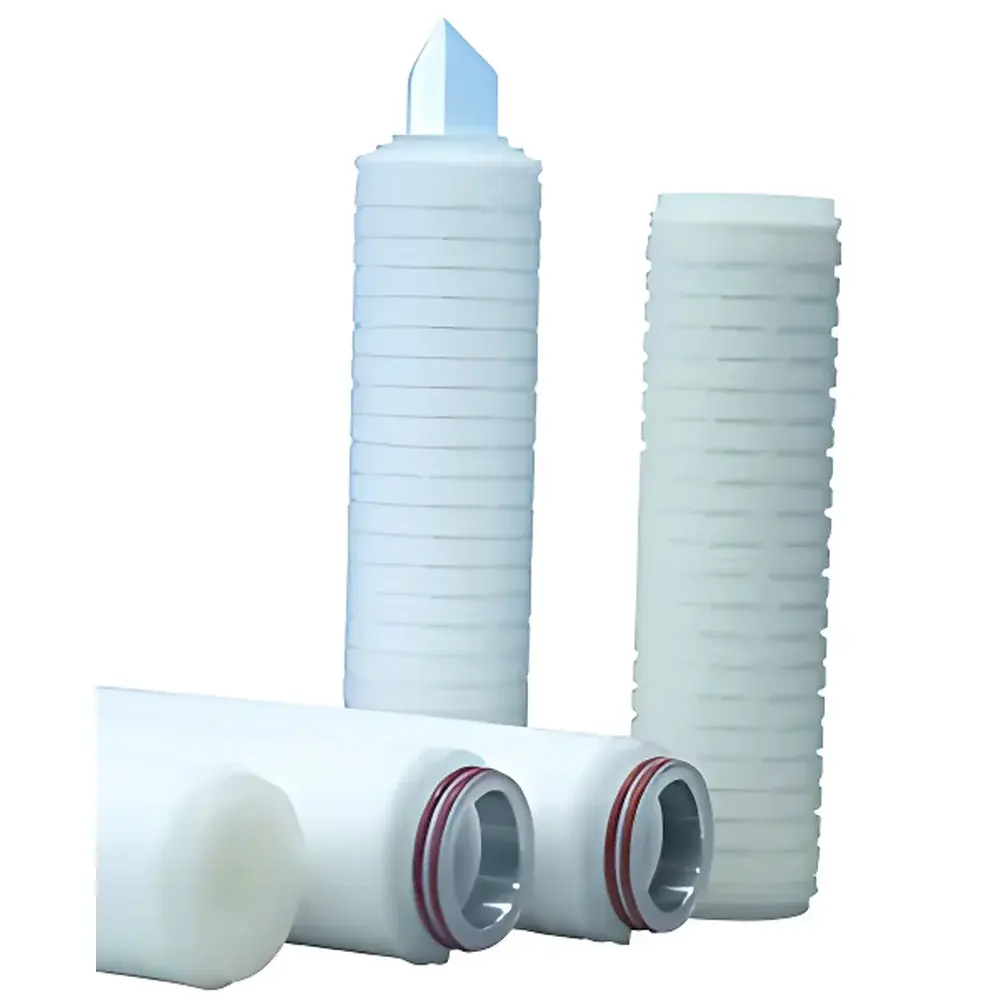
NeuronBC PVDF Pleated Membrane Cartridge
| Brand | NeuronBC |
|---|---|
| Model | PVDF |
| Filter Material | Polyvinylidene Fluoride (PVDF) Microporous Membrane |
| Filtration Area (10″) | 0.60 m² |
| Liquid Sterile Filtration Rating | 0.22 µm |
| Gas Filtration Rating | 0.01 µm |
| Bubble Point (Isopropanol, 0.22 µm) | ≥ 0.065 MPa |
| Air Flow Rate | ≥ 6 m³/min at ΔP = 0.015 MPa (inlet pressure 0.13 MPa) |
| Forward Pressure Drop | 0.42 MPa at 25 °C |
| Reverse Pressure Drop | 0.21 MPa at 25 °C |
| Operating Temperature | ≤ 65 °C (standard), ≤ 95 °C (high-temp grade, 0.1 MPa) |
| Steam Sterilization | 121 °C, 0.1 MPa, 30 min per cycle (validated for ≥ 100 cycles) |
| Housing & Endcap Material | Polypropylene (PP) or PVDF |
| Core Support | Imported Polyester Nonwoven |
| Seal Material | Silicone or FKM (Fluoroelastomer) |
| Chemical Compatibility | Broad resistance to strong acids, aliphatic/aromatic hydrocarbons, ketones, ethers, and halogenated solvents |
Overview
The NeuronBC PVDF Pleated Membrane Cartridge is a high-integrity, sterile-grade filtration device engineered for demanding bioprocessing, pharmaceutical manufacturing, and analytical laboratory applications. Constructed using phase-inversion technology, the cartridge features a symmetric, double-sided PVDF microporous membrane cast onto a high-strength imported polyester nonwoven support layer. This architecture delivers uniform pore geometry—predominantly circular and elliptical—with narrow pore size distribution (0.22 µm for liquid sterilization; 0.01 µm for critical gas filtration). The membrane exhibits intrinsic hydrophobicity and negative surface charge, enabling efficient removal of bacteria, particles, and aerosols from both liquids and gases without leaching or extractables. Its thermal stability supports repeated in-line steam sterilization (121 °C, 0.1 MPa, 30 min) with validated integrity retention over ≥100 cycles—meeting core requirements for GMP-compliant process validation under FDA 21 CFR Part 11 and EU Annex 1 frameworks.
Key Features
- Pleated PVDF membrane design: Maximizes effective filtration area (0.60 m² for 10-inch configuration) while minimizing footprint and system pressure drop—critical for high-flow, low-energy bioreactor harvest and buffer preparation lines.
- Thermal and chemical robustness: Withstands autoclaving up to 138 °C and exhibits broad compatibility with aggressive solvents (e.g., acetone, THF, chloroform), strong mineral acids (HCl, HNO₃), and alkaline solutions—enabling reuse in solvent-intensive purification workflows.
- Welded construction, no adhesives: Thermal bonding of endcaps and housing eliminates organic binders, ensuring zero particle shedding, low extractables, and compliance with USP , , and ICH Q5C bioburden control standards.
- Asymmetric integrity verification: Validated bubble point ≥ 0.065 MPa (isopropanol, 0.22 µm rating) provides quantitative, non-destructive integrity testing prior to and after use—supporting ALCOA+ data governance principles.
- Multi-material configuration options: Available with PP or PVDF housings, 304/316 stainless steel cores, and FKM/silicone seals—allowing precise matching to process fluid chemistry, temperature, and regulatory audit requirements.
Sample Compatibility & Compliance
This cartridge is routinely deployed in sterile filtration of cell culture media, monoclonal antibody harvest streams, chromatography buffers, and final-fill formulations. It is compatible with aqueous, alcoholic, and mixed-organic systems—including ethanol/water blends used in vaccine formulation and IPA-based cleaning-in-place (CIP) solutions. The PVDF membrane meets ISO 9001-certified manufacturing controls and conforms to ASTM F838-22 (bacterial challenge testing) and ISO 13408-1 (aseptic processing of health care products). All materials comply with USP Class VI biological reactivity testing and EU Pharmacopoeia 2.6.1 extractables profiling protocols. Documentation packages include Certificate of Conformance, Extractables Summary Report, and Sterilization Cycle Validation Dossier upon request.
Software & Data Management
While the cartridge itself is a passive hardware component, its integration into automated filtration skids enables full digital traceability. When paired with programmable logic controllers (PLCs) or SCADA systems, pressure differential (ΔP), flow rate, and total throughput are logged in real time. These datasets can be mapped to electronic batch records (EBRs) and linked to LIMS platforms via OPC UA or Modbus TCP. Integrity test results—including pre- and post-use bubble point or diffusion tests—are captured with operator ID, timestamp, and instrument calibration metadata—satisfying FDA 21 CFR Part 11 electronic signature and audit trail requirements. Optional QR-coded labeling supports serialized lot tracking across supply chain and manufacturing execution systems (MES).
Applications
- Sterile filtration of heat-labile biologics (e.g., recombinant proteins, viral vectors, mRNA-LNPs)
- Final filtration of parenteral drug products and ophthalmic solutions
- Gas sterilization of compressed air, nitrogen, and CO₂ in bioreactor headspaces and lyophilizer chambers
- Removal of endotoxins and subvisible particles from process solvents and cleaning agents
- Pre-filtration and polishing of ultra-pure water (UPW) and clean steam condensate loops
- Critical vent filtration in single-use bioreactors and storage bags
FAQ
Can this cartridge be used for both liquid and gas filtration?
Yes. Its dual-rated pore structure (0.22 µm for liquids, 0.01 µm for gases) and hydrophobic surface enable validated use in sterile liquid filtration and high-efficiency particulate air (HEPA)-equivalent gas decontamination.
What is the maximum number of steam sterilization cycles supported?
The cartridge is validated for ≥100 cycles of saturated steam at 121 °C and 0.1 MPa for 30 minutes per cycle, with integrity maintained per ASTM F838 criteria.
Is the PVDF membrane compatible with 70% isopropyl alcohol (IPA)?
Yes. The membrane demonstrates full chemical compatibility with IPA at ambient and elevated temperatures—making it suitable for CIP and aseptic barrier validation protocols.
Does the cartridge require pre-wetting before use in aqueous applications?
Yes. Due to inherent hydrophobicity, the PVDF membrane must be pre-wetted with alcohol (e.g., 70% IPA) followed by buffer equilibration to ensure complete pore penetration and avoid air lock during operation.
Are extractables data available for regulatory submissions?
Yes. A comprehensive extractables study—conducted per USP and EMA Guideline on Extractables and Leachables—is included in the Technical Dossier, covering volatile organic compounds (VOCs), semi-volatiles, and elemental impurities under worst-case extraction conditions.
Related Products



