
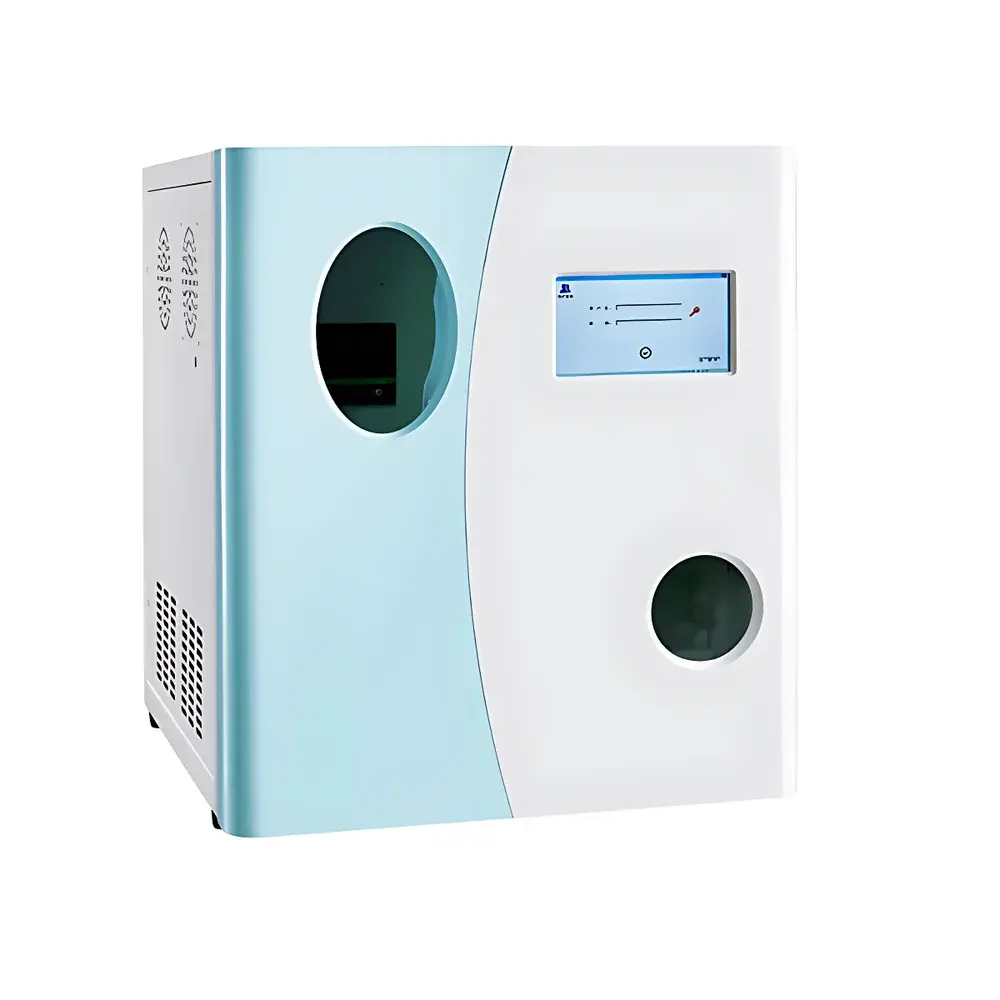
NeuronBC TA-100 High-Range Online Total Organic Carbon (TOC) Analyzer
| Brand | NeuronBC |
|---|---|
| Origin | Beijing, China |
| Model | TOC100 |
| Instrument Type | Online TOC Analyzer |
| Detection Principle | Non-Dispersive Infrared (NDIR) Absorption |
| Oxidation Method | UV/Persulfate Oxidation |
| Measurement Range | 0–10,000 mg/L |
| Accuracy | ±3% of reading |
| Resolution | 0.001 mg/L |
| Detection Limit | 0.001 mg/L |
| Repeatability | ±3% RSD |
| Compliance | Designed for ISO 8469, ASTM D5905, USP <643>, and EPA Method 415.3 environments |
Overview
The NeuronBC TA-100 is a high-range, online total organic carbon (TOC) analyzer engineered for continuous, real-time monitoring of organic contamination in aqueous matrices. It employs non-dispersive infrared (NDIR) detection following complete oxidation of organic carbon to CO₂ via dual-mode UV/persulfate oxidation—ensuring quantitative conversion across diverse sample types including low-conductivity drinking water, high-salinity seawater, and complex industrial effluents. The instrument’s architecture integrates thermally regulated reaction kinetics, precision gas-phase moisture management, and digital signal processing optimized for stability under variable flow and matrix conditions. Designed for unattended operation in central laboratories, municipal water facilities, pharmaceutical manufacturing suites, and environmental monitoring stations, the TA-100 meets the functional requirements of ISO/IEC 17025-accredited labs and supports audit-ready data integrity per FDA 21 CFR Part 11 when paired with compliant software configurations.
Key Features
- Modular hardware design enables field-replaceable components—including oxidation module, NDIR detector, and TIC reaction chamber—reducing mean time to repair (MTTR) and eliminating system downtime during maintenance.
- Integrated TIC (Total Inorganic Carbon) reaction cell combines heating, active cooling, condensate management, and liquid-level sensing in a single compact unit, minimizing dead volume and shortening analysis cycle time to ≤4 minutes per measurement.
- Adaptive moisture removal system dynamically adjusts refrigeration power based on sample injection volume and conductivity, ensuring consistent desiccation of CO₂ carrier gas and eliminating baseline drift from water vapor interference.
- Dual-channel 24-bit digital NDIR detection with embedded temperature/pressure compensation delivers linear response across the full 0–10,000 mg/L range; 32-bit real-time signal processing enhances signal-to-noise ratio and suppresses flow-induced artifacts.
- Embedded safety architecture includes automatic leak detection, real-time gas flow monitoring, low-voltage internal circuitry (<24 VDC), and interlocked thermal shutdown—fully compliant with IEC 61010-1 for laboratory and industrial installation.
- Onboard diagnostics continuously compare operational parameters (e.g., oxidation temperature, UV lamp intensity, detector voltage) against user-defined thresholds and trigger audible/visual alerts with contextual remediation guidance.
Sample Compatibility & Compliance
The TA-100 accommodates samples with conductivity ranging from 0.1 µS/cm (ultrapure water) to 50 mS/cm (brackish or treated wastewater), with optional acidification and sparging modules available for high-TIC matrices. It complies with core regulatory frameworks governing water quality analysis: ISO 8469 for TOC determination in natural waters, ASTM D5905 for drinking water, USP for purified and water-for-injection (WFI) validation, and EPA Method 415.3 for wastewater and surface water applications. Its firmware supports GLP/GMP audit trails—including user logins, method versioning, calibration history, and electronic signatures—when operated with validated LIMS or SCADA integration.
Software & Data Management
The TA-100 operates with NeuronBC’s TOCView™ v3.2 control software, providing remote configuration, method scheduling, trend visualization, and automated report generation (PDF/CSV). All raw sensor outputs—including analog detector voltages, temperature logs, and flow profiles—are timestamped and stored locally with 32 GB onboard memory (expandable via microSD). Data export supports OPC UA and Modbus TCP protocols for seamless integration into plant-wide DCS or MES systems. Audit trail functionality records every parameter change, calibration event, and alarm condition with immutable timestamps and operator ID—meeting ALCOA+ principles for data reliability and traceability.
Applications
- Pharmaceutical water systems: Continuous TOC surveillance of PW, WFI, and pure steam condensate per EU GMP Annex 1 and FDA guidance.
- Municipal water treatment: Source water assessment, disinfection by-product precursor tracking, and distribution system integrity verification.
- Power generation: Monitoring condensate polishers and boiler feedwater purity to prevent corrosion and deposition.
- Electronics manufacturing: Ultrapure water (UPW) qualification for semiconductor fab process tools.
- Environmental agencies: Long-term ecological monitoring of rivers, lakes, and coastal zones under national water quality standards.
- Industrial pretreatment: Compliance verification for discharge permits (e.g., NPDES) and internal process optimization.
FAQ
What oxidation methods does the TA-100 support?
The instrument uses simultaneous UV photolysis (185/254 nm) and persulfate chemical oxidation under acidic, heated conditions—validated for >95% recovery of refractory organics including humic substances and low-molecular-weight acids.
Can the TA-100 measure TOC in seawater or high-salinity samples?
Yes—its robust oxidation module and pressure-compensated NDIR detector maintain accuracy up to 35 g/kg salinity; optional salt-tolerant peristaltic pump heads and acid-resistant fluidic path materials are available.
Is the system compliant with 21 CFR Part 11 for electronic records?
When deployed with TOCView™ in validated mode and paired with network authentication, role-based access control, and digital signature workflows, it satisfies predicate rule requirements for electronic records and signatures.
What maintenance intervals are recommended?
UV lamp replacement every 12 months, NDIR detector zero/gain calibration every 7 days (automated), and oxidation reagent replenishment every 30 days under continuous operation—full schedule documented in the IQ/OQ protocol package.
Does the TA-100 support external trigger inputs or analog outputs?
Yes: 4–20 mA analog output (TOC concentration), isolated digital inputs for start/stop commands, and TTL-level pulse outputs synchronized to measurement cycles.
Related Products







