
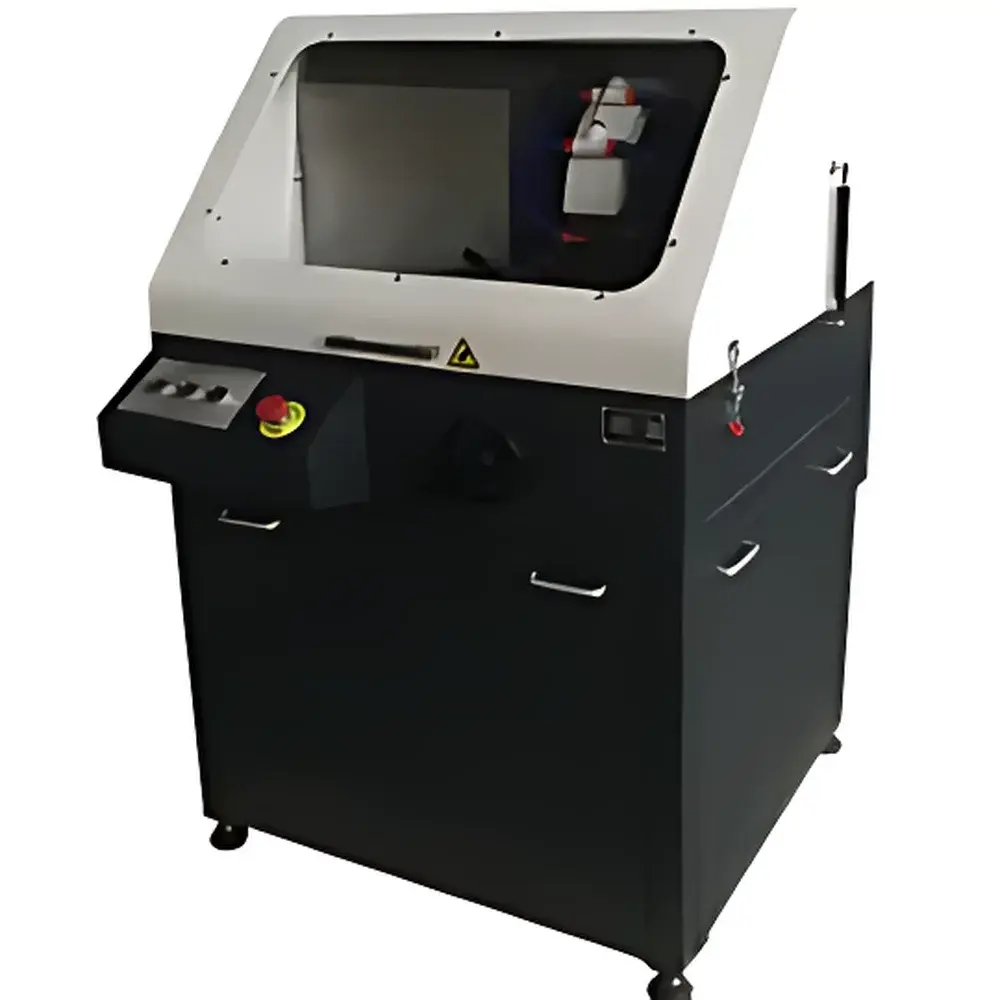
YANRUN QG-5A Metallographic Sample Cutting Machine
| Brand | YANRUN |
|---|---|
| Origin | Shanghai, China |
| Manufacturer Type | Direct Manufacturer |
| Product Category | Domestic |
| Model | QG-5A |
| Instrument Type | Metallographic Cutting Machine |
| Spindle Speed | 2840 rpm |
| Y-Axis Table Travel | 280 mm |
| Maximum Cutting Capacity | 380 × 130 × 100 mm |
| Effective Feed Distance | 250 mm |
| Cutting Table Dimensions | 310 × 310 mm |
| Blade Specifications | Ø300–350 × 2.0 × 32 mm |
| Clamping System | Dual-position mechanical fixture |
| Cooling System | Automated triple-channel water cooling |
| Motor Power | 4.0 kW |
| Construction | Floor-standing integrated unit |
| Voltage Requirement | 380 V AC, 3-phase |
| Net Weight | 300 kg |
| Enclosure Type | Fully enclosed cutting chamber |
Overview
The YANRUN QG-5A Metallographic Sample Cutting Machine is an industrial-grade, manually operated precision cutting system engineered for reliable specimen preparation in metallurgical, materials science, and quality control laboratories. Designed around the fundamental principle of controlled abrasive sectioning under continuous coolant flow, the QG-5A employs high-torque rotary motion (2840 rpm) to drive diamond-impregnated or silicon-carbide cutting wheels—enabling clean, low-distortion cross-sections of metallic alloys, composites, ceramics, and geological specimens. Its fully enclosed cutting chamber ensures operator safety per ISO 13857 and minimizes airborne particulate generation during operation. The machine’s structural rigidity—evidenced by its 300 kg floor-standing cast-iron frame—suppresses vibration-induced kerf deviation, supporting reproducible cut geometry across repeated runs. Unlike semi-automated or CNC-based systems, the QG-5A prioritizes tactile operator control over programmable repeatability, making it particularly suited for variable-batch, low-to-medium throughput environments where sample heterogeneity (e.g., weld zones, heat-affected regions, or multi-phase aggregates) demands real-time feed-rate adjustment.
Key Features
- Fully enclosed cutting chamber with transparent polycarbonate viewport—meets CE machinery directive requirements for operator protection against flying debris and coolant splash.
- Dual-position mechanical clamping system providing independent, parallel-force fixation of irregular or asymmetrical specimens up to 100 mm in height.
- Triple-channel automated water-cooling circuit delivering targeted coolant streams to blade interface, specimen surface, and motor housing—reducing thermal damage (e.g., martensitic transformation in steels or recrystallization in aluminum alloys) and extending blade service life.
- Manual feed mechanism with calibrated depth scale and fine-adjustment handwheel—enabling precise control of cut rate (typically 0.05–0.5 mm/s depending on material hardness and blade specification).
- Integrated 4.0 kW induction motor mounted directly to the base structure—minimizing belt-driven energy loss and ensuring stable spindle speed under load variations.
- Large Y-axis travel (280 mm) and generous cutting envelope (380 × 130 × 100 mm) accommodate oversized billets, castings, and rock core samples without repositioning.
- Modular blade mounting system compatible with standard ISO 4064-compliant cutting wheels (Ø300–350 mm, 2.0 mm thickness, 32 mm bore).
Sample Compatibility & Compliance
The QG-5A accommodates a broad spectrum of conductive and non-conductive solid materials—including ferrous and non-ferrous metals, sintered carbides, refractory bricks, concrete cores, and silicate-rich geological specimens—when paired with appropriate abrasive blades (e.g., diamond segments for granite or tungsten carbide; resin-bonded SiC for mild steel). Its mechanical clamping design eliminates electromagnetic interference concerns associated with vacuum or magnetic chucks, enabling safe handling of non-magnetic or annealed alloys. The unit complies with IEC 60204-1 for electrical safety and incorporates IP54-rated enclosures for motor and control components. While not certified for GMP or GLP environments out-of-the-box, its consistent mechanical performance, traceable calibration points (spindle speed verification via tachometer port), and absence of software-controlled variables support audit-ready documentation under ISO/IEC 17025-accredited laboratory quality systems.
Software & Data Management
The QG-5A operates as a stand-alone electromechanical instrument with no embedded firmware or digital interface. All operational parameters—including spindle speed (fixed at 2840 rpm), coolant flow activation, and emergency stop sequencing—are managed through hardwired push-button controls and electro-mechanical relays. This architecture eliminates cybersecurity vulnerabilities, ensures deterministic response timing, and simplifies validation in regulated settings where software qualification (per FDA 21 CFR Part 11 or EU Annex 11) would otherwise be required. Maintenance logs, blade usage records, and cut outcome assessments (e.g., microstructural integrity verified via subsequent grinding/polishing and optical microscopy) are maintained externally using laboratory information management systems (LIMS) or paper-based SOPs.
Applications
- Preparation of metallographic specimens for ASTM E3, ISO 643, and GB/T 13298 microstructure evaluation.
- Sectioning of welded joints and heat-affected zones for fracture mechanics analysis per ASTM E8/E8M.
- Rock and mineral sample preparation in geotechnical and petrographic labs—particularly when used with diamond-impregnated blades for quartzite or basalt.
- Dimensional reduction of additively manufactured (AM) metal parts prior to density measurement or porosity assessment (ASTM B962).
- High-volume QC sampling in foundries and forging facilities where rapid, operator-guided sectioning supports incoming material inspection protocols.
FAQ
Is the QG-5A compatible with automatic feed or CNC integration?
No—the QG-5A is strictly manually operated. It does not support motorized feed axes, programmable logic controllers (PLCs), or external motion controller interfaces.
What blade types are recommended for stainless steel and titanium alloys?
Diamond-segmented blades with metal bond matrix (e.g., Fe-Ni-Cu based) are recommended for stainless steels; for titanium and Ti-6Al-4V, resin-bonded diamond blades with optimized grit concentration (80–120 mesh) yield lower thermal input and reduced alpha-case formation.
Does the unit include blade balancing equipment?
No—blade static balancing must be performed externally using a mandrel-type balancer before installation. Unbalanced wheels may induce excessive bearing wear and compromise cut accuracy.
Can the cooling system operate with deionized water or corrosion inhibitors?
Yes—provided conductivity remains below 50 µS/cm and pH is maintained between 6.5–8.5. Use of glycol-based coolants is not recommended due to potential pump seal degradation.
What maintenance intervals are specified for the main spindle bearings?
Under normal operating conditions (≤6 hrs/day), grease replenishment is required every 1,500 operating hours; full bearing replacement is advised after 12,000 hours or upon detection of axial play exceeding 0.03 mm.



