
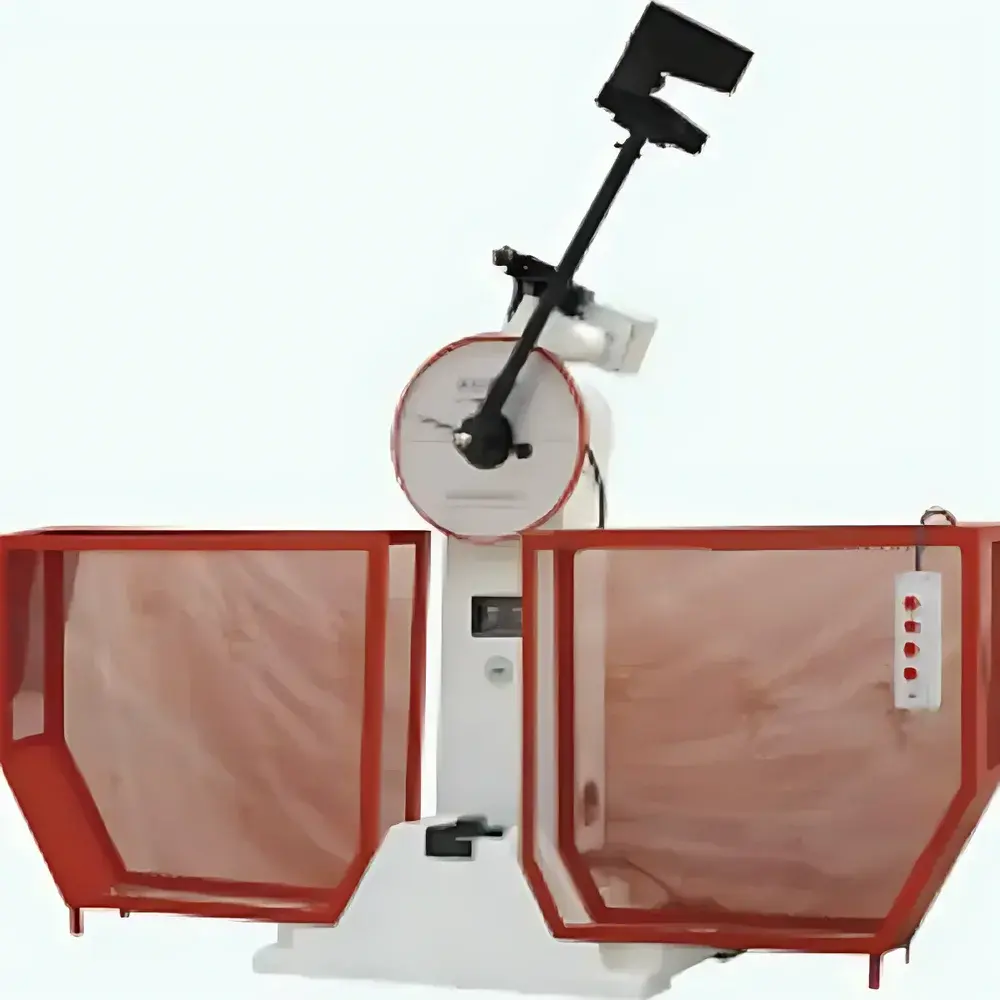
YANRUN JB-50B Semi-Automatic Charpy/Izod Impact Testing Machine
| Brand | YANRUN |
|---|---|
| Origin | Shanghai, China |
| Manufacturer Type | Direct Manufacturer |
| Country of Origin | China |
| Model | JB-50B |
| Instrument Type | Pendulum Impact Tester |
| Impact Energy | 50 J (large hammer), 25 J (small hammer) |
| Impact Velocity | 3.8 m/s |
| Pendulum Torque (Impact Constant) | M = 26.7680 N·m (50 J), 13.3840 N·m (25 J) |
| Pendulum Pre-lift Angle | 150° |
| Span Between Supports | 40 mm |
| Support Anvil Radius | R1.0–R1.5 mm |
| Impact Blade Radius | R2.0–R2.5 mm (Charpy), R8 mm (Izod) |
| Distance from Pendulum Center to Impact Point | 470 mm |
| Standard Specimen Dimensions | 10 × 10 × 55 mm (also compatible with 7.5 × 7.5 × 55 mm and 5 × 5 × 55 mm) |
| Power Supply | 3-phase, 4-wire, 50 Hz, 380 V, 120 W |
| Overall Dimensions | 2124 × 600 × 1340 mm |
| Net Weight | 150 kg |
Overview
The YANRUN JB-50B Semi-Automatic Charpy/Izod Impact Testing Machine is a precision-engineered pendulum impact tester designed for standardized measurement of notched and unnotched specimen toughness under controlled impact loading conditions. It operates on the fundamental principle of gravitational potential energy conversion: a calibrated pendulum is raised to a fixed pre-lift angle (150°), released, and allowed to strike a standardized specimen supported in either Charpy (three-point bending) or Izod (cantilever beam) configuration. The energy absorbed during fracture—calculated from the difference between initial and residual pendulum height—is directly indicative of material resistance to sudden dynamic loading. This instrument complies with core international test standards including ISO 148-1 (Metallic materials — Charpy pendulum impact testing), ISO 180 (Plastics — Determination of Izod impact strength), ASTM E23, and GB/T 229. Its robust single-column, cantilevered pendulum architecture ensures mechanical stability and repeatable alignment—critical for achieving high inter-laboratory reproducibility in QC/QA and metallurgical research environments.
Key Features
- Single-column structural design with cantilevered pendulum mounting for enhanced rigidity and minimal frame deflection during impact.
- U-shaped pendulum hammer body optimized for mass distribution and aerodynamic consistency across repeated cycles.
- Quick-release impact blade assembly secured via hex-head screws—enabling tool-assisted blade replacement without recalibration.
- Dual-range pendulum system: two interchangeable hammers (25 J and 50 J) with precisely defined torque constants (13.3840 N·m and 26.7680 N·m respectively), ensuring traceable energy delivery per ISO 148-2 requirements.
- Four-point safety architecture: integrated mechanical safety pin, full-coverage polycarbonate safety net, automatic lockout during pendulum motion, and emergency stop circuit compliant with IEC 60204-1.
- Semi-automatic operation sequence: electrically actuated lifting, latching, release, and post-fracture automatic re-lift—minimizing operator intervention and enabling high-throughput batch testing.
- Precision-machined anvil and support blocks with certified radii (R1.0–R1.5 mm for supports; R2.0–R2.5 mm for Charpy blade; R8 mm for Izod blade) to meet dimensional tolerances specified in ISO 148-3 and ISO 180-2.
Sample Compatibility & Compliance
The JB-50B accommodates standard metallic and polymeric specimens per ISO/ASTM dimensions: 10 × 10 × 55 mm (primary), plus optional 7.5 × 7.5 × 55 mm and 5 × 5 × 55 mm cross-sections. The 40 mm support span is adjustable within ±0.1 mm tolerance using supplied calibration gauges. All mechanical components—including pendulum axis bearings, knife-edge geometry, and specimen alignment fixtures—are manufactured to metrological traceability standards. The system supports routine verification per ISO/IEC 17025 calibration protocols, and its mechanical design inherently satisfies requirements for GLP-compliant laboratories performing ASTM E23 or ISO 148-1 validation studies. Optional digital angle encoder upgrade enables real-time angular displacement logging for advanced uncertainty analysis.
Software & Data Management
While the base JB-50B operates as a stand-alone electromechanical tester, it features analog signal outputs (0–10 V) and RS-232 interface for integration with external data acquisition systems. When paired with YANRUN’s optional IMPACT-Link™ software (v3.2+), users gain automated result calculation (absorbed energy, normalized energy per unit area), statistical reporting (mean, SD, CV%), PDF certificate generation, and audit-trail-enabled storage compliant with FDA 21 CFR Part 11 requirements. Raw angular position and time-stamped impact events are logged at ≥1 kHz sampling rate, supporting post-test waveform reconstruction and fracture event timing analysis.
Applications
This instrument is routinely deployed in metallurgical process control labs for monitoring ductile-to-brittle transition temperature (DBTT) shifts in steels, quality assurance of weld joints and castings, and comparative evaluation of heat-treated microstructures. In polymer R&D, it supports formulation screening of impact modifiers and validation of low-temperature toughness in automotive thermoplastics. Educational institutions use the JB-50B for hands-on instruction in fracture mechanics principles, energy absorption modeling, and standardization methodology. Its semi-automatic workflow makes it especially suitable for high-volume testing in foundries, pipe manufacturers, and aerospace component suppliers where >50 tests/day are required under ISO 17660 or EN 10045-1 compliance frameworks.
FAQ
What standards does the JB-50B comply with?
It meets the mechanical and procedural requirements of ISO 148-1 (Charpy), ISO 180 (Izod), ASTM E23, and GB/T 229. Calibration and verification procedures align with ISO/IEC 17025 Annex C.
Can the machine test both Charpy and Izod configurations?
Yes—interchangeable anvils and clamping fixtures allow rapid reconfiguration between Charpy (center-notched, simply supported) and Izod (notch at clamp, cantilevered) modes.
Is operator training required for compliance audits?
Per ISO/IEC 17025 clause 6.2, personnel must demonstrate documented competence in specimen preparation, machine setup, energy verification, and result interpretation—training records should be retained for audit readiness.
How often must the pendulum constant be verified?
Annually per ISO 148-2, or after any maintenance affecting pendulum mass distribution, bearing friction, or pivot geometry.
Does the system support GLP/GMP documentation?
With IMPACT-Link™ software enabled, full electronic records—including user ID, timestamp, environmental conditions, calibration status, and raw angular data—are archived with immutable audit trails meeting ALCOA+ principles.



